

Introduction: The New Economics of Growing Indoors
From Windowsill Hobby to Controlled Environment
Indoor cultivation has moved from niche hobby to routine practice. Home growers want herbs year-round, restaurants want living lettuce on the counter, nurseries want shorter propagation cycles, and vertical farms want predictable grams per square meter. All of these depend on one variable a window cannot guarantee: consistent, measurable light delivered to the leaf surface for a known number of hours every day.
The Light Gap That Sinks Most First Setups
Most disappointing first gardens fail for a structural reason. A window supplies a fraction of outdoor intensity from a single direction, which forces plants to lean and shade each other. Cheap panels fix intensity but not distribution: a bright hotspot sits under the fixture while the shelf edges receive almost nothing, producing an uneven canopy and the conclusion that indoor gardening "just does not work."
What This Article Covers
The sections that follow explain how plants use light, how a tube light is built, why its linear geometry solves the distribution problem, what side-by-side comparisons reveal, and how to select, install, and maintain a system for a shelf, a rack, or a commercial room - so the purchase decision rests on numbers rather than marketing language.
What Plants Actually Need From Light
PAR and the 400–700 Nanometer Window
Plant lighting begins with a defined measurement band. Photosynthetically active radiation covers roughly 400 to 700 nanometers, the slice of the spectrum photosynthetic pigments can use. Chlorophyll a and b absorb most strongly near 430–450 nm and 640–660 nm, while carotenoids broaden the usable range. This is why plant fixtures are rated in micromoles of photons rather than lumens: the lumen is calibrated to the human eye, and a lamp that looks dim to us can still be photon-rich for a leaf.
Red and Blue: The Two Engines of Photosynthesis
Red and blue photons do different jobs, and a good fixture respects both. Red drives the bulk of photosynthetic electron transport and, through phytochrome, influences flowering, stem elongation, and leaf-to-stem ratio. Blue, sensed through cryptochrome and phototropin, controls compactness, leaf thickness, stomatal opening, and pigment synthesis. Red-only light yields fast but floppy growth; blue-only light yields tight, dark, slow plants. The answer is a deliberate blend, not an extreme.
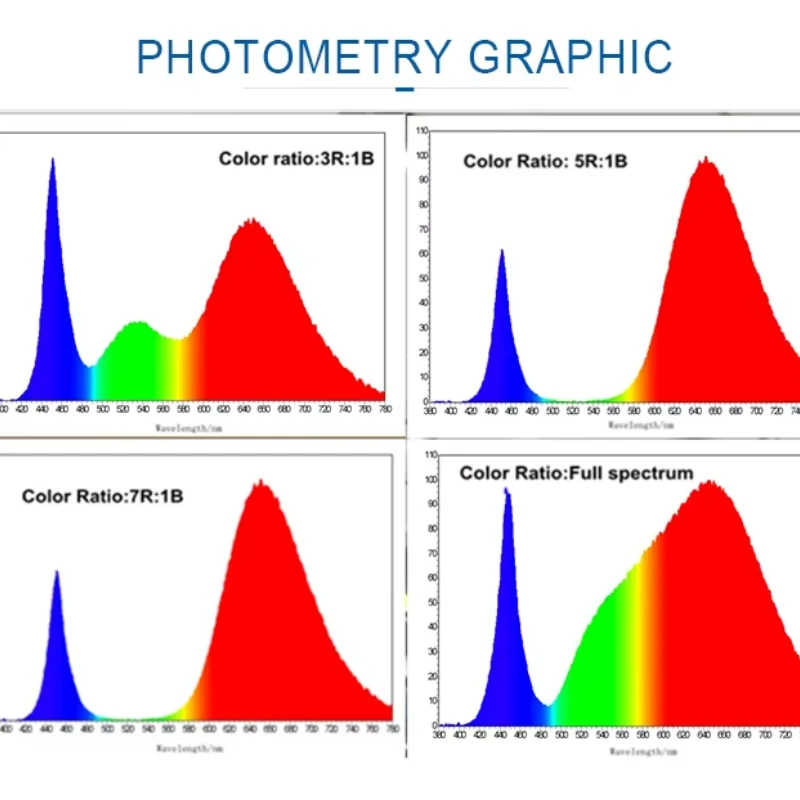
Reading a Spectrum Chart: 3R:1B, 5R:1B, 7R:1B and Full Spectrum
Spectrum charts encode a simple decision. A 3R:1B curve concentrates energy in a narrow red peak near 660 nm with a smaller blue peak near 450 nm, suiting leafy greens, seedlings, and stocky vegetative growth. A 5R:1B blend is the general-purpose middle ground for herbs, lettuce, and mixed shelves. A 7R:1B curve pushes deeper into red, favoring crops that must convert assimilates into fruit rather than leaves. Full-spectrum curves add green and yellow energy between 500 and 600 nm, which penetrates deeper into the canopy, reaches lower leaves, and keeps plant color natural under working light.
Intensity, Photoperiod and the Daily Light Integral
Spectrum decides efficiency; intensity and duration decide whether there is enough light. Intensity is PPFD, micromoles per square meter per second at canopy level. Duration is the photoperiod, typically 16 hours on and 8 off for vegetative growth, 12 and 12 for flowering. Multiplied together they give the daily light integral, the total photon dose per day. Leafy greens perform well around 12–17 mol, herbs a little higher, and fruiting crops such as tomatoes need substantially more. A spectrum without enough PPFD is a paint job on an empty tank.
Why "Purple Equals Powerful" Is a Myth
The link between purple light and serious cultivation is a leftover from the first generation of high-output LED panels. Purple is simply what red and blue look like when mixed; it is not evidence of quality. A well-built full-spectrum tube can deliver the same photon dose with a white appearance, which matters to anyone inspecting leaves for pests, disease, or nutrient deficiency. Judging a fixture by its color instead of its measured output, efficiency, and uniformity is the most expensive habit in indoor gardening.
Anatomy of a Quality Grow Tube Light
Aluminum Extrusion and the Thermal Path
A grow tube is a thermal device before it is a lighting device. The housing is typically a 6063 aluminum extrusion whose ribs act as a passive heat sink, moving heat from the LED junction into the board, into the extrusion, and into the air by convection. Adequate mass and surface area keep junction temperature low, and low junction temperature is what preserves output over thousands of hours. Thin or plastic housings save cents and cost months of usable life.
LED Bins, Lenses and Beam Angle
Two fixtures can carry the same part number and behave differently. Ask about the LED bin: chips sorted within a narrow flux and wavelength range produce consistent color from tube to tube, while wide-bin chips drift. Ask about the optical cover as well. A clear polycarbonate cover with a wide beam spreads light across a shelf; a frosted diffuser softens hotspots for close-in propagation. The right choice depends on mounting height, not on which option sounds more advanced.
End Caps, IP Rating and Connectors
The end cap is where cheap tubes fail first. It carries the electrical connection, seals the tube against humidity, and absorbs the stress of repeated plugging. Look for molded caps with gaskets, strain-relieved cable entries, and a stated ingress protection rating - IP65 or higher for misted propagation rooms, IP44-class construction for dry shelving. Sealed, keyed connectors that cannot be reversed are a safety feature as much as a convenience when tubes are linked in a row.
Drivers, Daisy-Chaining and Electrical Safety
The driver converts mains power into regulated constant current, and its quality determines flicker, power factor, surge tolerance, and lifespan. An isolated driver with a power factor above 0.9 and low ripple protects plants and people alike. Respect the stated maximum number of linked units: exceeding it overloads the first connector, overheats the cable, and creates a genuine fire risk. Grounded circuits, correctly rated timers, and cables kept off wet floors are the line between a garden and a claim.
Why Tube Lights Outperform Legacy Fixtures
Retrofitting the Space You Already Own
Tube lights win on geometry before they win on technology. A linear fixture maps onto structures people already have: shelf standards, wire racks, wardrobe rails, greenhouse benches, and the T8 sockets left behind by old fluorescent strips. No tent, hanging frame, or custom cabinet is required. One tube lights a shelf, six light a shelving unit, and the same hardware scales from a kitchen windowsill to a rented warehouse corner without redesign.
Linear Uniformity vs. Point Hotspots
Every plant in a tray competes for the same photons, and distribution decides the winner. A point-source panel creates a bell-shaped curve - bright in the middle, weak at the margins - so central seedlings stretch less and edge seedlings stretch more. Overlapping linear sources, spaced at roughly their mounting height apart, sum into a flatter curve. That flatness produces an even canopy, synchronized harvest, and consistent quality across a whole tray.
Heat, Noise and the Electricity Bill
Passive aluminum tubes run cool at the housing and add little to a room's heat load, which matters in closed cabinets and small apartments. They have no fans, so there is no hum, no bearing wear, and no dust pulled into the fixture. Because LED converts a higher share of input power into photons than fluorescent or discharge sources, the same delivered dose costs noticeably less on the meter - a difference that compounds in a room running sixteen hours a day.
Scaling From One Shelf to a Grow Room
Modular hardware changes a project's risk profile. A home grower can buy three tubes, measure results for a season, and add three more without replacing the first purchase. A commercial operation can standardize one length and spectrum across dozens of racks, simplifying spares, training, and procurement. Identical fixtures at identical spacing also produce a repeatable light field, which is the foundation of any yield forecast.
Cost per Gram, Not Cost per Watt
The cheapest tube is rarely the cheapest light. Purchase price is one term in a longer equation: watts consumed, photons per watt, replacement interval, labor to swap failures, and the market value lost to uneven growth. A fixture that sheds a third of its output in the first year and fails at eighteen months can cost more per harvested gram than a better-built unit at twice the price. Evaluate delivered photons and service years, not the invoice alone.
Evidence in the Field: What Side-by-Side Comparisons Show
Color and Anthocyanin Development in Succulents
Succulent color is a light-driven stress response. Side-by-side photographs of the same cultivar show the difference plainly: unlit plants stay blue-green with faint margins, while lit plants develop saturated red and pink edges. That coloration is anthocyanin and carotenoid accumulation triggered by a strong red component plus adequate blue. For collectors and retailers, it is the difference between inventory that looks ordinary and inventory that sells on sight.
Compact Growth and Leaf Density
The second visible effect is architecture. Under a balanced spectrum at sufficient intensity, lettuce and rosette plants build shorter internodes, broader leaves, and tighter hearts, investing in leaf area rather than stem. Under weak or blue-starved light, the same genetics produce pale, elongated, open growth that is slow to sell and slower to recover. Compactness is not cosmetic; it is proof that photon dose and blue fraction are both adequate.
Fruiting Crops: Tomatoes and Peppers
Fruiting crops test whether a fixture does more than keep leaves green. Tomatoes need a high daily photon dose to set and fill trusses, and they respond to a red-heavy spectrum during fruit development. In comparison photographs, lit plants carry fuller trusses, more uniform fruit size, and more even ripening, while unlit controls drop blossoms and produce smaller, later fruit. Peppers follow the same pattern: thicker walls, fewer aborted flowers, shorter time to harvest.
Propagation, Seedlings and Tissue Culture
Propagation is where uniformity pays for itself. Seedlings under identical light emerge evenly, develop similar stem calipers, and transplant without a shock period; tissue-culture jars at low, even intensity produce fewer hyperhydrated or etiolated shoots. Because tube fixtures spread light horizontally rather than in a cone, a full tray receives the same dose edge to edge - decisive for nurseries judged on consistency rather than on the best specimen in the flat.
Choosing the Right Tube for Your Setup
Match the Spectrum to Crop and Stage
The spectrum decision follows the crop, then the stage. Use the table below as a starting framework, then confirm it with the supplier's measured spectrum report rather than a rendered illustration.
|
Spectrum |
Typical ratio |
Best suited to |
|
Vegetative blend |
3R:1B |
Leafy greens, herbs, seedlings, compact mothers |
|
Balanced blend |
5R:1B |
Mixed shelves, lettuce, general vegetative use |
|
Flowering blend |
7R:1B |
Tomatoes, peppers, strawberries, flowering crops |
|
Full spectrum |
Continuous 400–700 nm |
Propagation, tissue culture, display, inspection-friendly rooms |
Sizing by Area: The Watt-per-Area Rule of Thumb
Sizing starts with area, not with shelf count. Measure the growing footprint, set the target daily light integral, then work backward to installed wattage. As a rule of thumb for modern LED tubes, leafy greens and herbs need roughly 10–18 watts per square foot of canopy, while high-light fruiting crops move toward 25–35 watts per square foot, spread across overlapping fixtures rather than concentrated in one. Treat these ranges as a starting point to be tuned with a PAR meter.
Length, Voltage and Plug Standards
Physical compatibility prevents most return shipments. Confirm the tube length against the shelf - 60 cm, 120 cm, and 150 cm are the common formats - and confirm that voltage and plug match the destination market. Export buyers should specify 110 V or 220–240 V, 50 or 60 Hz, the correct plug type, and documentation for the certifications that market requires. A tube that cannot be legally installed is not a bargain at any price.
A Pre-Purchase Quality Checklist
Before committing to a container load, ask for six things: LED chip brand and bin, driver brand and power factor, measured wattage and PPFD at a stated distance, ingress protection rating, aluminum profile thickness, and warranty terms with spare-part availability. Then order samples from the actual production line, not from a hand-built prototype. A supplier who answers with documents rather than adjectives deserves a second order.
Installation: A Practical Walkthrough
Mounting Hardware and Rack Layout
Tubes mount with clips, chains, T-rails, or screws through the extrusion channel, so almost any existing structure can host them. Plan the layout on paper: run tubes parallel to the shelf's long axis, center them over the tray rather than the shelf edge, and leave end caps accessible for linking and replacement. In humid rooms, keep a few centimeters of air gap above the fixture so convection works and the driver stays cooler.
Height and Spacing
Height is the variable growers adjust most often and understand least. Start 30–45 cm above newly transplanted seedlings, 25–35 cm above established vegetative plants, and 15–25 cm above flowering canopies, then lower gradually while watching for bleaching, curled margins, or washed-out color. Spacing between tubes should roughly equal the tube-to-canopy distance so the light cones overlap and the intensity curve stays flat.
Wiring and Daisy-Chain Limits
Connect no more units than the manufacturer states, and never exceed the rating of the first connector, link cord, or circuit. Use a grounded outlet, keep link cords off the floor and away from misting lines, and never bury connectors under trays. If a timer is used, confirm its contact rating covers the whole chain. When in doubt, split the chain across two circuits; an extra cable is trivial next to a melted connector.
Light Schedules That Match Crop Stage
Consistency beats complexity. Leafy greens and herbs commonly run 16 hours on and 8 off; propagation and mother plants suit 18 and 6; flowering crops switch to 12 and 12 to trigger and support fruit development. Use a timer, keep the dark period uninterrupted, and change schedules in steps rather than jumps. Plants measure light in accumulated dose, so a stable schedule produces a forecastable harvest.
First-Week Mistakes to Avoid
The first week decides whether a new installation looks like progress or damage. Do not place full intensity centimeters from fresh seedlings; acclimate over three to five days. Do not mix aged and new tubes on one shelf, because the older units deliver less and the tray will grow unevenly. Expect transpiration to rise with light and adjust irrigation instead of reaching for fertilizer, and check airflow - bright light plus still air invites tip burn and mold.
Maintenance and Total Cost of Ownership
Cleaning in Humid Rooms
Dust and condensation films steal photons quietly. Unplug the fixture, wipe the cover with a soft microfiber cloth and mild diluted detergent, and dry the end caps completely before reconnecting. Avoid solvents, abrasive pads, and high-pressure spray, which degrade polycarbonate covers and push water past gaskets. In misted propagation rooms, inspect connectors monthly and replace any cap whose seal has hardened or cracked.
Lumen Depreciation and Replacement Timing
LED tubes do not fail suddenly; they fade. Quality products are rated for tens of thousands of hours to a defined lumen-maintenance threshold, typically 70 percent of initial output. Replace a shelf as a batch when output has visibly dropped, when color has shifted, or when a PAR meter shows meaningful loss against your baseline. Batch replacement preserves uniformity and prevents a canopy of mixed growth rates.
Certifications, Warranty and Spare Parts
For commercial buyers, paperwork is part of the product. Confirm the safety and electromagnetic compatibility certifications required by the destination market, ask for a test report rather than a logo, and read the warranty terms for what is actually covered - driver, LEDs, or housing - and for how long. Then ask about spare end caps, link cords, and clips: a fixture with no spares becomes waste the first time a connector fails.
Commercial Applications
Vertical Farms and Container Farms
In rack-based farms, the tube's low profile is a structural advantage: fixtures sit close to each tier without stealing growing height, and overlapping rows produce the flat light field that automated harvest and consistent gram-per-tray economics require. Low heat gain also reduces the load on HVAC, one of the largest operating costs in a sealed container.
Greenhouse Supplementary Lighting
Greenhouses do not need more light in summer; they need dependable top-up in winter and on overcast days. Tube arrays above benches raise the daily light integral through the short-day season without the heat and maintenance profile of older discharge fixtures, while red-heavy blends support fruiting crops and full-spectrum tubes keep crop inspection practical for staff.
Nurseries and Propagation Lines
Propagation lines are judged on uniformity: plug trays that emerge together, ship together, and transplant without shock. Linear fixtures deliver the same dose to the tray edge as to its center, reducing culling, shortening the production window, and making scheduling predictable. Diffused covers and lower mounting heights suit delicate seedlings and tissue-culture jars where intensity must be gentle but even.
Retail, Restaurant and Educational Displays
Living displays sell product. A full-spectrum tube keeps basil, lettuce, and microgreens looking fresh under customer-facing light, adds almost no heat beside refrigerated cases or prep surfaces, and gives staff enough visible light to check quality. Schools and demonstration gardens benefit from the same traits: safe surface temperatures, no fan noise, and a spectrum that makes plant health legible rather than mysterious.
Frequently Asked Questions
Do tube lights work for flowering crops?
Yes, if the fixture has enough output and a red-dominant spectrum. A 7R:1B tube at adequate wattage per area can carry tomatoes, peppers, and strawberries through flowering and fruiting; the limiting factor is usually total delivered dose and canopy coverage rather than the tube format itself.
Can I mix spectrums on one rack?
You can, and sometimes should: a vegetative blend for the propagation tier above a flowering blend for the fruiting tier is a sensible split. Avoid mixing spectrums within one tray, because different ratios drive different growth habits and the canopy will grow unevenly even at equal intensity.
Are they safe in wet, misted rooms?
Choose fixtures rated for the environment - IP65 or higher for misting and overhead irrigation - with sealed caps and strain-relieved cable entries. Mount above spray height, keep connectors off the floor, and use a grounded circuit with residual current protection. No fixture substitutes for basic electrical hygiene in a wet room.
How many tubes per shelf?
For a typical 120 cm shelf at 40–45 cm mounting height, two tubes spaced about 30–35 cm apart usually give a reasonably flat field for leafy greens; a third adds intensity for high-light crops. Confirm with a PAR meter at tray center and edges, and add fixtures until variation is acceptable for your crop.
What about heat and fire risk?
Quality tubes dissipate heat passively through aluminum and run far cooler than legacy sources, but the risk comes from installation: overloaded daisy chains, undersized timers, damaged link cords, connectors sitting in water. Respect the maximum chain length, keep connections dry and elevated, and have the circuit checked when scaling beyond a few shelves.
Conclusion: Build the Garden You Actually Want
A Three-Step Starting Plan
Start with one shelf and one crop. Measure the footprint and set the target daily light integral; choose spectrum and wattage per area from the table and confirm the numbers with the supplier's test report; install at the recommended height, take a PAR reading at tray center and edges, and adjust spacing before buying more hardware. One calibrated shelf teaches more than ten guessed ones.
Where to Go From Here
The difference between an indoor garden that disappoints and one that produces reliably is rarely a secret ingredient. It is spectrum matched to the crop, intensity matched to the stage, and geometry that spreads both evenly across the canopy. Tube lights deliver that combination in a format that fits the shelves, racks, and benches growers already own - which is why they have become the default choice from windowsill basil to container farms. Build one shelf properly, measure it, and let the results argue for the next twenty.
How To Cooperate With Us?
Our firm prides itself on owning its own factory, guaranteeing complete control over the production process and the quality of our goods. We are not only agents; we are manufacturers committed to offering our clients the most competitive rates available. We invite consumers to evaluate our samples first, as we are assured that the quality and pricing of our items are self-evident. Our dedication to excellence and client satisfaction compels us to consistently perform at our best and provide superior quality products.
Our address
3rd Floor, 5th Building, Hebei Industrial Park, Hualian Community, Longhua District, Shenzhen, China





