

Introduction: A Fixture Designed Around Three Words
Most downlight families on the market today are described with the same vocabulary: efficient, reliable, cost-effective. Those words are true of almost every product and therefore useful to almost no one. When we began development work on this new collection, we deliberately chose three different words to guide every engineering and design decision: sleek, modern, and functional.
Each of these words maps to a specific discipline. Sleek is a design constraint: the fixture must read as a clean, quiet cylinder on the ceiling, with no visible hardware, no decorative clutter, and no compromise in finish quality. Modern is an engineering constraint: it must use contemporary COB light engines, current-controlled drivers, die-cast aluminium construction, and dimming architecture that works with the control systems installed in buildings today. Functional is an installation and operations constraint: it must be fast to mount, straightforward to wire, sealed against dust and moisture, and stable over years of daily operation.
The result is a collection that behaves like a specification-grade product but is priced and packaged for volume distribution. This article explains what that means in practice.
Why Surface-Mounted Downlights Are Redefining Modern Lighting Layouts
The Architectural Case for Surface Mounting
Recessed downlights dominated the last two decades of interior lighting because they disappear into the ceiling plane. That advantage has a cost: it requires a cut-out, a void behind the ceiling, access for maintenance, and a structural assessment whenever the ceiling is fire-rated, acoustic, or heritage-protected. In concrete soffits, in ceilings with dense services above them, and in retrofit projects where the ceiling cannot be opened, recessed fixtures become expensive or impossible.
Surface-mounted downlights invert the logic. Instead of removing material from the ceiling, they place a compact, deliberately designed object on top of it. Because nothing is cut, nothing needs to be inspected, sealed, or restored. The ceiling membrane remains intact - an important consideration for fire compartmentation, acoustic performance, and moisture barriers in wet areas.
Where Surface Fixtures Outperform Recessed Downlights
The performance advantage is most obvious in five situations. First, in renovation and retrofit work, where the existing ceiling is tiled, textured, painted, or load-bearing, and any cut-out introduces a repair obligation. Second, in concrete and coffered ceilings, where drilling is impractical and recessed housings have no cavity to occupy. Third, in suspended and exposed-grid ceilings, where surface fixtures read as part of the architecture rather than as a hole in it. Fourth, in areas with high dust or moisture load such as kitchens, bathrooms, laundries, food preparation zones, car parks, and semi-external soffits, where a sealed surface luminaire is easier to keep clean than a recessed aperture. Fifth, in temporary or modular installations, where fixtures must be movable, re-usable, or installed without specialist trades.
Lighting Quality Advantages That Are Often Overlooked
A surface cylinder carries its light engine forward of the ceiling plane. This geometry gives the optical system more physical depth to work with, allowing a deeper, better-shielded reflector and therefore a lower unified glare rating for the same delivered illuminance. In practical terms, a well-designed surface downlight can light a space to a given lux level with less visual discomfort than a shallow recessed fixture, which matters in living rooms, hotel lobbies, restaurants, and retail environments where the ceiling sits within the occupant's field of view.
Sleek: A Design Language Reduced to Its Essentials
Cylindrical Geometry and a Visually Quiet Profile
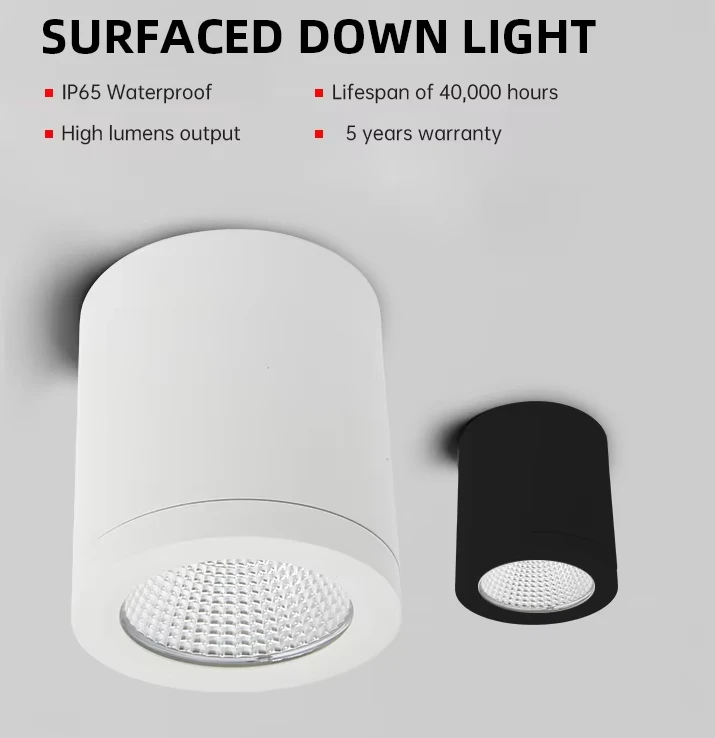
The collection is built around a pure cylindrical body with an even wall thickness and a precisely machined front ring. There is no taper, no flange detail, no decorative groove, and no visible screw head from any normal viewing angle. The top plate and the front ring are matched in finish and tone so that the fixture reads as a single continuous object with clean edges.
This restraint is deliberate. In contemporary interiors, ceilings increasingly carry multiple fixture types - spots, linear profiles, pendants, sensors, and speakers. A downlight that competes for attention makes those ceilings feel noisy. A fixture that reads as a quiet geometric volume instead lets the architecture lead and the light do the work.
Two Finishes, One Design Intent
The collection is offered in matte white and matte black as standard finishes. White is the correct choice for the majority of residential and hospitality ceilings, where the fixture should merge with the painted plane and provide a soft, uninterrupted surface. Black is the correct choice for dark ceilings, exposed concrete, industrial-loft interiors, retail displays, and accent installations where the luminaire is intended to be seen as a deliberate element.
Both finishes use a powder-coated surface with a low-sheen, fine-texture appearance. Matte finishing is not cosmetic. On a downlight, a gloss surface reflects the light source itself and creates a secondary highlight that reads as a defect on camera and in person. A properly cured matte coating suppresses that reflection and keeps the cylinder visually clean even when lit.
The Anti-Glare Optic as a Design Element
Behind the front ring sits the reflector assembly: a deeply faceted, metallised cone with a fine prismatic structure. The faceting serves two purposes at once. Optically, it mixes the output of the COB source so the beam is smooth and free of colour shadowing, hotspots, and striation. Visually, it sets the light source back from the aperture edge so that the bright emitter is not directly visible from typical viewing angles.
That is the difference between a downlight that is merely bright and one that is comfortable. Comfort is the specification most often requested by designers and most often omitted from cheap product data. In this collection, it is a structural feature of the design rather than an optional accessory.
Modern: Engineering Inside the Cylinder
Die-Cast Aluminum Housing and Thermal Discipline
The body is produced by die-casting aluminium, not by extruding or by forming thin-gauge steel. This decision carries three consequences that matter in service.
First, thermal performance. Aluminium die-cast sections provide a thick, continuous conduction path from the COB substrate to the housing wall, and the cylindrical form gives the housing a large, unobstructed external surface for convective and radiative exchange. The result is a low junction temperature, which is the single most important determinant of lumen maintenance over the fixture's life. Two downlights can share the same LED bin and the same driver and still differ by thousands of hours of useful life because of how effectively heat leaves the package.
Second, mechanical integrity. A die-cast housing is dimensionally stable. It does not distort under lamp heat, it does not deform when the terminal block is tightened, and it holds the front ring, the reflector, and the bracket in alignment for the life of the installation. On projects where hundreds of fixtures are installed, that consistency is what prevents call-backs.
Third, finish quality. Die-cast surfaces accept a uniform powder coat with good edge coverage, which is why the matte finishes on this collection hold up in humid and coastal environments better than coatings applied to thinner substrates.
High-Lumen COB Engine and Even Light Distribution
The light engine is a chip-on-board (COB) array positioned at the focal point of the faceted reflector. COB architecture offers three practical advantages for this product type: a single, compact emission area that the reflector can control precisely; a high package density that allows substantial lumen output from a physically small aperture; and a uniform emission surface with no visible LED dots, which keeps the reflector appearance clean.
The reflector's fine prismatic faceting distributes that emission into a smooth, symmetrical beam with a soft edge transition. In application, this produces floors and walls that look evenly lit rather than spotlit, which is exactly the effect required in residential living areas and in hospitality spaces where guests sit beneath the fittings.
Driver Integration and Dimming Architecture
The driver is integrated within the fixture body, which removes the need for an external driver box, a remote gear tray, and the associated cable route. Integrated architecture reduces installation labour, removes an additional failure point, and simplifies maintenance: the whole luminaire is replaced as one sealed unit rather than diagnosed as a system of parts.
The dimming circuit is designed for smooth, continuous control from 0 to 100 percent, with a stable low-end floor. This matters more than headline dimming range. Many fixtures claim full-range dimming but drop out, flicker, or step visibly below ten percent. A stable low end is what allows a hotel room, a restaurant, or a living room to sit comfortably at a low ambience level without the light appearing unstable or colour-shifted. Compatibility with mainstream leading-edge, trailing-edge, and DALI-type control schemes is available depending on configuration and should be confirmed at order stage against the control system specified for the project.
Functional: Performance Specifications That Matter on Site
IP65 Ingress Protection - Designed for Wet and Exposed Locations
The flagship configuration of this collection is rated IP65 on the front and the housing, which means protection against dust ingress in harmful quantity and against low-pressure water jets from any direction. For a surface downlight this rating is the difference between a fixture that can be installed in a semi-external soffit, a bathroom zone, a commercial kitchen, a car wash, a food processing area, or a coastal project, and one that cannot.
The seal is achieved through the front ring gasket, the lens-to-reflector interface, and the sealed cable entry, rather than through a single gasket at the aperture. That construction protects the optical chamber and the driver chamber independently, which is the correct approach: water that reaches the housing wall should never be able to reach the electronics.
An IP54 variant is also available for applications where splash resistance is sufficient and where cost optimisation is the priority - for example, covered external soffits and general utility areas. Specifiers should choose the rating that matches the actual exposure of the installation position, not the rating that appears on the front of the catalogue.
0–100% Smooth Dimming
Dimming is not a luxury feature in 2026; it is a baseline expectation in residential, hospitality, and premium retail work. The collection is engineered for continuous, flicker-free dimming across the full range, with consistent colour temperature behaviour as the level falls. Because the driver and the light engine are matched and tested as a pair, the low-end behaviour is controlled rather than inherited from a generic third-party driver.
For contractors, this translates into fewer commissioning issues on site. For distributors, it translates into fewer returns from customers who expected a fixture to behave the way the datasheet promised.
40,000-Hour Rated Lifespan and a 5-Year Warranty
The collection carries a rated lifespan of 40,000 hours and a 5-year warranty. Read together, these two numbers describe a design intent rather than a marketing claim. Forty thousand hours at a typical eight-hour daily duty cycle is more than thirteen years of operation. A five-year warranty period is therefore a conservative fraction of the rated life - the manufacturer is underwriting the period in which failure rates must remain near zero.
For a distributor, the warranty is a commercial asset. It converts a lighting line from a transactional sale into a repeat-purchase relationship, because the customer who has not had a failure in five years becomes the customer who specifies the same brand on the next project.
Installation Hardware and Terminal Access
The collection uses a bracket-based mounting system with a plate that carries the terminal block and the driver connection, and spring-loaded clips that engage the bracket for a fast, repeatable fixing. The terminal block is a push-in, three-pole design, clearly marked for live, neutral, and earth, sized to accept standard cable gauges with room for a second conductor where loop-in wiring is used.
This hardware arrangement delivers practical benefits that a datasheet rarely captures. The installer can pre-wire the bracket on the surface, test the supply, and then mount the luminaire body in a single movement. On a ceiling with fifty fixtures, that workflow difference is measured in hours, and it is the difference between a line item that contractors are willing to quote and one that they avoid.
Applications: Where This Collection Earns Its Place
Residential Interiors
In apartments, villas, and renovation projects, the collection solves the two most common residential problems at once: the ceiling cannot be cut, and the client wants a clean, contemporary appearance. Matte white cylinders on a painted ceiling, dimmed to a low ambience level, deliver the soft, glare-free light that residential spaces need, while the IP65 rating extends the same fixture family into bathrooms, kitchens, balconies, and covered terraces without a second product line.
Hospitality, Retail, and Leisure
Hotels, restaurants, bars, showrooms, and salons require fixtures that look deliberate at close range and perform consistently across hundreds of units. The matte black finish gives designers a way to place the luminaire as part of the interior scheme rather than as an intrusion, while the deep faceted reflector keeps the light source out of the guest's line of sight at seated eye level. Stable low-end dimming is essential here: hospitality lighting lives at twenty to forty percent output for most of the evening, not at full output.
Commercial, Industrial, and Semi-External Installations
In commercial premises, the collection's value is in durability and service access. In industrial and semi-external locations - loading bays, plant rooms, warehouse aisles, car parks, canopies, service corridors - the value is in the IP65 seal, the die-cast housing, and the long rated life. These are environments where a failed fixture is not merely an inconvenience; it is a maintenance ticket, a safety observation, and an unbudgeted cost. A fixture family with a five-year warranty and a 40,000-hour rating is the correct answer to that exposure.
Quality Assurance, Compliance, and Customisation
Every unit in this collection is subject to an aging test before shipment, with output, colour consistency, and dimming behaviour verified at the end of the run. Photometric and electrical parameters are documented per production batch, and test reports are available for project submittals.
CE and RoHS declarations, along with test documentation for the relevant photometric and safety standards, can be supplied on request for the destination market. Because compliance requirements differ between the EU, the UK, North America, Australia, and the Middle East, we recommend confirming the required certification package at enquiry stage rather than after the purchase order is issued.
For OEM and ODM customers, the collection supports customisation across the parameters that matter most in specification work: colour temperature selection, output level, beam distribution, finish tone, and branding on the housing and the packaging. Tooling for private-label packaging and printed inserts is available, and our engineering team can advise on the most cost-effective configuration for a given target price point.
Total Cost of Ownership: The Commercial Case
A downlight is rarely bought on unit price alone; it is bought on the cost of owning it for a decade. Three factors determine that cost.
Energy. A modern COB engine with a well-managed thermal path holds its efficacy far better than a thermally compromised alternative. Over a large installation, a difference of a few lumens per watt is a difference of thousands of kilowatt-hours per year.
Maintenance labour. The real cost of a failed fixture is not the replacement unit; it is the access equipment, the electrician's time, and the disruption. A 40,000-hour rating reduces the number of interventions across the life of the building, and the bracket mounting system reduces the time each intervention takes.
Warranty exposure. A five-year warranty transfers risk from the buyer to the manufacturer for the period in which most field failures would otherwise surface. That transfer is a quantifiable value, and it should be weighed against unit price when a tender is evaluated.
Specification Summary
| Parameter | Specification |
|---|---|
| Product type | Surface-mounted cylindrical downlight |
| Housing | Die-cast aluminium, powder-coated |
| Finishes | Matte white, matte black (custom tones on request) |
| Light engine | High-output COB with faceted anti-glare reflector |
| Ingress protection | IP65 (flagship configuration); IP54 variant available |
| Dimming | 0–100% smooth dimming; control scheme per configuration |
| Rated lifespan | 40,000 hours |
| Warranty | 5 years |
| Mounting | Bracket plate with spring-clip engagement; push-in 3-pole terminal |
| Customisation | CCT, output, beam, finish, private label (OEM/ODM) |
Configurations, outputs and options are confirmed at quotation stage against the specific project requirement.
Conclusion: Three Words That Hold Up Under Scrutiny
Sleek is easy to claim and hard to deliver, because it requires restraint at every design decision. Modern is easy to claim and hard to deliver, because it requires matched engineering across the light engine, the driver, and the thermal path. Functional is easy to claim and hard to deliver, because it requires the fixture to survive the site, the climate, and the maintenance regime of a real building rather than a showroom.
This collection is our answer to all three, and it is built to be defended in front of a specifier, a contractor, and a procurement manager in the same meeting. For samples, photometric data, certification documentation, and volume pricing, contact our sales team with your project details - destination market, quantity, required CCT and output, and control scheme - and we will return a configuration proposal that is ready to quote.
How To Cooperate With Us?
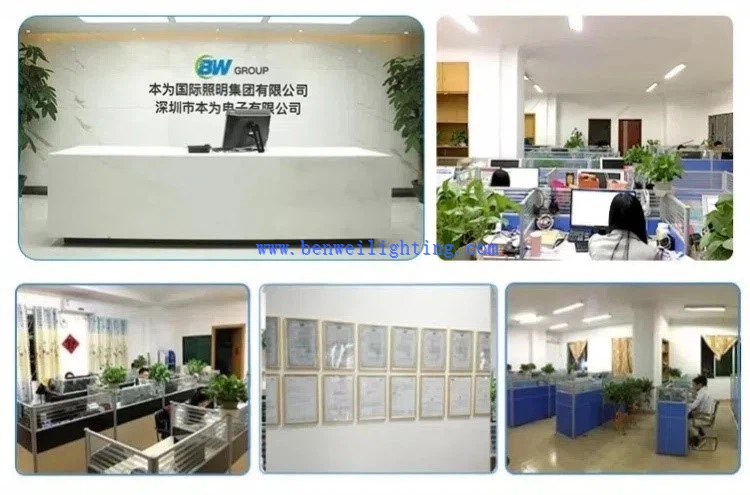
We are happy to have total control over the manufacturing process and the calibre of our products since we have our own facilities. Since we are producers rather than just brokers, we are dedicated to providing our customers with the best pricing. Since we are certain that the price and quality of our products are clear, we invite customers to see our samples first. Our commitment to quality and customer satisfaction drives us to continuously provide top-notch goods.
Our address
3rd Floor, 5th Building, Hebei Industrial Park, Hualian Community, Longhua District, Shenzhen, China





