

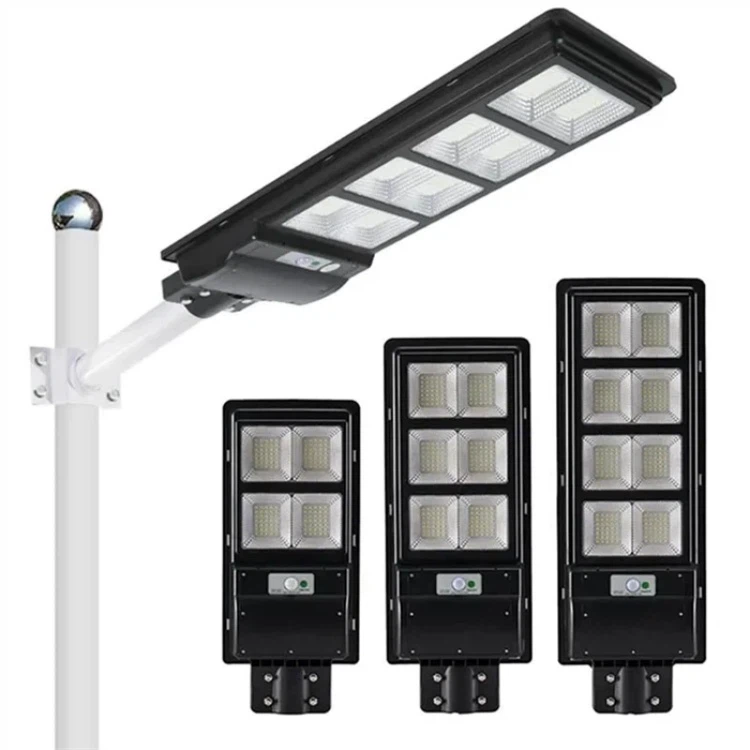
The idea behind how solar street lights operate
Based on photovoltaic conversion and energy storage technology, solar streetlights are self-contained illumination systems that generate power from the sun. Solar panels, batteries, LED lights, and smart controllers make up the majority of the system. During the day, solar panels gather sunlight and transform it into electrical energy, which is then stored in the batteries via a charge controller. The controller automatically senses the ambient brightness and activates the power to the LED lights to provide illumination at night when it gets dark or the light levels are too low.
Efficient monocrystalline or polycrystalline solar panels with photoelectric conversion efficiency of up to 18–22% are used in contemporary solar streetlight systems. Deep cycle lead-acid batteries or more sophisticated lithium-ion batteries, which have a longer lifespan and reliable discharge performance, are often used batteries. LED fixtures are the best light source for solar streetlights because of their extended lifespan (about 50,000 hours) and excellent luminous efficacy (up to 100-150 lumens/watt).
The "brain" of the system is the smart controller, which not only controls the charging and discharging procedures to avoid overcharging and overdischarging but also has sophisticated features like time control, light management, and human sensing. In order to further save energy, some high-end versions even have remote monitoring and dimming features that enable brightness change based on actual needs.
The benefits and difficulties of solar-powered street lighting
Compared to conventional electric lighting, solar streetlights offer a number of noteworthy benefits. First of all, because they only use solar energy, which has no carbon emissions and doesn't use conventional electrical resources, they are environmentally benign and energy-efficient. Second, they are simple to install; no road excavation is necessary for cable laying, which makes them ideal for mountainous terrain, isolated locations, and recently built roads. Solar streetlights also require little upkeep, and because of its modular nature, malfunctioning parts may be easily replaced.
Economically speaking, solar street lights are more cost-effective in the long term even though they require a larger initial expenditure. They save money on cable installation and electricity, and the investment usually pays for itself in three to five years. Typically, the system lasts 8 to 10 years, during which time only routine solar panel cleaning and battery condition checks are necessary.
Solar lamps do, however, have several drawbacks. The primary problem is weather dependence because persistently rainy days can result in an inadequate power supply. To solve this, contemporary system designs typically use intelligent energy-saving modes to prolong lighting time and take into account the energy storage capacity for three to five consecutive wet days. Furthermore, in colder climates, performance may deteriorate in the winter, necessitating the use of specially built anti-freezing measures. Battery longevity and recycling are additional environmental concerns that require ongoing development.
The use of solar street lights and their advancements
Solar streetlights have been used extensively in a variety of settings. Solar streetlights are preferred for their flexible installation and safety performance in locations like parking lots, campuses, and scenic spots. They are also frequently used to illuminate auxiliary roads, park trails, and bike paths in urban areas. In rural areas, they solve lighting problems brought on by inadequate grid coverage. Solar beacons and obstacle lights are also utilized in specific areas, like ports and the outskirts of airports.
Future advancements in solar streetlight technology will focus on the following areas: first, increased efficiency, including more luminous efficacious LED light sources and more efficient solar cells (like PERC and HJT technologies); second, more intelligent control systems that incorporate IoT technology to accomplish fault warning, adaptive dimming, and remote monitoring; third, more environmentally friendly energy storage options, like graphene and solid-state batteries; and fourth, more aesthetically pleasing designs that become an integral part of urban landscapes.
Solar streetlights will become more and more significant in urban and rural lighting as a result of the global focus on renewable energy and ongoing technological breakthroughs, supporting a low-carbon and environmentally friendly way of life.

If you are interested, feel free to contact us https://www.benweilighting.com/.





