

In order to run poultry farms on a daily basis, lighting is crucial. It is crucial to give hens both natural light and extra artificial illumination to guarantee their healthy growth and optimal production potential. This is especially true for contemporary chicken farming operations, which frequently use completely enclosed spaces, necessitating the use of additional lights. This was traditionally accomplished with incandescent bulbs, which resulted in high yearly costs for chicken coops, particularly given the poultry industry's present low profitability. In an attempt to reduce breeding expenses, several farms have begun to replace incandescent bulbs with energy-efficient LED lamps in recent years.
What are the advantages of LED lighting?
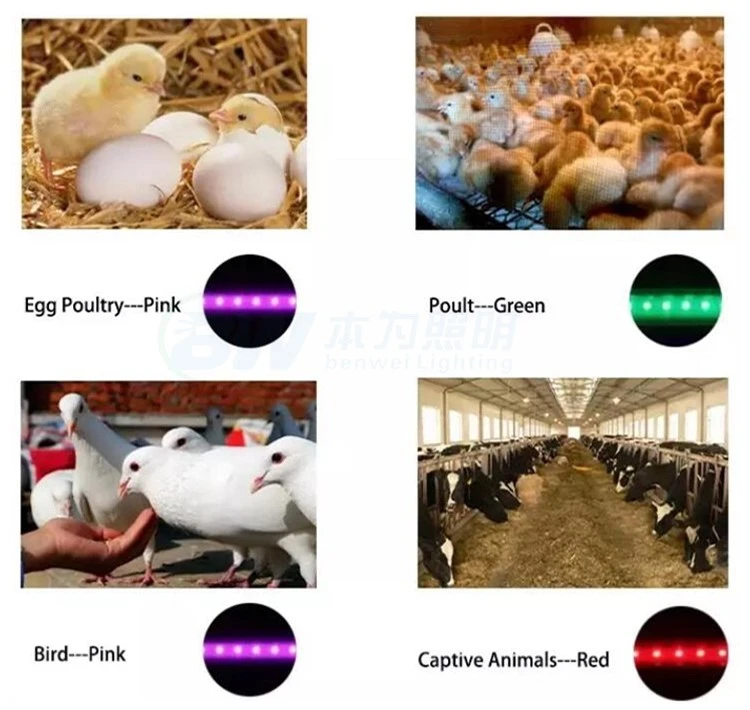
LED lamps can reduce electricity consumption by over 50%.
LED light is a piece of electroluminescent semiconductor material placed on a lead frame and protected in epoxy resin. Voltage at the LED's PN junction provides energy levels that spur electron jumping and light emission. LED lamps are popular due to their lower power consumption, better brightness, and longer lifespan. They are becoming the primary supplemental bird lighting choice in standardised closed chicken farms.
One farm with 50,000 commercial laying hens uses LED bulbs for one-third of its lighting. A year of comparison showed that LED lamps use almost 50% less electricity than energy-saving bulbs. In a chicken coop with 10,000 laying hens, one bulb is set every 3 meters to provide lighting during laying, according to Xiuyuan Animal Husbandry general manager Li Ruxing. Instead of 80 10-watt energy-efficient lamps, 5-watt LED lamps may create the same lighting effect while saving 50% on energy expenditures.
During laying, hens need 16 hours of light daily. An estimated 80 bulbs of the same intensity are needed for a 10,000-hen chicken coop. In a completely enclosed chicken coop, energy-saving lamps consume 12,800 watt-hours per day (16 hours × 80 lamps × 10 watts), while LED bulbs for hens consume 6.400 watt-hours per day (16 hours × 80 lamps × 5 watts). LED bulbs save 6,400 watt-hours of electricity everyday, or 50% more than typical energy-saving lamps.
A farm has used LED lamps for laying hens for nearly two years after switching and replacing all its lighting. The farm now uses 3-watt LED lamps instead of 9-watt energy-saving lamps. Comparisons reveal that the 3-watt LED bulbs match the 9-watt energy-saving lamps, meeting the hens' egg-laying lighting needs. LED lighting save approximately 60% of electricity.
Many poultry farms have had low profit margins in recent years, driving owners to decrease costs. These farms prioritise energy savings. Some farmers pay ¥0.56/kWh for agricultural electricity and ¥0.75/kWh for sideline electricity. LED lighting might save a chicken coop with 10,000 laying hens 1,569,79 yearly on electricity expenditures, assuming a rate of 0.56/kWh.
LED lamps, Adjustable light intensity, consistent brightness
Modifying light intensity ensures consistent brightness and improves chicken flock uniformity. A chicken coop can house 300.000 laying hens year-round. LED lights' adjustable light intensity reduces worker workload. Laying chickens need different lighting during brooding and raising. A fully enclosed chicken coop must have light intensity above 20 lux for chicks 0 to 5 days old and 20 lux for those beyond 5 days old. Chickens grow at 5–10 lux throughout raising. LED lights provide exact duration and intensity control. A controller can automatically adjust LED lights to satisfy hens' light intensity needs at particular growth stages, reducing human adjustments' complexity and faults.
Laying hen farming is becoming more automated, with mechanical systems for drinking, feeding, spraying, and egg collection. The chicken coop lighting must be raised to install this equipment. Due to low light intensity, the old incandescent lamps on the fourth tier of a four-tier chicken cage caused many dark areas, reducing feed intake and weight gain. Thus, egg production grew modestly during the initial laying phase and peaked briefly. However, the LED lights provide consistent light intensity across both upper and lower cages, allowing fourth-tier chickens to feed properly and improving flock uniformity.
LED lamps have a longer lifespan
LED bulbs last 5–6 times longer than energy-saving ones. LED bulbs have worked effectively for my laying hens for almost two years, even though energy-saving lamps usually last over a year. However, 7%–8% damage occurs. LED lighting for laying hens save the farm money.
About our company
Shenzhen Benwei Lighting Technology Co., Ltd is a well-known company that designs, develops, makes, and sells high-tech goods, including LED lighting products. The plant where we work opened in 2010 and is in Shenzhen.
Our address
3rd Floor, 5th Building, Hebei Industrial Park, Hualian Community, Longhua District, Shenzhen, China






