

Introduction: The Paradigm Shift in Residential Illumination
From Static to Dynamic Lighting
Traditional interior lighting relies on fixed fixtures – ceiling pendants, wall sconces, floor lamps – that produce a constant, unchangeable light distribution and colour temperature. While functional, such systems cannot adapt to different activities (e.g., reading vs. party) or emotional states. The introduction of flexible, colour‑tunable LED strips has broken this static mould. These thin, self‑adhesive circuits with surface‑mounted LEDs can be cut to length, bent around corners, and installed in previously inaccessible locations (under cabinets, behind furniture, along crown moulding).
Scope of This Analysis
This article evaluates five key drivers of LED strip popularity:
Versatility in generating diverse lighting moods and scenes.
Architectural highlighting to accentuate objects, edges, and textures.
Energy efficiency and longevity (80% less energy than incandescent, L70 > 30,000 h).
Installation convenience (adhesive mounting, plug‑and‑play controllers).
Full chromatic control (RGB, RGBW, and tunable white, plus music synchronisation).
Each driver is examined using lighting engineering principles and real‑world design applications.
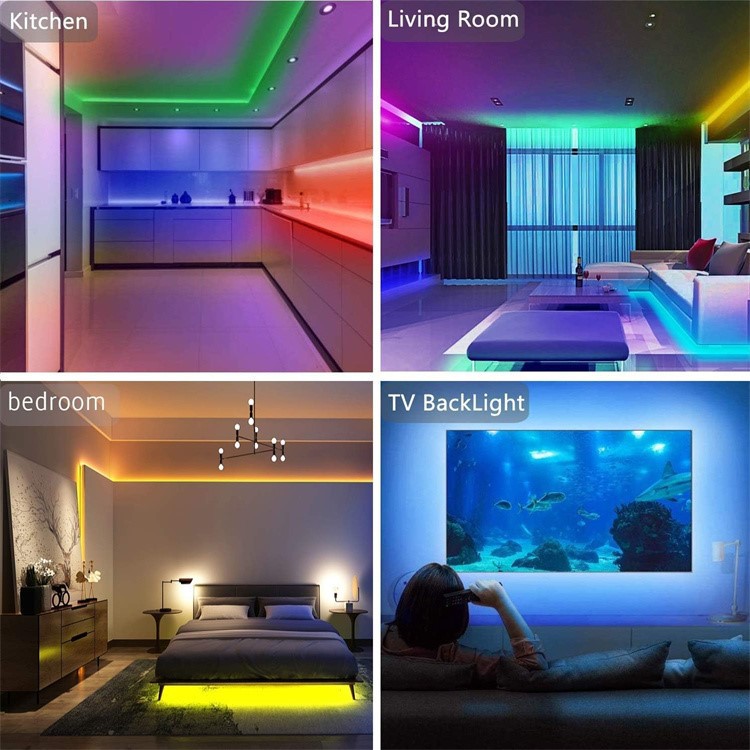
Versatility: Creating Adaptive Lighting Scenes
Colour Temperature and Mood Modulation
The human circadian system and emotional response are highly sensitive to correlated colour temperature (CCT). LED strips are available in three primary categories:
Tunable white (2700K–6500K): Allows seamless shift from warm (cozy, relaxing) to cool (alert, energising).
RGB (red‑green‑blue): Produces 16 million colour combinations via additive mixing.
RGBW (RGB + dedicated white chip): Adds pure white (usually 4000K or 5000K) for pastel and accurate white tones.
| Room / Activity | Recommended LED Strip Configuration | Effect |
|---|---|---|
| Living room (movie night) | 2700K dimmed white or deep amber | Reduces blue light, enhances relaxation |
| Home gym (morning workout) | 6500K cool white or cyan | Increases alertness and perceived energy |
| Bedroom (winding down) | 2200K–2700K with red shift (sunset simulation) | Supports melatonin production |
| Home office (focused work) | 4000K–5000K neutral white | Reduces eye strain, improves contrast |
Dynamic Effects: Fading, Strobing, and Chasing
Beyond static colours, LED strips incorporate programmable integrated circuits (IC) that enable addressable LEDs (e.g., WS2812B, SK6812). Each LED can be controlled individually, creating:
Breathing (slow fade in/out).
Chasing arrows (for stair risers or coves).
Rainbow waves (for children's rooms or game rooms).
Music‑reactive patterns (amplitude and frequency driven).
This dynamic capability transforms a passive room into an interactive environment, particularly popular in home theatres and entertainment areas.
Architectural Highlighting: Framing Space and Objects
Indirect Lighting for Depth Perception
Direct overhead lighting produces harsh shadows and flat surfaces. LED strips installed behind cornices, inside recessed channels, or under floating furniture create indirect illumination – light bounced off ceilings or walls. This technique:
Eliminates glare.
Adds perceived depth to shallow rooms.
Softens shadow edges, making spaces feel larger.
Placing LED strips behind a television or monitor (bias lighting) reduces eye strain by increasing ambient contrast. A 6500K white strip at 10–20% of the TV's brightness improves perceived black levels and colour accuracy. For paintings and photographs, LED strips with high CRI (≥90) and narrow beam angles (via aluminium channels with diffusers) create a "grazing" effect that highlights brush texture.
Under‑Cabinet and Toe‑Kick Illumination
In kitchens, under‑cabinet LED strips eliminate countertop shadows cast by overhead lights. For bathrooms and hallways, toe‑kick strips (mounted at floor level) serve as night lights without disturbing sleepers. Both applications benefit from low profile (≤5 mm thick) and daisy‑chainable connectors.
Cove Lighting and Crown Moulding Integration
Architectural coves (recessed ledges near the ceiling) are ideal for LED strips. The strip faces upward, washing the ceiling with colour. This technique can visually raise or lower ceiling height:
Light colour on ceiling = higher apparent ceiling.
Dark colour on ceiling = more intimate, lower feel.
With remote controllers, a single cove can change from bright white for cleaning to deep blue for a party, all without altering physical décor.
Energy Efficiency and Longevity: Economic and Environmental Drivers
Quantitative Comparison of Light Sources
| Technology | Luminous Efficacy (lm/W) | Typical Lifespan (hours) | Energy Use for 800 lm equivalent |
|---|---|---|---|
| Incandescent | 12–18 | 1,000 | 60 W |
| Halogen | 16–24 | 2,000–3,000 | 43 W |
| CFL | 50–70 | 8,000–10,000 | 13–15 W |
| LED strip (mid‑power) | 80–120 | 25,000–50,000 | 7–10 W |
| LED strip (high‑efficacy) | 130–180 | 50,000+ | 5–6 W |
A living room using 20 metres of LED strip (14.4 W/m, common density) consumes 288 W at full brightness. If left on for 5 h/day, annual consumption = 525 kWh. Replacing an equivalent length of incandescent rope light (60 W/m → 1,200 W) would consume 2,190 kWh. Annual saving: 1,665 kWh. At 0.12/kWh,thatis0.12/kWh,thatis200 per year – paying back the LED strip cost in under one year.
Reduced Waste and Maintenance
With an L70 rating of 30,000–50,000 hours, a LED strip used 8 h/day lasts 10–17 years. Incandescent rope lights require replacement every 4–6 months under the same usage. This drastically reduces material landfill and the labour effort of re‑installing.
Installation Convenience: Democratising Interior Lighting
Adhesive Backing and Flexible Substrates
Most LED strips feature a 3M VHB or similar acrylic adhesive tape on the reverse side. This allows mounting on clean, dry surfaces (wood, metal, plastic, glass) without drilling. For porous surfaces (brick, textured wallpaper), additional mounting clips or aluminium channels are recommended.
LED strips are marked with cut lines (every 3, 6, or 12 LEDs, typically every 50 mm or 100 mm). Using scissors, users can trim to exact length. Remaining segments can be rejoined using solderless connectors (clip‑on, snap‑to‑close) – no soldering iron required.
Power Supply and Control Options
| Control Type | Range | Features | Best For |
|---|---|---|---|
| IR remote | ≤8 m (line‑of‑sight) | Basic colour, brightness, 4–6 modes | Small rooms, one‑off installations |
| RF remote | ≤30 m (through walls) | More colours (static), dimming, memory | Larger homes, multiple zones |
| Wi‑Fi (Smart Life, Tuya) | Unlimited (via internet) | Voice control (Alexa, Google), schedules, scenes | Whole‑home automation |
| Bluetooth (app) | ≤15 m | Music synchronisation, colour picker from camera | Entertainment areas |
Measure the desired length (add 10% for bends).
Cut strip at marked copper pads.
Peel adhesive backing and press firmly onto surface.
Connect to controller and power supply (12 V or 24 V DC).
Plug into mains via UL‑listed adapter.
Pair with app (if smart) and enjoy.
No electrician required for low‑voltage (≤24 V) systems, making LED strips one of the most accessible DIY lighting upgrades.
Chromatic Customisation: From Subtle to Spectacular
Colour Gamut and White Point Accuracy
Basic RGB strips produce colours by mixing red, green, and blue LEDs. However, the resulting white is often "rainbow white" – a bluish or pinkish tint with low CRI (typically 60–70). RGBW strips add a dedicated white LED chip (usually 4000K or 6500K) with CRI ≥80, producing pastel colours and true white. For interior design requiring accurate skin tones (makeup mirrors, dressing rooms), select RGBW with CRI ≥90.
Music Synchronisation: The Entertainment Factor
Many LED strip controllers include a built‑in microphone or line‑in jack. The controller analyses audio amplitude and frequency (bass vs. treble) and changes colours or patterns in real time. This feature is particularly popular in:
Home theatres (synchronised with movie soundtracks).
Gaming desks (reactive to in‑game explosions).
Party rooms (beats‑to‑lights).
Advanced versions use FFT (Fast Fourier Transform) to distinguish low, mid, and high frequencies, assigning different colour zones to each range.
Scene Memory and Scheduling
Smart LED strips can store multiple "scenes" – e.g., "Morning" (5000K at 50%), "Relax" (2700K at 20%), "Party" (RGB rotating). Schedules automatically transition between scenes based on time of day or sunset. This transforms a hallway from bright daylight simulation (noon) to a gentle nightlight (midnight) without manual intervention.
Practical Recommendations for Homeowners and Designers
Selecting the Right LED Strip for Your Project
| Requirement | Recommended Strip Type | Key Specification |
|---|---|---|
| Warm, dimmable reading nook | Tunable white (2700K–3000K) | CRI ≥90, 60 LEDs/m |
| Under‑cabinet task lighting | 4000K fixed white | 120 LEDs/m, aluminium channel with diffuser |
| Gaming/entertainment wall | RGBW addressable (WS2812B) | 144 LEDs/m, 5 V, music controller |
| Outdoor patio (waterproof) | Silicone‑encapsulated RGB or white | IP65 or IP67, 24 V for long runs |
| Minimalist cove lighting | High‑density (densely packed chips) | 160 LEDs/m, 2700K, no visible dots |
Avoiding Common Pitfalls
Voltage drop: For runs >5 m (12 V) or >10 m (24 V), inject power at both ends or use thicker gauge wire.
Heat management: High‑density strips (>14.4 W/m) require aluminium channels for heat sinking; otherwise LED lifespan shortens.
Adhesion failure: Clean surface with isopropyl alcohol; use mounting clips for ceilings or textured walls.
Flicker: Cheap PWM (pulse‑width modulation) controllers cause visible flicker at low brightness. Choose high‑frequency (≥2 kHz) controllers labelled "flicker‑free".
Integration with Smart Home Ecosystems
For a cohesive system, select LED strips that are compatible with widely used platforms:
Amazon Alexa / Google Home – voice commands like "set living room strip to 50% blue".
Apple HomeKit – requires specific chips (e.g., ESP32 with HomeKit firmware).
IFTTT – trigger strips from motion sensors, door sensors, or weather changes.
Conclusion
The surging popularity of colourful LED strips in interior design is not a transient trend but a reflection of fundamental shifts in lighting technology and user expectations. Their versatility enables adaptive environments that change mood, colour, and intensity on demand. Their architectural highlighting capabilities turn ordinary edges and corners into deliberate design statements. Energy efficiency and long lifespans deliver economic savings while reducing environmental impact. Installation convenience democratises high‑end lighting effects, placing them within reach of any DIY homeowner. Finally, chromatic customisation – including music synchronisation and smart control – elevates lighting from a utility to an interactive art form. As LED strip technology continues to advance (higher density, flexible substrates with integrated diffusers, wireless synchronisation of multiple controllers), the boundary between "lighting" and "decoration" will further blur. For anyone planning a home renovation or interior refresh, incorporating LED strips is no longer an optional luxury – it is a strategic upgrade that enhances both function and beauty. Embrace the colour revolution, and let your walls, ceilings, and furniture shine in new light.

How To Cooperate With Us?
Our firm prides itself on owning its own factory, guaranteeing complete control over the production process and the quality of our goods. We are not only agents; we are manufacturers committed to offering our clients the most competitive rates available. We invite consumers to evaluate our samples first, as we are assured that the quality and pricing of our items are self-evident. Our dedication to excellence and client satisfaction compels us to consistently perform at our best and provide superior quality products.
Our address
3rd Floor, 5th Building, Hebei Industrial Park, Hualian Community, Longhua District, Shenzhen, China





