

The technology behind LED grow lights is still pretty new. Its ability to make a lot of different emission bands is one of its benefits.
We talk about what a full spectrum LED grow light is and whether they are good for plant growth in this piece.
What is the normal range of LED grow lights?
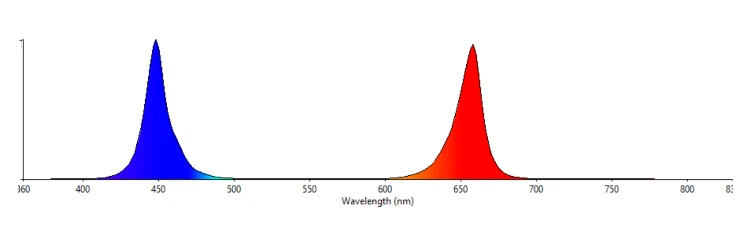
Blue and red LEDs are often used together in a standard grow LED grow light. The pinkish-purple light that comes out is usually a sign. This is what happens when blue and red light are mixed.
The blue and red parts of the range are where photosynthesis works best for plants, which is why this is how standard LED grow lights are made.
But it's clear from this spectrum that it only covers a small part of the whole visible spectrum. This is not even close to being full range.
Most of the time, these grow lights only use two LEDs, one blue and one red. A good way to tell is to look at its spectral power distribution, which you can see below:
But if blue and red light are the best for photosynthesis, then why should we care about other wavelengths?
The answer is that photosynthesis is not the only thing that affects a plant's health and strength. This could lead to a better crop, one that looks better, or one that has more nutrients. More than just number, in other words.
A strict definition of full spectrum LED grow lighting
A lot of research still needs to be done, but more and more studies and tests are showing that plants grow best in a healthy range.
This is because plants have evolved to use natural sunshine not only as food, but also as a warning to do things like growing and making fruit.
So, a strict meaning of "full spectrum" would include a range of energies from ultraviolet to infrared, which is what natural daylight has.
This kind of light spectrum makes a light source look white. If an LED grow light gives off white light, does that mean it's a full spectrum grow light?
The answer is no, and we'll talk more about this in the next part.
How to make white light in different ways
Full spectrum grow lights usually have a glow layer instead of the blue and red LEDs that are used in regular LED grow lights.
A phosphor layer is good for full spectrum grow lights because it changes light from a single narrow wavelength range (like 460 nm blue) to a wide range of longer wavelength ranges (like 600–700 nm red).
A blue LED can cover a much wider range of visible light by being coated with a mix of green, yellow, and/or red phosphors.
Because phosphors give off light with a lot of different bands, the light that comes out is a balanced mix of colours called white light.
Even though an LED grow light gives off white light, that doesn't always mean it's a full spectrum light source.





