


What Is The History of LED Panel Lights?
Panel lights, often called troffer lights, have been around since fluorescent lighting began. Traditional troffer lights were rectangular fixtures with fluorescent tubes. They were popular because they were efficient and provided homogeneous lighting in commercial and institutional environments.
Light-emitting diode (LED) technology, developed in the 1960s, led to LED panel lights. In the late 20th century, LED technology and manufacturing techniques improved, making LED panel lights financially viable and widely accepted.
LEDs were initially utilized as indication lights in electrical gadgets due to their tiny size and low power consumption. Continuous research and development improved LED efficiency, brightness, and color quality, extending their uses.
LED panel lights advanced due to the development of white LEDs, which emit a wide range of visible light. Combining blue LEDs with phosphor coatings that convert some blue light into other colors produces white LEDs.
In the early 2000s, LED technology became suitable for general lighting. Incandescent and fluorescent lights were replaced with LED bulbs in household and business lighting.
LED panel lights became popular due to its energy efficiency, durability, and adaptability. Their flat, slender design produced superb light and homogeneous illumination. For a sleek, modern lighting solution, the panels can be easily integrated into drop ceilings or surface-mounted.
LED technology has improved efficiency, light output, and color rendering. Affordable LED panel lights are becoming available to more households and businesses.
Offices, schools, hospitals, retail locations, and homes use LED panel lights nowadays. Due to their energy efficiency, longevity, and high-quality lighting, they are popular. Future LED technology advancements are projected to improve LED panel light performance and capabilities.
How Do LED Panels Work?
LED panels emit light using LEDs. LED panels use electroluminescence to convert electrical energy into visible light.
A brief description of LED panels' operation:
An LED has a junction between two semiconductor layers, an n-type layer (electron-rich) and a p-type layer (electron-deficient). The layers are usually constructed of GaAs or GaN.
A forward voltage applies current from the LED's positive (anode) terminal to its negative (cathode) terminal. This current crosses semiconductor layers, including the p-n junction.
Electron Movement: The p-n junction combines electrons from the n-type layer and holes (electron vacancies) from the p-type layer as current travels through. Energy is released as photons.
Light: Electron-hole recombination emits light. The semiconductor layers' materials determine the LED's light color. Combinations of materials can produce red, green, blue, or white light.
Blue LED chips are utilized to make white LEDs, and phosphor material is put to them. Phosphors fluoresce white when LED chip blue light interacts with them. This is phosphor conversion.
Light Distribution: LED panels have a grid of LEDs on a flat panel. A diffuser or light guide plate can disperse light evenly across a back-lit or edge-lit panel to reduce glare.
Power source: LED panels are powered by a power source that supplies current and voltage. The power supply may incorporate drivers or controllers to regulate current and LED brightness.
LED panels outperform traditional lighting sources in energy efficiency, heat output, and lifespan. They provide adaptable, eco-friendly lighting for many applications.
Where To Use LED Panel Light?
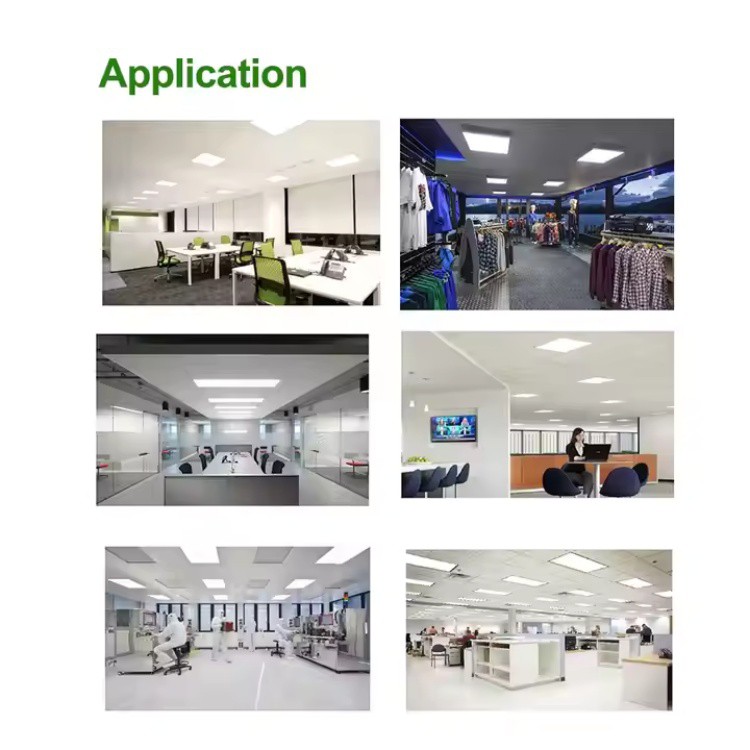
LED panel lights are multifunctional indoor lighting solutions. These are some common LED panel light applications:
Offices: LED panel lights are frequently utilized to create consistent, bright illumination in workplace settings. They lessen eye strain and make work comfortable. They fit in open offices, meeting rooms, conference rooms, and corridors.
Commercial: LED panel lights work in retail establishments, supermarkets, showrooms, and malls. They provide steady, high-quality lighting that improves product visibility and welcomes customers.
Educational Establishments: Schools, colleges, and universities frequently use LED panel lights. Classrooms, libraries, lecture halls, and common areas use them for effective and uniform lighting for learning, reading, and other activities.
Medical Facilities: Hospitals, clinics, and healthcare facilities all use LED panel lights. They illuminate exam rooms, waiting areas, halls, and operating rooms evenly. The flicker-free and glare-free illumination of LED panels benefits medical personnel and patients.
If you are interested, feel free to contact us.
Telephone: +86 755 27186329
whatsapp: +86 19375189821
Email: bwzm09@ledbenweilighting.com
Website: https://www.benweilighting.com/





