

With the continuous development of lighting technology and the upgrading of home decoration concepts, modern homeowners are no longer satisfied with the single lighting function of traditional fixtures; they pursue more personalized, atmospheric, and functional lighting solutions. LED (Light-Emitting Diode) strip lights, as a new type of decorative lighting, have gradually become a core element in modern interior design due to their unique advantages: they are thin, flexible, and can be cut and bent according to needs, adapting to various irregular spaces; they support color temperature adjustment (from warm white 2700K to cool white 6500K) and RGB color changing, meeting different atmospheric needs; they have low power consumption (energy efficiency is 3-5 times that of incandescent bulbs), long service life (up to 50,000+ hours), and easy installation, which can be completed by DIY or simple professional operation.
The creative application of LED strip lights is not only to add light to the space but also to integrate lighting with the home's architecture, decoration, and functional needs, creating a sense of hierarchy, warmth, and artistry. From highlighting architectural features to optimizing functional spaces, from creating focal points to enhancing outdoor ambiance, LED strip lights can play a unique role in every corner of the home. This blog focuses on the creative usage of LED strip lights in home spaces, divides them into different categories according to application scenarios and functional positioning, and elaborates on each usage in detail, providing professional and actionable guidance for homeowners to apply LED strip lights creatively.
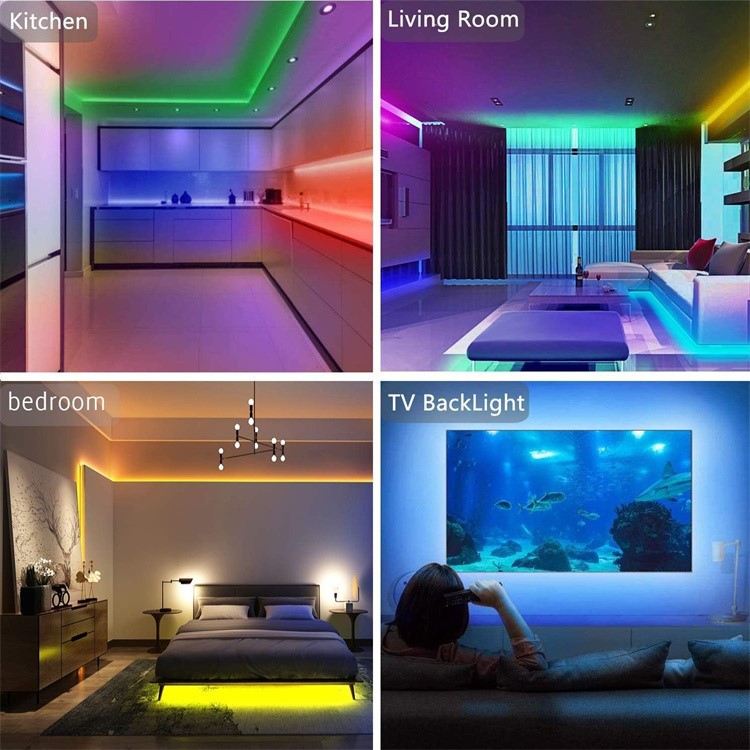
Highlight Home Architecture: Enhance Spatial Hierarchy and Artistry
The core of using LED strip lights to highlight home architecture is to use light and shadow to outline the contour and texture of architectural structures, enhance the spatial hierarchy, and make the home's inherent design features more prominent. This method is suitable for various architectural styles, from modern minimalist to European classical, and can be adjusted according to the characteristics of the space.
Lighting Along Ceiling and Floorboards
Installing LED strip lights along the ceiling or floorboards is a classic way to highlight the spatial shape, which mainly relies on the "silhouette lighting" effect to outline the outline of the room, making the space appear more open and layered. For small-sized rooms, this method can visually expand the space; for large-sized rooms, it can divide the space and avoid the emptiness of the large area. In terms of color temperature selection, warm white (2700K-3000K) is suitable for living rooms, bedrooms, and other spaces that need warmth; cool white (5000K-6500K) is suitable for study rooms, corridors, and other spaces that need clarity; RGB color-changing strips can be used in entertainment areas to increase the sense of atmosphere.
For ceiling installation, it is recommended to install the LED strip lights in the ceiling cove (if any) or along the edge of the ceiling, using a hidden installation method to avoid direct exposure of the light source, creating a soft "sky light" effect. The installation steps are as follows: first, clean the installation position to ensure it is dry and dust-free; then, use the self-adhesive tape attached to the LED strip to fix it, or use fixing clips for reinforcement (especially for uneven surfaces); finally, connect the power supply and adjust the brightness and color. For floorboard installation, the LED strip lights can be installed along the gap between the floor and the wall, or embedded in the skirting line, which not only highlights the contour of the room but also provides auxiliary lighting for night walking, avoiding the glare of traditional floor lamps. It should be noted that the LED strip lights installed on the floor need to choose waterproof models (IP65 or above) to prevent damage from moisture and dust.
LED Under Stair Treads
Installing LED strip lights under stair treads is not only a decorative method but also a functional lighting solution, which can solve the problem of insufficient lighting on stairs at night and improve safety. At the same time, the light emitted from under the treads can outline the shape of the stairs, creating a dramatic and layered visual effect, which is particularly suitable for lofts, duplex houses, or stairs with a sense of design. For modern minimalist or industrial-style homes, this method can add a sense of technology and artistry; for warm-style homes, warm white LED strips can enhance the cozy atmosphere.
The installation of LED strip lights under stair treads needs to follow the principle of "hidden and safe": first, measure the length of each stair tread, cut the LED strip lights according to the size (cut only at the designated cutting points to avoid damaging the circuit); then, install the strip lights on the bottom of the upper tread, ensuring that the light is directed downward to the step surface, avoiding glare; finally, connect the strip lights in series (pay attention to the maximum load of the power supply) and hide the wires in the stair structure to ensure the beauty and safety. It is recommended to choose low-voltage LED strip lights (12V/24V) to avoid electrical safety hazards; for stairs in wet areas (such as near the bathroom), waterproof LED strips and connectors must be used to prevent short circuits caused by moisture.
Create Focal Points: Highlight Decorative Features and Visual Focus
In interior design, a focal point is the visual center of the space, which can attract people's attention and enhance the artistic sense of the space. LED strip lights can be used to create focal points by highlighting decorative elements, blank walls, or functional areas, making the space more vivid and hierarchical without increasing too much decoration cost.
LED Strip Lights for Accent Walls
For large blank walls in the home (such as the wall behind the sofa, the wall at the head of the bed, or the TV background wall), LED strip lights can be used to create an accent wall, breaking the monotony of the blank wall and adding a sense of artistry. The design methods are diverse: vertical installation of LED strip lights along the edge of the wall can create a sense of height; horizontal installation can divide the wall into layers; arranging the strip lights into geometric shapes (such as rectangles, circles, or irregular lines) can add a sense of design. In terms of style matching, modern minimalist homes can choose monochromatic LED strips (such as black, white, or gray) to maintain a simple and elegant style; Nordic-style homes can choose warm white or light-colored RGB strips to enhance the warm atmosphere; industrial-style homes can choose cool white strips with exposed wires to highlight the rough and bold style.
When creating an accent wall with LED strip lights, it is necessary to pay attention to the coordination between the light and the wall material: for smooth walls (such as painted walls, wallpaper walls), self-adhesive LED strips can be directly used; for rough walls (such as brick walls, stone walls), fixing clips or brackets need to be used to ensure the stability of the strip lights. In addition, the brightness of the LED strip lights should be controlled appropriately: too bright will make the accent wall too abrupt, and too dark will not achieve the effect of highlighting. It is recommended to use a dimmer switch to adjust the brightness according to the ambient light and usage needs. For better visual effect, you can install a diffuser cover on the LED strip lights to make the light softer and more uniform.
Highlight Artwork and Decorative Elements
LED strip lights can be used to highlight artwork (such as oil paintings, photos, and sculptures), decorative shelves, vases, and other elements, making these decorations the focal point of the space. The core principle of this method is "focused lighting", that is, using the directional light of LED strip lights to illuminate the decorative elements, highlighting their details and texture, while keeping the surrounding environment relatively dark to form a contrast between light and shadow. For artwork, the color temperature of the LED strip lights should be selected according to the type of artwork: warm white (3000K-4000K) is suitable for oil paintings and photos to restore the true colors of the works; cool white (5000K-6000K) is suitable for sculptures and modern artworks to highlight their lines and textures.
For artwork hanging on the wall, LED strip lights can be installed on the frame of the artwork (hidden around the frame) to create a "backlight" effect, making the artwork stand out from the wall; for decorative shelves, LED strip lights can be installed under the shelf board or along the edge of the shelf to illuminate the items on the shelf, enhancing the sense of hierarchy. When installing, it is necessary to pay attention to the distance between the LED strip lights and the decorative elements: too close will cause glare and uneven lighting, and too far will not achieve the highlighting effect. It is recommended that the distance be controlled between 10-15cm. In addition, choose LED strip lights with high Color Rendering Index (CRI ≥ 85) to ensure that the colors of the decorative elements are restored truly.
Optimize Functional Spaces: Improve Usability and Comfort
In addition to decorative functions, LED strip lights can also be used to optimize the lighting of functional spaces, solve the problem of insufficient lighting in dark areas, and improve the usability and comfort of the space. This type of application focuses on practicality, combining the functional needs of the space with the characteristics of LED strip lights to achieve the dual effect of lighting and convenience.
Lighting Up Closets and Wardrobes
Closets and wardrobes are common dark spaces in the home, and traditional ceiling lights or wall lights are often unable to illuminate the internal corners, making it difficult to find clothes and accessories. Installing LED strip lights in closets can solve this problem, providing uniform and soft lighting for the entire closet space, making it easier to distinguish the color and style of clothes. The design requirements for closet lighting are: soft light (avoid glare that damages the eyes), uniform illumination (no dark corners), and energy saving (long-term use without excessive power consumption). It is recommended to choose low-voltage warm white LED strip lights (2700K-3000K), which are soft and not dazzling, and can restore the true color of clothes.
The installation of LED strip lights in closets can be divided into three positions: the top of the closet (illuminating the entire space), under the shelf (illuminating the clothes on the lower layer), and inside the drawer (illuminating small accessories). The installation steps are: clean the installation position, fix the LED strip lights with self-adhesive tape or fixing clips, connect the power supply, and install a switch (it is recommended to use a door sensor switch, which can automatically turn on the light when the closet door is opened and turn off the light when the door is closed, saving energy and convenient to use). For intelligent home users, WiFi-enabled LED strip lights can be selected, which can be controlled by a mobile phone or voice, adjusting the brightness and color temperature according to needs.
Illuminating Cabinetry in Kitchens and Bathrooms
Kitchen and bathroom cabinets are often in dark environments, and the internal lighting is insufficient, making it difficult to find items. Installing LED strip lights in the cabinets can improve the usability of the cabinets and enhance the safety of use (avoiding collisions when looking for items in the dark). For kitchen cabinets, LED strip lights can be installed under the upper cabinet (illuminating the countertop, facilitating food preparation) or inside the cabinet (illuminating the internal items); for bathroom cabinets, LED strip lights can be installed inside the mirror cabinet (illuminating the face, facilitating makeup and shaving) or under the cabinet (illuminating the floor, avoiding stepping on water stains).
When installing LED strip lights in kitchens and bathrooms, the key is to meet the waterproof and high-temperature resistance requirements. Kitchens have high temperatures and oil fumes, so it is recommended to choose LED strip lights with high-temperature resistance (operating temperature -20℃ to 60℃) and easy cleaning; bathrooms have high humidity, so waterproof LED strip lights (IP65 or above) must be selected to prevent short circuits caused by moisture. The installation steps are similar to closet lighting: fix the strip lights, connect the power supply, and install a switch. For under-cabinet lighting in the kitchen, it is recommended to use a touch switch or a motion sensor switch, which is convenient to operate during food preparation.
Create Unique Ceiling Designs: Break Through Traditional Lighting Limitations
The ceiling is an important part of home interior design, and traditional ceiling lighting is often limited to chandeliers, downlights, and other fixed fixtures, which are lack of creativity. LED strip lights, with their flexibility and customizable characteristics, can create unique ceiling designs, break through the limitations of traditional lighting, and add a sense of technology and artistry to the space.
Geometric and Patterned Ceiling Lighting
Using LED strip lights to create geometric shapes or patterns on the ceiling is a popular creative method in modern interior design. Common patterns include circles, waves, squares, and irregular lines, which can be designed according to the shape of the ceiling and the overall style of the room. For example, in the living room, a circular LED strip light can be installed in the center of the ceiling to simulate the effect of a "starry sky"; in the bedroom, a wave-shaped LED strip light can be installed to create a soft and romantic atmosphere; in the children's room, cartoon-shaped LED strip lights (such as stars, moons) can be installed to meet the children's preferences. This method is suitable for modern minimalist, Nordic, and other styles that pursue individuality and artistry.
The installation of geometric and patterned ceiling lighting requires pre-design and measurement: first, draw the desired pattern on the ceiling, mark the installation position of the LED strip lights; then, cut the LED strip lights according to the pattern (pay attention to the cutting points and the direction of the light source); next, fix the strip lights on the ceiling (for suspended ceilings, the strip lights can be embedded in the ceiling; for flat ceilings, fixing clips or adhesive tape can be used); finally, connect the power supply and adjust the brightness and color. It should be noted that the pattern design should not be too complicated, so as to avoid making the ceiling appear cluttered; the color of the LED strip lights should be coordinated with the ceiling color and the overall decoration style.
Hidden Ceiling Lighting (Cove Lighting)
Hidden ceiling lighting (also known as cove lighting) is a method of installing LED strip lights in the ceiling cove, using the reflection of light to create a soft and uniform "sky light" effect. This method can make the ceiling appear higher, visually expand the space, and create a warm and comfortable atmosphere. It is suitable for various spaces, especially bedrooms, living rooms, and corridors. The light emitted by hidden ceiling lighting is soft and not dazzling, which is conducive to relaxing the mood and improving the comfort of the space. In addition, hidden ceiling lighting can be used together with other lighting fixtures (such as chandeliers, downlights) to create a layered lighting effect.
The installation of hidden ceiling lighting requires the ceiling to have a cove (if there is no cove, a suspended ceiling can be installed to create a cove). The installation steps are: clean the cove, fix the LED strip lights along the cove (the light source is directed upward to the ceiling), connect the power supply, and adjust the brightness. When designing, the width and depth of the cove should be considered: the width is generally 10-15cm, and the depth is 5-10cm, to ensure that the light can be fully reflected and avoid direct exposure of the light source. In terms of color temperature selection, warm white (2700K-3000K) is suitable for bedrooms and living rooms, and cool white (5000K-6500K) is suitable for corridors and study rooms.
Extend to Outdoor Spaces: Create Comfortable Outdoor Ambiance
LED strip lights are not only suitable for indoor spaces but also can be extended to outdoor spaces, such as patios, decks, balconies, and courtyards, creating a comfortable and romantic outdoor ambiance for outdoor entertainment and rest. Outdoor application of LED strip lights needs to focus on waterproof, dustproof, and weather resistance to ensure long-term use in outdoor environments.
Lighting Around Patios and Decks
Installing LED strip lights around patios and decks can transform these outdoor spaces into comfortable entertainment areas, suitable for family gatherings, barbecues, and evening rest. The design objective is to provide soft and sufficient lighting, create a warm and romantic ambiance, and highlight the outline of the patio and deck. For example, installing LED strip lights along the edge of the patio railing can outline the shape of the patio and provide safety lighting for night walking; installing LED strip lights under the deck board can create a "floating" effect, making the deck appear more romantic.
Outdoor installation of LED strip lights must choose waterproof models with IP65 or above (preferably IP67 for areas with frequent rain), and use waterproof connectors and power supplies to prevent short circuits caused by rain and moisture. The installation steps are: fix the LED strip lights on the railing, deck edge, or wall using waterproof fixing clips (avoid using self-adhesive tape, which is easy to fall off in outdoor environments); connect the waterproof connectors and power supply; bury the wires in the ground or along the wall to avoid damage. It is recommended to choose solar-powered LED strip lights for outdoor use, which are energy-saving and environmentally friendly, and do not need to be connected to the mains, making installation more convenient.
Lighting for Balconies and Courtyards
For balconies and courtyards, LED strip lights can be used to highlight the green plants, decorative elements, and architectural features of the space. For example, installing LED strip lights along the edge of the balcony railing can create a sense of security and decoration; installing LED strip lights around the flower pots can highlight the green plants and add a sense of vitality; installing LED strip lights along the courtyard path can provide safety lighting and guide the direction. When selecting LED strip lights for balconies and courtyards, it is necessary to consider the weather conditions of the area: for areas with strong sunlight, choose LED strip lights with UV resistance to avoid aging and discoloration; for areas with low temperatures, choose LED strip lights with low-temperature resistance to ensure normal operation in winter.
Create Themed Spaces: Meet Personalized Needs
LED strip lights can be used to create themed spaces according to personal hobbies and usage needs, such as cozy reading nooks, children's play areas, and home theaters, making the space more personalized and in line with the lifestyle of the residents.
Cozy Reading Nook Lighting
A reading nook requires soft, uniform, and non-glare lighting, which can reduce eye fatigue and create a cozy reading atmosphere. LED strip lights are very suitable for reading nook lighting because they can provide soft and adjustable light, and can be installed in hidden positions to avoid direct glare. The key requirements for reading nook lighting are: appropriate brightness (300-500 lumens), warm color temperature (2700K-3000K), and uniform illumination (no dark spots or glare).
The installation positions of LED strip lights in reading nooks can be: behind the bookshelf (emitting soft light to illuminate the books and the reading area), under the headboard (for reading nooks with beds), or along the edge of the reading desk (illuminating the desktop). When installing, it is recommended to use a dimmer switch to adjust the brightness according to the light intensity and reading needs. In addition, the color of the LED strip lights should be coordinated with the decoration of the reading nook: for example, the reading nook with wooden furniture can choose warm white LED strips to enhance the cozy atmosphere; the reading nook with modern furniture can choose neutral white (4000K) LED strips to maintain a clean and comfortable style.
Themed Lighting for Children's Rooms and Home Theaters
For children's rooms, LED strip lights can be used to create a playful and interesting themed space: install RGB color-changing LED strip lights along the edge of the bed, ceiling, or bookshelf, which can be adjusted to various colors according to the children's preferences, creating a fairy-tale-like atmosphere. It is recommended to choose LED strip lights with low brightness and no flicker to protect children's eyes. For home theaters, LED strip lights can be installed behind the TV, around the projection screen, or along the edge of the ceiling, creating a cinematic atmosphere. Choose warm white or dark blue LED strip lights, which can reduce the contrast between the screen and the surrounding environment, protect the eyes, and enhance the viewing experience.
Conclusion
LED strip lights, with their flexibility, energy efficiency, and customizable characteristics, have become an important decorative and functional element in modern home design. Their creative application can not only enhance the artistic sense and hierarchy of the home space but also optimize the functional experience of the space, meeting the personalized needs of homeowners for home decoration and lighting. This blog has systematically explored the creative usage of LED strip lights in home spaces, including highlighting home architecture, creating focal points, optimizing functional spaces, creating unique ceiling designs, extending to outdoor spaces, and creating themed spaces, and elaborated on the design principles, installation methods, and effect presentation of each usage in detail.
In practical application, homeowners can combine their own home style, space characteristics, and usage needs to choose appropriate usage methods, and pay attention to the selection of high-quality LED strip lights, compliance with installation specifications, and reasonable matching of color temperature and brightness. With a little creativity and professional guidance, LED strip lights can transform ordinary home spaces into personalized, comfortable, and artistic environments, bringing a new experience to home life. It is believed that with the continuous development of LED technology, the application of LED strip lights in home design will be more diverse and intelligent, creating more possibilities for modern home decoration.

How To Cooperate With Us?
Our firm prides itself on owning its own factory, guaranteeing complete control over the production process and the quality of our goods. We are not only agents; we are manufacturers committed to offering our clients the most competitive rates available. We invite consumers to evaluate our samples first, as we are assured that the quality and pricing of our items are self-evident. Our dedication to excellence and client satisfaction compels us to consistently perform at our best and provide superior quality products.
Our address
3rd Floor, 5th Building, Hebei Industrial Park, Hualian Community, Longhua District, Shenzhen, China





