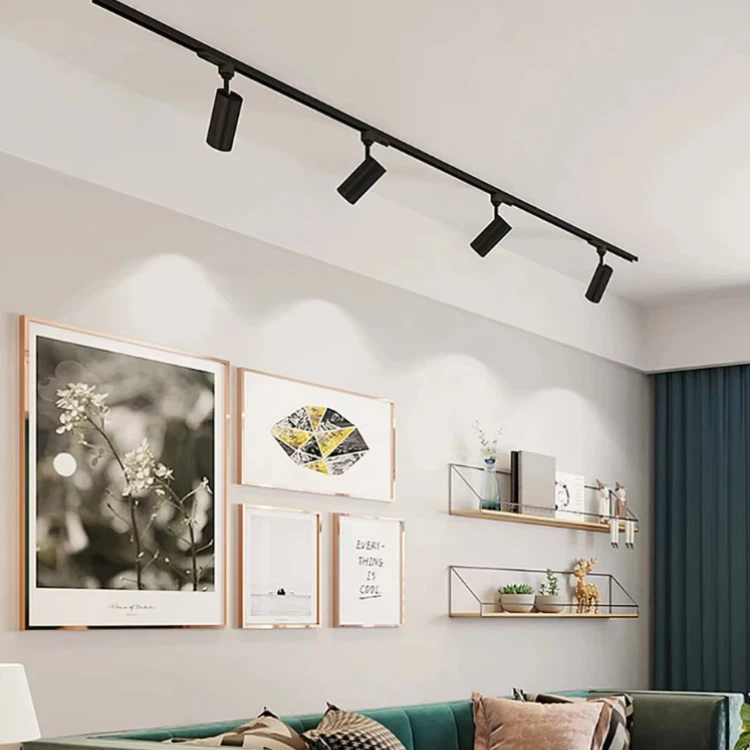
Track lights are frequently used in both commercial spaces-such as brand retail stores, art galleries, and cafes-and residential interiors because of its versatility, excellent adaptability to different contexts, and sleek, contemporary aesthetics. They make it possible to precisely focus light and highlight important regions, producing layered lighting effects that are just not possible with conventional fixed lamps. However, users often run into a number of problems during the actual installation, operation, and maintenance stages, which can lower lighting quality, reduce equipment lifespan, and even present safety threats. In order to help industry professionals and end users use track lighting systems successfully and efficiently, this article analyses the five most prevalent types of issues related to track lights, presents a thorough examination of their underlying causes, and offers focused remedies.
Inadequate Electrical Contact: Unreliable Lighting
This is the most prevalent problem with track lighting. Flickering lights, sporadic outages, uneven brightness, or a total lack of illumination are its main symptoms. This may eventually cause damage to the power drivers and lamp heads, raising the expense of maintenance.
Fundamental Reasons: The contact points on the lamp heads experience oxidation from moisture and dust buildup or wear and tear from frequent installation and removal; the wiring specifications are insufficient-or the circuit is overloaded-resulting in unstable current flow; or the track connectors are not tightened securely, causing loosening due to lamp head adjustments or environmental vibrations.
Solutions: Make sure the track connectors are tightened securely during installation; confirm the proper polarity (positive and negative) and use a multimeter to test for circuit continuity; wipe the lamp head contact points with a soft, dry cloth on a regular basis and replace any worn components right away; choose copper wiring with a cross-sectional area of 1.5–2.5 mm² based on the circuit load-ensuring that a single circuit on a single-phase track does not exceed a load of 3 kW and that the load is distributed equally across a three-phase track system.
Track and lamp heads are incompatible.
Despite having a big impact, this problem is readily ignored. It immediately leads to lamp heads that are difficult to install, have poor electrical contact, or don't produce the desired lighting effect. The most common causes are careless mixing of goods from several brands or a failure to check standards before procurement.
Fundamental Reasons: Single-phase and three-phase track systems are the two primary categories. Brands differ greatly in terms of interface dimensions, electrical standards, and load capacities. Combining parts from different brands can result in problems like mismatched beam angles and wattage, a lack of power supply, or lamp heads that don't snap into position.
Remedies: Prioritise choosing lamp heads from the same brand as the track system and clearly define the necessary track type and specifications before purchasing; if combining components is inevitable, check compatibility with the supplier beforehand; for custom systems, work with the manufacturer to make sure all matching parameters are properly aligned.
Inadequate Installation: Risks to Safety
In addition to impairing lighting performance, improper installation might result in safety concerns including electric shocks, short circuits, or falling tracks. These problems are usually caused by careless handling or a disregard for important installation requirements.
The following are the main causes: failing to evaluate the ceiling's load-bearing capacity, which leads to insecure fastening hardware; improper grounding of the track system, which increases the risk of electrical leakage; improper wiring or exposed wires, which can result in short circuits; and failing to set aside enough space for maintenance, which makes future inspection and repairs challenging.
Solution: Check the load-bearing capacity of the ceiling before installation; for commercial spaces, choose tracks that are at least 1.2 mm thick. Make sure the track is grounded correctly and confirm that the insulation resistance is at least 2MΩ. Make sure that access points are set aside for maintenance and have a qualified electrician handle the wiring in compliance with safety regulations.
Inadequate Lighting (Dark Spots, Glare)
The main benefits of track lighting are undermined by this; glare diminishes comfort and creates eye strain, while dark areas lead to uneven light distribution. Usually, improper beam angles, mounting heights, or light head spacing are the cause of these problems.
Root Causes: Glare can be caused by utilising narrow beam angles in confined spaces or by putting light heads too low; dark spots or uneven brightness can result from having too few light heads or too many light heads that overlap.
Solution: Choose beam angles according to the particular situation (36° for general area illumination, 60° for general house use, and 15°–24° for tiny shows). Use the "1.2 times the mounting height" approach to calculate the distance between light heads. Install glare shields or choose anti-glare light heads for areas that are susceptible to glare.
Inadequate Upkeep Causing a Shortened Life
Despite having a potential lifespan of over 50,000 hours, LED track lights frequently have a far shorter operating life. Inadequate upkeep is the main cause of this disparity.
Root Causes: Wiping with corrosive cleaning agents or cleaning the fixtures before they have cooled down can harm the light heads and tracks; failing to maintain power drivers-or leaving the system powered on during extended periods of inactivity-accelerates component ageing; neglecting routine cleaning allows dust and grease to accumulate, compromising light transmission and electrical contact.
Solution: Make sure the light heads have cooled down before handling them, and wipe the tracks and light heads on a regular basis with a soft, dry cloth. Examine the power drivers on a regular basis and replace any worn-out parts right away. During prolonged periods of idleness, turn off the main power supply; for commercial areas, plan a thorough inspection and maintenance check every three to six months.
In conclusion, electrical contact, component compatibility, installation, illumination performance, and maintenance are the five primary categories into which common problems with track lighting usually fall. Proper product selection, expert installation, and regular maintenance can successfully prevent these problems. Gaining proficiency in this area will greatly improve your user experience and lower costs, regardless of whether you work in the business or are a home or commercial track lighting user. Please do not hesitate to contact us if you experience any of the aforementioned problems when choosing, installing, or using your track lighting-or if you need a specialised track lighting solution made for particular business or residential settings.
www.benweilighting.com/professional-lighting/led-track-light/aluminum-cob-led-track-light.html