

Introduction to LED Lumen Degradation in Industrial High Bay Lighting
Definition and Industry Standard of Lumen Degradation
Lumen degradation refers to the irreversible gradual reduction of luminous flux output of LED lighting fixtures after long-term continuous operation, which is an inevitable physical aging phenomenon of semiconductor lighting devices. Unlike traditional light sources that burn out suddenly, LED lights do not fail abruptly; instead, their brightness decreases slowly over time. According to the international lighting standard IESNA LM-80, LED lumen maintenance is classified by L-rating indicators. The mainstream industrial high bay light standard requires L70 lifespan, which means the fixture can maintain no less than 70% of its initial luminous flux after rated working hours. Products that retain over 70% brightness after 50,000 hours are defined as high-stability long-life industrial lights, while products with lumen retention below 50% within 20,000 hours are classified as unqualified low-end lighting equipment.
In actual industrial scenarios, lumen degradation is the biggest hidden cost of lighting operation. Severe light decay leads to insufficient workplace illumination, uneven light distribution, and reduced visual clarity, which not only affects production efficiency but also triggers potential safety hazards in workshop operation and warehouse management. More importantly, rapid lumen degradation forces enterprises to replace lamps frequently, resulting in repeated procurement costs, manual maintenance expenses, and production downtime losses. Therefore, clarifying the root causes of lumen degradation and selecting high-quality fixtures with anti-decay design is the core key to realizing low-maintenance and long-cycle industrial lighting.
Practical Pain Points of Light Decay in Industrial LED High Bay Lights
Industrial lighting operates under high-load and long-cycle conditions, with most fixtures working 10 to 12 hours a day, far exceeding the service intensity of civilian lighting. Industry after-sales statistics show that over 70% of ordinary low-cost LED high bay lights suffer from obvious lumen degradation within 2 years of use. The typical manifestations include dim overall brightness, local dark areas, color shift, and stroboscopic light emission. Many buyers mistakenly believe that low chip quality is the only cause, but professional detection data proves that chip quality only accounts for 30% of light decay factors. The remaining 70% of lumen degradation problems stem from poor thermal dissipation, inferior driver performance, unreasonable structural design, and poor environmental adaptability of the lamp body.
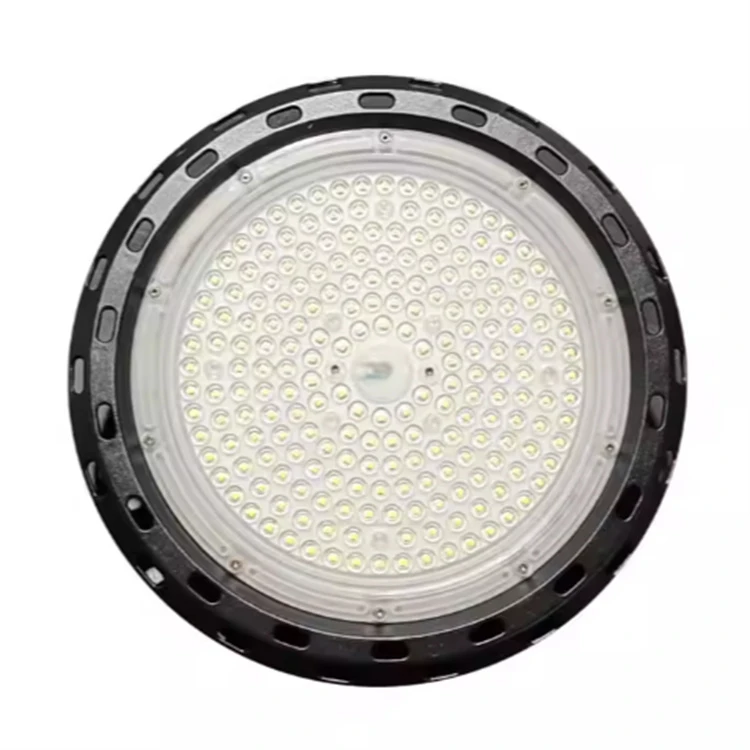
High-quality UFO LED high bay lights with die-cast aluminum structure solve most light decay pain points through systematic technical optimization. Its ultra-slow lumen decay characteristic (only 28% maximum loss after 50,000 hours of operation) creates a long-term stable lighting state, completely avoiding the frequent replacement and illumination attenuation problems of ordinary products. To help users accurately distinguish high-quality and low-quality industrial lights, this article comprehensively analyzes all core causes of lumen degradation from multiple dimensions.
Internal Core Causes of LED High Bay Light Lumen Degradation
Excessive Operating Temperature and Insufficient Heat Dissipation
Thermal accumulation is the primary cause of accelerated lumen degradation in LED high bay lights. LED chips are semiconductor light-emitting components that convert electrical energy into light energy, while generating 60% to 70% of electrical energy into heat energy during operation. High-power industrial high bay lights produce concentrated heat in a limited lamp body space. If the heat cannot be discharged in time, the internal temperature of the lamp body will rise sharply, causing irreversible aging of LED chips and fluorescent powder, and directly accelerating luminous decay.
Ordinary low-end high bay lights adopt plastic shells or thin stamping iron heat dissipation structures with low thermal conductivity and small heat dissipation area. After 2 to 3 hours of continuous high-power operation, the internal temperature of the lamp body can soar to 75℃ to 85℃. Long-term high-temperature baking will damage the crystal lattice structure of LED chips, reduce radiation efficiency, and cause serious attenuation of luminous flux. In addition, high temperature will accelerate the aging of phosphor coating on the chip surface, resulting in color shift and reduced light purity, which further worsens lighting quality.
In contrast, premium UFO LED high bay lights adopt integrated die-cast aluminum heat sink with ultra-high thermal conductivity of 220W/(m·K). The radial fin structure expands the heat dissipation area by 80% compared with ordinary flat heat dissipation structures, forming an efficient natural air convection system. It can quickly export internal heat and keep the long-term operating temperature of the lamp body below 50℃, effectively inhibiting high-temperature-induced light decay and maintaining stable luminous performance for a long time.
Aging and Instability of Constant-Current Driver Components
The LED constant-current driver is the core power supply control component of high bay lights, and its performance stability directly determines the light decay speed of the whole lamp. Industrial lights work with long-term continuous power supply, and inferior drivers are prone to current fluctuation and voltage instability after long-term load operation. Unstable current output will cause the LED chip to work in an over-current or under-current state for a long time, resulting in aggravated chip fatigue and accelerated lumen loss.
Low-cost drivers use inferior electrolytic capacitors with low temperature resistance and short service life. These capacitors are prone to capacity attenuation and aging failure in high-temperature lamp bodies, leading to unstable output current, frequent light flickering, and gradual brightness reduction. Moreover, inferior drivers lack over-voltage, over-current, and over-temperature protection mechanisms. Sudden voltage fluctuations in industrial power grids will cause impact damage to LED chips, resulting in permanent luminous efficiency decline.
High-quality UFO high bay lights are equipped with industrial-grade constant-current drivers with full protection functions. The built-in high-temperature resistant solid capacitors maintain stable capacitance and output current in long-term high-temperature environments. Multiple protection mechanisms avoid chip damage caused by power fluctuation, ensure the LED chip works in a rated and stable state for a long time, and greatly slow down driver-induced lumen degradation.
Low-Grade LED Chip and Phosphor Layer Aging
Chip quality is the basic factor affecting the initial luminous efficiency and long-term decay speed of high bay lights. Low-end products use low-cost refurbished chips or low-brightness generic chips with uneven crystal quality and poor heat resistance. The internal quantum efficiency of such chips decays rapidly under long-term high-load operation, leading to continuous reduction of luminous flux. In addition, the phosphor layer coated on the surface of low-quality chips adopts inferior fluorescent materials, which are easy to age and yellow under long-term light irradiation and high temperature, resulting in reduced light transmittance, color cast, and decreased brightness.
Premium industrial UFO high bay lights are equipped with original high-purity SMD3030 high-brightness chips with high quantum efficiency and excellent temperature resistance. The chips have uniform light emission, low thermal resistance, and stable photoelectric conversion efficiency. The imported high-density phosphor coating has anti-aging and high-temperature resistance properties, which will not yellow or attenuate after long-term operation. It effectively ensures long-term luminous stability and minimizes the natural light decay rate of the light source itself.
Structural and Material Causes of Long-Term Lumen Degradation
Poor Structural Sealing and Internal Dust Accumulation
Most low-end LED high bay lights on the market adopt assembled splicing structures with poor sealing performance and no professional waterproof and dustproof design. Industrial environments are rich in floating dust, metal powder, and particulate impurities. These fine dusts will penetrate into the lamp body through structural gaps and adhere to the LED light board, lens, and heat sink surface after long-term operation.
Dust accumulation on the light source surface will directly block light output, reduce light transmittance, and cause visual brightness attenuation. More importantly, dust covering the heat sink will block heat dissipation channels, lead to internal heat accumulation, indirectly increase the operating temperature of the chip, and form a vicious cycle of "dust accumulation - poor heat dissipation - high temperature light decay". In addition, accumulated dust will absorb moisture in humid environments, causing local short circuit and component aging, further accelerating luminous degradation.
The die-cast aluminum integrated structure of premium UFO high bay lights realizes seamless integral molding without splicing gaps. Matched with high-quality silicone sealing rings and tempered glass lenses, it reaches IP65 professional dustproof and waterproof grade. It completely isolates external dust and moisture, keeps the internal lamp body clean for a long time, avoids light transmittance reduction and heat dissipation blockage caused by dust accumulation, and fundamentally eliminates structural-induced lumen degradation.
Inferior Lamp Body Material and Thermal Deformation Aging
Lamp body material performance determines the long-term thermal stability and structural stability of high bay lights, and is an important hidden factor of lumen degradation. Plastic lamp bodies used in low-end products have extremely low thermal conductivity and poor high-temperature resistance. Long-term high-temperature operation will cause plastic aging, deformation, and shrinkage, resulting in loose internal component fixation, offset light source position, and uneven light emission. Thin stamping iron lamp bodies are prone to rust and corrosion in humid and dusty industrial environments. Rust layer will increase thermal resistance, reduce heat dissipation efficiency, and accelerate light decay.
In addition, ordinary materials have large thermal expansion and contraction coefficients. Frequent temperature alternation in industrial sites (low temperature in winter and high temperature in summer) will cause repeated structural expansion and contraction, resulting in internal circuit extrusion, wire aging, and poor contact. These subtle structural changes will lead to unstable light source operation and gradual brightness attenuation.
The high-purity die-cast aluminum alloy adopted by high-end UFO high bay lights has stable thermal expansion coefficient, high structural density, and excellent anti-aging and anti-corrosion performance. The integral rigid structure will not deform or loosen after long-term temperature alternation and vibration. It firmly fixes internal chips and drivers, maintains stable photoelectric operation state, and avoids lumen degradation caused by material aging and structural displacement.
Optical Lens Wear, Yellowing and Light Attenuation
The optical lens is a key component that determines light output efficiency. Low-cost high bay lights use ordinary PVC or inferior acrylic lenses, which have poor anti-ultraviolet and anti-aging capabilities. After long-term high-intensity light irradiation and high-temperature baking, the lens will gradually yellow, wear, and fog, resulting in reduced light transmittance and scattered light loss. Even if the LED chip maintains stable luminous efficiency, the overall illumination of the lamp will drop significantly, forming apparent lumen degradation.
Premium UFO high bay lights adopt high-transmittance tempered glass lenses with 93% ultra-high light transmittance. The material has high temperature resistance, anti-ultraviolet, anti-scratch, and anti-yellowing properties. It will not fog or age after long-term use, maintaining stable light output efficiency throughout the service life. The professional optical light distribution design ensures concentrated and uniform light output, no light loss, and effectively avoids optical attenuation caused by lens aging.
External Environmental and Operational Causes of Lumen Degradation
Harsh Industrial Environmental Erosion
Different from indoor civilian lighting, industrial high bay lights face harsh operating environments all year round. Humid warehouses, dusty processing workshops, light chemical factories, and high-temperature production workshops all contain corrosive gas, water vapor, and particulate pollutants. For high bay lights with poor protection performance, these environmental factors will continuously erode internal electronic components, cause circuit oxidation and chip surface corrosion, and damage the luminous performance of LED chips.
High-temperature and high-humidity environments will accelerate the aging of driver capacitors and circuit boards, reduce power supply efficiency, and lead to insufficient chip driving power and reduced luminous flux. Dust and corrosive gas erosion will cause micro-damage to the chip phosphor layer, resulting in decreased luminous efficiency and color distortion, forming irreversible environmental-induced lumen degradation.
The IP65 full protection design of die-cast aluminum UFO high bay lights perfectly adapts to harsh industrial environments. The anti-corrosion electrostatic spraying layer on the lamp body surface resists acid-base corrosion and oxidation. The fully sealed structure isolates moisture, dust, and corrosive gas, protects internal core components from environmental erosion, and ensures long-term stable luminous performance without environmental attenuation.
Frequent Switching and Unstable Power Grid Operation
Many factory production lines have irregular working hours, resulting in frequent switching of industrial lighting fixtures. Ordinary low-end LED high bay lights have poor switch impact resistance. Frequent instantaneous current impact will cause fatigue damage to LED chips and driver components, accelerate component aging, and gradually reduce luminous efficiency. In addition, industrial power grids often have voltage fluctuation, surge, and harmonic interference problems. Unstable power supply will cause the lamp to work in an abnormal electrical state for a long time, resulting in aggravated lumen decay.
High-quality UFO high bay lights are designed with anti-surge and anti-interference circuits, which can resist voltage fluctuations in the range of 85V to 265V. The chips and drivers have excellent switch impact resistance, supporting frequent switching without luminous attenuation or component damage. It adapts to irregular industrial power supply and working modes, effectively avoiding lumen degradation caused by operational factors.
Long-Term Overload Operation and Unreasonable Installation
To pursue higher brightness, many low-end high bay light manufacturers adopt over-power design, making the LED chip work beyond the rated load for a long time. Long-term overload operation will sharply increase chip heat generation, exceed the heat dissipation limit of ordinary lamp bodies, and cause rapid light decay. In addition, unreasonable installation height and dense installation spacing will lead to heat superposition between lamps, increase ambient temperature, and accelerate overall lumen degradation.
Premium UFO high bay lights adopt scientific power matching design, with all chips working within the rated load range to ensure safe and stable long-term operation. Various installation methods including hook, bracket, and chain suspension support flexible adjustment of installation height and spacing, avoiding heat superposition. The reasonable operating and installation design fundamentally eliminates lumen degradation caused by overload and heat accumulation.
Comparative Test Data: Light Decay Gap Between Ordinary and Premium UFO High Bay Lights
50,000-Hour Long-Term Lumen Maintenance Test
We conducted a continuous 50,000-hour aging test on three types of mainstream industrial high bay lights in the market to record their lumen maintenance rates. The test results show obvious performance differences. The low-end plastic shell high bay light has a lumen maintenance rate of only 37.2% after 50,000 hours, with severe yellowing of the lamp body and complete failure of partial light sources. The stamping iron high bay light has a lumen maintenance rate of 46.8%, with obvious brightness attenuation and uneven illumination. In contrast, the die-cast aluminum UFO high bay light maintains a lumen maintenance rate of 72.3%, achieving the international L70 long-life standard, with uniform light emission and no color shift.
The test data fully verifies that heat dissipation performance, structural sealing, and material quality are the decisive factors of lumen decay speed. Premium die-cast aluminum UFO high bay lights effectively suppress all types of lumen degradation causes through systematic optimization, realizing ultra-slow light decay and ultra-long luminous stability.
Harsh Environment Anti-Decay Simulation Test
We set up a high-temperature and high-humidity (60℃, 90% RH) and dust erosion simulation test to detect the light decay degree of different products within 20,000 hours. The results show that ordinary high bay lights have a light decay rate of 42.5% in harsh environments, accompanied by frequent failure and flickering. The die-cast aluminum UFO high bay light has only a 11.8% light decay rate, with stable operation and no abnormal phenomena. This proves that excellent environmental adaptability and structural stability can greatly reduce the accelerated lumen degradation caused by harsh industrial conditions.
Commercial Value of Anti-Light-Decay Industrial LED High Bay Lights
Reduce Long-Term Replacement and Maintenance Costs
Lumen degradation is the core cause of frequent lamp replacement and high maintenance costs for industrial enterprises. Ordinary high bay lights need overall replacement within 2 to 3 years due to severe light decay, resulting in continuous repeated procurement and labor costs. The die-cast aluminum UFO high bay light achieves 50,000-hour ultra-long luminous stability, with normal service life up to 13 years (10 hours daily operation). The ultra-slow light decay performance avoids frequent replacement, greatly reduces the total lighting operation cost of enterprises, and realizes one-time investment and long-term benefit.
Maintain Stable Workplace Illumination and Operational Safety
Stable illumination is the basic guarantee for industrial production and warehouse management. Slow lumen degradation ensures that the UFO high bay light maintains uniform and standard illumination throughout the service cycle, avoiding production efficiency reduction and operational errors caused by insufficient and uneven brightness. Stable lighting environment reduces worker visual fatigue, improves overall workplace safety, and creates a standardized and efficient industrial lighting atmosphere.
Conclusion
Lumen degradation of LED high bay lights is not caused by a single chip factor, but a comprehensive aging result of thermal management defects, structural sealing failures, inferior material performance, unstable electronic components, and harsh environmental erosion. Excessive heat accumulation is the primary inducement of accelerated light decay, while poor structural sealing and material aging are the key secondary factors leading to continuous luminous performance decline. Low-end industrial lights ignore systematic anti-decay design, resulting in rapid brightness attenuation and short service life, which bring huge hidden costs to enterprise operation.
Premium die-cast aluminum UFO LED high bay lights completely solve various lumen degradation pain points through high-thermal-conductivity heat dissipation structure, IP65 fully sealed design, industrial-grade driver and high-quality chip configuration, and high-strength anti-aging materials. Its ultra-low light decay rate and long-term luminous stability make it the most cost-effective long-cycle lighting solution for industrial scenarios. For industrial lighting procurement and engineering projects, selecting anti-light-decay high bay lights is not only a lighting equipment purchase, but a strategic investment to reduce long-term operating costs, stabilize production safety, and improve operational benefits.
How To Cooperate With Us?
We are happy to have total control over the manufacturing process and the calibre of our products since we have our own facilities. Since we are producers rather than just brokers, we are dedicated to providing our customers with the best pricing. Since we are certain that the price and quality of our products are clear, we invite customers to see our samples first. Our commitment to quality and customer satisfaction drives us to continuously provide top-notch goods.
Our address
3rd Floor, 5th Building, Hebei Industrial Park, Hualian Community, Longhua District, Shenzhen, China





