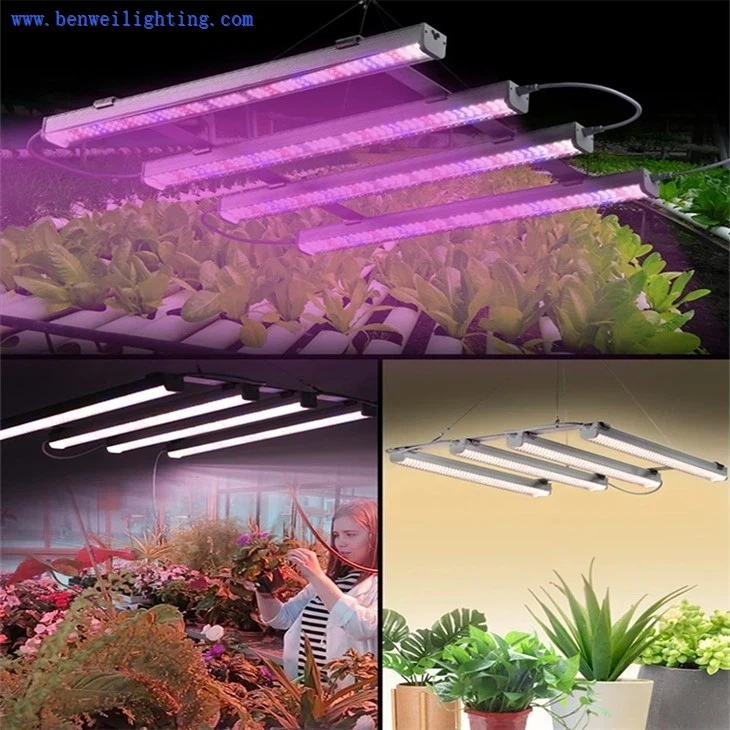
Due to their benefits, including energy savings, high efficiency, adjustable spectrum, and long life, LED plant growth lights have become essential equipment to replace natural light and ensure the healthy growth of plants with the rapid development of facility agriculture, indoor planting, home gardening, and vertical agriculture [3]. Growers, buyers, and industry professionals frequently ask themselves "which colour of LED is most suitable for plant growth" in real-world planting situations. Different colours of LED light correspond to different wavelengths, and their effects on plant photosynthesis, growth cycle, and morphological development differ significantly. Crop quality and planting efficiency are directly impacted by the choice of light colour.
Core Requirements for Plant Growth: The Operating Principles of LED Light Colors
Photosynthesis, which is based on photosynthetic pigments like chlorophyll absorbing light of particular wavelengths to transform light energy into chemical energy and provide the energy required for growth, flowering, and fruiting, is essential to plant growth . Only certain wavelengths of light may be efficiently absorbed and utilised by plants, despite the fact that different LED colours correspond to specific wavelengths (measured in nanometres). As a result, not every LED colour is appropriate for growing plants. In particular, the essential spectral band for plant development is the 400–700 nm range, also referred to as Photosynthetically Active Radiation (PAR); within this range, LEDs of various colours (and consequently different wavelengths) have varying effects on plant growth. The basic idea behind choosing LED colours is to "match the specific growth stage and requirements of the plant"; there isn't a single, perfect "best" colour; instead, there are particular colour combinationsand options that are "best suited" to the task.
The Core LED Colors Best Suited for Plant Growth-and Their Functions
(1) Red Light (Wavelength: 600–700 nm; Core Recommendation): As the "primary driver" of plant photosynthesis, red light mainly encourages the synthesis of chlorophyll and the buildup of carbohydrates. It greatly increases crop output and quality by speeding up fruit ripening, flower bud differentiation, and stem elongation. For most plants, including tomatoes, strawberries, and roses, red light at about 660 nm is especially helpful throughout the flowering and fruiting stages. Additional red light can speed up bud emergence, increase flower size, and improve fruit sugar content. Red light should be used in conjunction with other light colours because it can cause plants to become lanky (etiolated) and develop thin leaves when used alone.
(2) Blue light (wavelength: 400–500 nm; Core Recommendation). It mainly controls the morphology of plants, encouraging the growth of the root system and the expansion of the leaves while preventing legginess. This produces thicker, more resilient leaves and stronger stems. Blue light, which has a wavelength of about 450 nm, is ideal for both the vegetative growth stage of plants, such as leafy greens like spinach and lettuce, and the seedling stage, where it efficiently keeps seedlings from growing lanky and increases the plant's susceptibility to environmental stress. Inadequate blue light can cause spindly stems and withering leaves, which will hinder further growth and development.
(3) Full Spectrum (Natural Light Simulation; Overall Suggestion): This spectrum, which closely resembles natural sunshine and may satisfy a plant's requirements throughout its whole life cycle, is made up of a combination of different wavelengths, such as red, blue, green, and a tiny bit of far-red light. The soft, gentle light produced by full-spectrum LED lighting promotes the blossoming and fruiting of crops that bear flowers as well as the vegetative growth of leafy greens. It is also widely suitable in environments like indoor horticulture and home gardening because it is made with human visual comfort in mind. It works very well for succulents and foliage plants that don't have really strict spectrum requirements. Its main disadvantages are that it is slightly more expensive and has a slightly lower photosynthetic efficiency than pure red-blue light combinations.
(4) Far-Red Light (Wavelength: 700–800 nm; Supplemental Recommendation): Far-red light affects the phytochrome system and is mainly utilised to control plant flowering cycles and morphology. It is a perfect supplement for flowering plants like roses and chrysanthemums since it can speed up the flowering process in ornamental crops while also encouraging stem elongation. In cultivation conditions where exact control over blooming time is needed, far-red light is usually employed in conjunction with red and blue light.
Recommendations for LED Color Selection Across Different Cultivation Scenarios
(1) Home Gardening (Succulents, Foliage Plants, Small Flowering Plants): Full-spectrum LEDs are the preferred choice here. They emit soft light, offer high adaptability, and can meet the full-cycle growth requirements of various household plants while remaining non-glaring and well-suited to indoor environments. If growing small flowering plants (such as Kalanchoe), a red-blue light combination (with a red-to-blue ratio of 6:1 to 9:1) can be selected to stimulate flowering.
(2) Greenhouse Cultivation (Tomatoes, Strawberries, Vegetables, Flowers): Since natural light already provides a broad spectrum, supplemental lighting should prioritize a red-blue light combination-specifically focusing on supplementing 660nm red light and 450nm blue light-to enhance photosynthetic efficiency and boost yields by over 12%. For flowers requiring controlled flowering cycles (such as chrysanthemums and roses), far-red light can be incorporated into the lighting scheme.
(3) Indoor Vertical Farming & Plant Factories (Leafy Greens, Medicinal Plants): In the absence of natural light, a red-blue light combination is the preferred choice (with a higher proportion of blue light for leafy greens, and a higher proportion of red light for flowering and fruiting crops). This option offers high luminous efficacy and energy efficiency, making it ideal for multi-tiered vertical cultivation setups. If the primary objective is to achieve balanced crop quality, full-spectrum LEDs may be selected instead.
(4) Seedling Propagation & Tissue Culture: Priority should be given to a red-blue light combination with a higher proportion of blue light (with a blue-to-red ratio of 4:1). This helps inhibit etiolation (stem elongation) while promoting root and leaf development, thereby laying a solid foundation for subsequent growth.
Common Misconceptions and Precautions in Product Selection
(1) Misconception 1: A single LED color is best for plant growth. - In reality, there is no "universal color." Red light alone can easily lead to etiolation (stretching), while blue light alone can inhibit growth. Therefore, the choice of a single core color or a combination of colors must be tailored to the specific crop type and its current growth stage.
(2) Misconception 2: The brighter the color, the better it is for plant growth. - LED brightness (light intensity) is just as important as color and must be matched to the plant's specific needs; for instance, seedlings require low light intensity, whereas fruiting plants require high light intensity. Excessive light intensity can scorch the plant's leaves.
(3) Important Considerations: When selecting a lighting model, use color temperature as an auxiliary guide. Warm white light (3000–3500K) is rich in red light and is suitable for flowering and fruiting crops; neutral white light (4000–5000K) features a balanced spectrum and is suitable for mixed growth stages; and cool white light (5000–6500K) is rich in blue light, making it suitable for leafy greens and the seedling stage. Additionally, it is essential to monitor the Photosynthetic Photon Flux Density (PPFD) to ensure that the light is effectively absorbed by the plants.
Plaase feel free to contact us at any time if you have any questions about the colour selection, product procurement, or application suitability of LED plant grow lights-or if you need specialised colour spectrums and product solutions made for your particular crops (like leafy greens, flowering and fruiting plants, or succulents) and cultivation environments (like greenhouses, home setups, or plant factories).
https://www.benweilighting.com/agricultural-lighting/plant-lighting/grow-lights-for-indoor-plants-integrated-ip65.html
Our address
No. 5-3 Niujiao Road, Yanchuan Community, Yanluo Street, Bao'an District, Shenzhen
Phone Number
+86 15558971035
benwei10@benweilighting.com