When undertaking projects involving UV curing, inspection, or sterilization, selecting the right wavelength is the first critical step. The 395nm wavelength falls within the long-wave UVA band and is widely used in industrial and commercial applications. This article outlines the common uses of 395nm UV LED strips to help you determine if they are suitable for your project.
Basic Characteristics of 395nm UV LED Strips
The 395nm wavelength lies within the UVA range (315–400nm), close to the visible light spectrum; the human eye perceives it as a faint, purplish glow. Compared to 365nm LEDs, 395nm versions offer higher optical power, superior chip efficiency, and lower costs. Compared to 405nm LEDs, they provide a purer UV output and are more effective at exciting fluorescent materials.
Their strip-like form factor allows them to conform to irregular surfaces and be arranged in linear arrays, covering a much larger area than point light sources. These advantages explain why many manufacturers use them to replace traditional mercury lamps: they require no warm-up time, offer instant on/off capabilities, are mercury-free, and generate relatively less heat.
UV Adhesive and Ink Curing
This is one of the primary industrial applications for 395nm LED strips. Many photoinitiators found in UV adhesives, inks, and coatings respond effectively to light in the 380–405nm range, making 395nm an ideal fit.
Typical use cases include:
Curing UV adhesive applied to electronic components
Drying UV inks on labels and packaging
Rapid positioning for glass and acrylic bonding
Auxiliary curing for small-batch printing and prototyping equipment
Note: While 395nm light offers good penetration-making it suitable for thicker adhesive layers-surface curing speed depends on light intensity and irradiation distance. When selecting a product, it is important to verify the photoinitiator's absorption peak with the adhesive supplier.
Fluorescence Detection and Anti-Counterfeiting Verification
Many fluorescent substances are excited by ultraviolet (UV) light in the 365–395nm range. 395nm LED strips can be used to:
Inspect fluorescent anti-counterfeiting marks on banknotes, identification documents, and tickets
Detect fluorescent penetrants on the surface of industrial parts
Locate leaks (using fluorescent tracers added to refrigerant or hydraulic systems)
Check for coating uniformity and glue overflow
Compared to 365nm, 395nm strips emit slightly more visible light, resulting in a faint purple background glow on the inspected surface; however, this trade-off offers higher brightness and lower costs. They are sufficient for less demanding field inspections. For rigorous non-destructive testing-such as in the aerospace or nuclear power industries-365nm sources should still be selected in accordance with standards.
3D Printing Resin Curing
Most resins used in light-curing 3D printing are sensitive to light in the 385–405nm range. 395nm LED strips are commonly used for post-curing (secondary curing) after printing:
Placing printed parts in a curing chamber lined with LED strips to ensure uniform, multi-sided illumination
Using a turntable to enhance curing consistency
Providing supplemental lighting for small-scale DIY curing setups or studios
The advantage of LED strips is their ability to be arranged in a loop or wrap-around configuration, eliminating shadowed areas.
Stage, Decorative, and Blacklight Effects
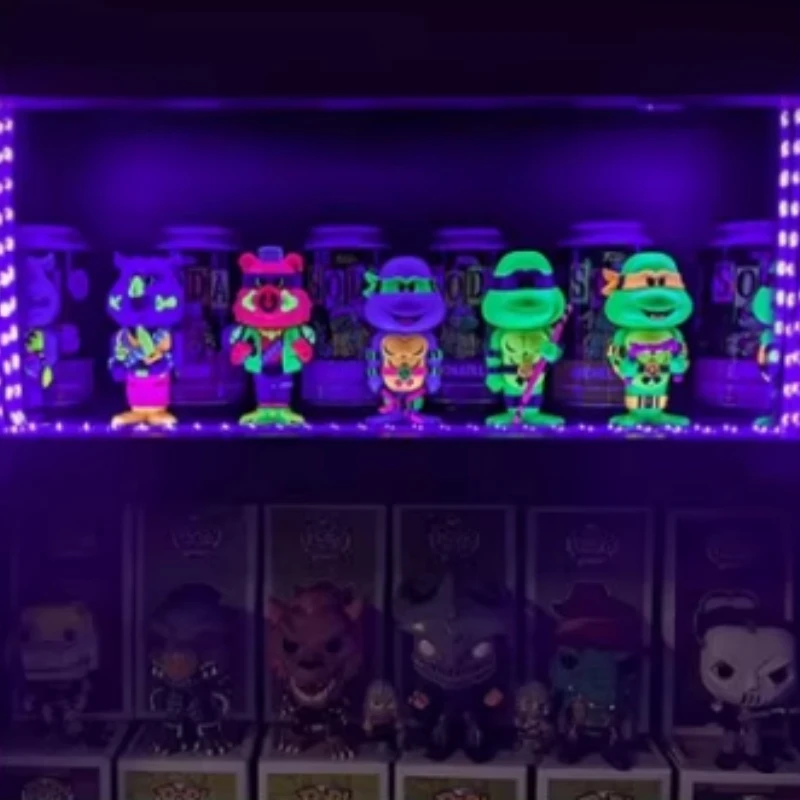
395nm light sits at the edge of the visible spectrum; the naked eye perceives a pale purple glow, while fluorescent pigments, paints, and white fabrics appear to glow brightly. Common applications include:
Blacklight ambient lighting for bars, karaoke lounges (KTVs), and performance stages
Illumination for fluorescent body art and posters
Special effect lighting for theme parks and escape rooms
Visual effects for event sets and window displays
These applications do not require high power output but place greater emphasis on light uniformity and installation methods.
Material Aging and Photolithography-Related Applications
Some laboratories and small-scale workshops utilize 395nm LED strips for various auxiliary tasks:
Conducting preliminary UV aging tests on coatings and plastics
Exposing photosensitive materials (such as certain PCB photo-resists and screen-printing emulsions)
Experimental irradiation of light-sensitive materials
These applications demand high stability in light intensity; therefore, we recommend using LED strips equipped with constant-current drivers to prevent light output degradation from compromising experimental data.
Summary
The core advantages of 395nm UV LED strips are high efficiency, cost-effectiveness, and broad coverage. They are suitable for UV adhesive and ink curing, fluorescence inspection, post-curing in 3D printing, stage "blacklight" effects, and various experimental applications. However, if your project requires strict non-destructive testing standards, or if the adhesive's photoinitiator responds only to a specific wavelength, you should verify the wavelength requirements before selecting a product.
We offer customization services for 395nm UV LED strips, covering specifications such as length, voltage, LED density, power output, and waterproof ratings. Simply provide us with details regarding your application scenario, irradiation distance, and required irradiance, and our engineers will offer tailored product recommendations and samples for testing. Please feel free to leave a message or send an email to request a quote.
Our address
No. 5-3 Niujiao Road, Yanchuan Community, Yanluo Subdistrict, Bao'an District, Shenzhen
bwzm18@ledbenweilighting.com