

Professionals in architectural or stage lighting are frequently asked the same question by clients: "Where exactly can RGBW wall washers be used?" While the question seems simple, the answer involves a range of technical details, such as color mixing principles, ingress protection (IP) ratings, and beam angles. This article aims to clarify the uses and advantages of RGBW wall washers, as well as the potential pitfalls to avoid when purchasing them.
What is an RGBW wall washer?
As the name suggests, an RGBW wall washer adds an independent white LED chip to the traditional RGB (Red, Green, Blue) setup. The purpose of this white chip is to resolve the issue where "white" light created by mixing RGB colors appears grayish or dim-a problem familiar to anyone who has performed on-site commissioning. The "white" light produced by overlapping RGB colors often leans towards a cool or purple hue and lacks color purity. By adding the "W" (white) component, both color rendering and brightness are significantly improved, whether for solid-color washes or pure white illumination.
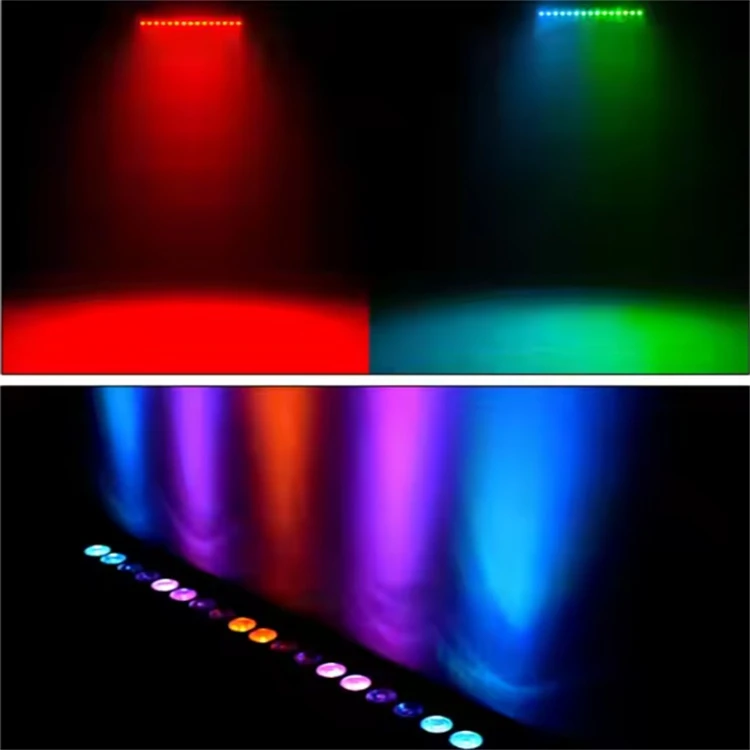
The design logic of a wall washer involves using specialized optical lenses to project light evenly onto a wall or building façade, creating a continuous band of light without dark spots-hence the term "wall washer."
Common application scenarios
RGBW wall washers have a much wider range of applications than many realize, generally falling into the following categories:
Architectural façade lighting: Wall washers are used to outline the silhouettes of commercial buildings, landmarks, and bridges at night. They also allow for color changes based on holidays or events-such as switching to red for National Day or green for Christmas.
Hotels and commercial spaces: Used in lobbies, on exterior walls, and for banquet hall backdrops, wall washers create an atmospheric effect that is more uniform and visually striking than traditional spotlights.
Stage and event lighting: Wall washers are a standard feature in stage lighting design for washing backdrops with color at concerts and product launches, often paired with DMX control systems to enable dynamic color changes.
Retail window displays and exhibition spaces: Brand stores use wall washers to highlight product display areas, utilizing color changes to align with promotional themes or seasonal atmospheres. Landscape lighting projects: For parks, plazas, and riverside landscapes, wall washer lights are used to create large-scale color washes, replacing traditional single-color floodlights.
These scenarios share a common requirement: the need for "large-area, uniform, and color-changing" lighting effects. This is precisely the key advantage of RGBW wall washers over standard floodlights.
Key advantages over RGB wall washers
While the model name differs by only one letter (RGB vs. RGBW), the actual performance differs significantly:
Higher white light purity: Light is emitted directly from a dedicated white LED chip rather than relying on mixing three colors; this results in more stable color temperature and Color Rendering Index (CRI).
Smoother color transitions: Incorporating a white light channel enriches color gradation during dynamic effects, preventing the "banding" or "stepped" look often seen in color transitions.
Broader application versatility: Many commercial projects require colorful effects for festive atmospheres alongside pure white light for standard illumination. A single RGBW fixture can meet both needs, eliminating the need for separate white-light fixtures.
Of course, this also means RGBW fixtures involve slightly more complex drive circuitry and control protocols-a factor to consider during product selection.
Key parameters to consider when purchasing
For purchasers or contractors selecting RGBW wall washers, it is recommended to focus on the following specifications:
IP protection rating: Outdoor architectural lighting requires a minimum of IP65; IP66 or IP67 is recommended for installations near water features or in coastal areas.
Beam angle: Narrow angles (10°–25°) are ideal for accentuating lines on high-rise facades, while wide angles (above 40°) are better suited for uniform wall washing at close range.
Control protocol compatibility: Verify support for DMX512, RDM, or mainstream smart control systems to avoid protocol incompatibility issues during system integration.
Heat dissipation design: High-power LEDs generate significant heat during prolonged operation; poor thermal design directly impacts the rate of lumen depreciation and the fixture's lifespan.
Color consistency (Binning): This refers to controlling color variation between fixtures in the same batch. It is particularly critical for large-scale installations, as noticeable color differences can ruin the overall visual effect.
Considerations for Installation and Use
When implementing a project, there are several easily overlooked details:
Optical simulations should be conducted beforehand to determine the installation angle and fixture spacing; excessive spacing can result in alternating light and dark bands-often called "zebra stripes"-on the wall surface.
For outdoor installations, waterproofing the wiring is crucial-particularly at the daisy-chain connectors between fixtures-as these are common points of failure.
If the project involves synchronized color-changing across multiple groups of fixtures, it is advisable to plan control system zoning and signal transmission distances in advance; signal attenuation must be considered for long-distance cabling.
Conclusion
The widespread adoption of RGBW wall washers in architectural lighting, commercial spaces, and stage performances stems from their ability to deliver both "pure white light" and "rich colors." A single fixture can serve multiple application scenarios, offering significant savings in costs and maintenance effort for both contractors and end-users. Of course, specific product selection should be based on a comprehensive assessment of the project's ingress protection (IP) requirements, control system, and budget; there is no single "best" combination of specifications-only the solution that is "most suitable" for the specific project.
If you are selecting RGBW wall washers for a project or have questions regarding specifications or bulk pricing, please feel free to contact us. We can provide tailored product recommendations and quotations based on your project's specific requirements.
Our address
No. 5-3 Niujiao Road, Yanchuan Community, Yanluo Subdistrict, Bao'an District, Shenzhen
bwzm18@ledbenweilighting.com






