

What is DALI ?
DALI Manual
Digital Addressable Lighting Interface is known as DALI. A lighting system's components may be controlled and can communicate with one another thanks to this two-way protocol.

IEC60929, which dates back to the late 1990s, defines DALI. It has undergone major change since then. DALI-2, which is the current (2020) version, is described in IEC62386. The older DALI-2 logo and the older DALI (version 1) logo.
Both logos are owned by DiiA. The goal of the Digital Illumination Interface Alliance is to expand the market for lighting-control systems based on digital addressable lighting interface technology. It is an open, international association of lighting firms.
All of the top manufacturers provide a huge selection of DALI-enabled lighting control systems, and it is now universally acknowledged as the industry standard for lighting control.
Key attributes of DALI include: 1. It is an open protocol that may be used by any manufacturer.
2. DALI-2's mandated certification processes ensure compatibility across manufacturers.
3. Simple installation. There is no need for shielding when power and control lines are connected together.
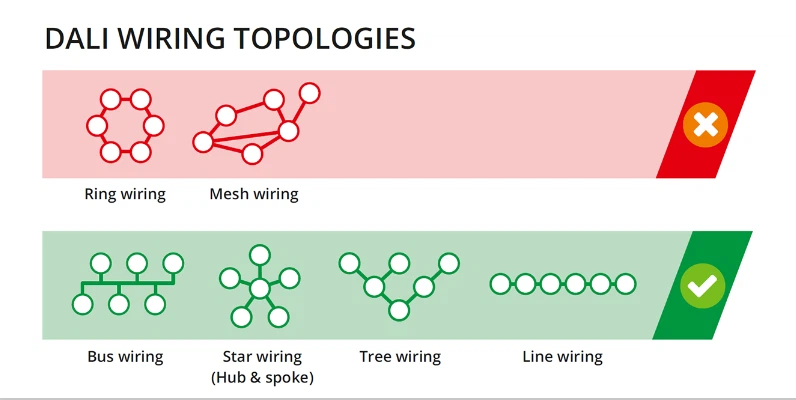
4. A star (hub and spoke), a tree, a line, or any combination of these may be used as the wiring topology.
5. Since communication is digital rather than analogue, numerous devices may receive the exact same dimming values, resulting in exceptionally consistent and accurate dimming performance.
6. Every component in the system has a unique address, providing a vast array of options for customizable control.

HOW DO DALI and 1-10V COMPARE?
DALI was created for and by the lighting industry, much like 1-10V. Lighting control parts with DALI and 1-10V interfaces, such as LED drivers and sensors, are offered by a variety of vendors. But it is the only resemblance there is.
There are some key distinctions between DALI and 1-10V:
DALI may be addressed. This paves the way for numerous beneficial features including grouping, scene-setting, and dynamic control, which allows for things like switching which sensors and switches control which light fixtures in reaction to changes in office layout.
Not analogue, but digital, is DALI. DALI can thus provide far more accurate light level control and more reliable dimming.
Since DALI is a standard, for instance, the dimming curve is specified, allowing for manufacturer-to-manufacturer compatibility of the equipment. Using multiple manufacturers of drivers on the same dimming channel might result in some extremely unpredictable outcomes since the 1-10V dimming curve has never been defined.
Only basic dimming and switching on/off are controlled via 1-10V. DALI is capable of controlling colours, changing colours, testing and providing feedback for emergency lights, creating complex scenes, and doing many other lighting-specific tasks.
CAN I USE ANY DALI PRODUCT WITH ANY OTHER DALI PRODUCT?
Because the standard was so constrained, there were some compatibility issues with the first iteration of DALI. The amount of instructions that could be sent and collision detection were both severely constrained by the fact that each DALI data frame only had 16 bits (8 bits for the address and 8 bits for the command). As a result, a number of manufacturers attempted to increase its capabilities by adding their own features, which led to certain incompatibilities.
This has been addressed with the introduction of DALI-2.
DALI-2 has a significantly wider scope than the original and several features that weren't included in it. As a consequence, the modifications that various manufacturers made to DALI are no longer necessary. Please refer to the section below under "How does DALI work" for a more thorough explanation of the DALI-2 design.
The Digital Illumination Interface Alliance (DiiA), the owner of the DALI-2 mark, has placed stringent restrictions on its usage. The most important of them is that no product may have the DALI-2 mark unless it has gone through a separate certification procedure to ensure that it complies fully with IEC62386.
DALI-2 permits, with certain limitations, the use of both DALI-2 and DALI components in a single installation. This essentially implies that DALI LED drivers—the principal example—can be used in a DALI-2 arrangement.
HOW DO KNX, LON, and BACnet compare to DALI?
Building control protocols like KNX, LON, and BACnet are designed for integrating and managing many systems and devices spread across a building. They cannot be used as lighting control protocols since there are almost no LED drivers on the market that can enable a direct connection to these protocols (although a very limited number of LED drivers are available with a KNX interface).
The DALI-2 command set, on the other hand, has a number of lighting-specific instructions since DALI and DALI-2 were created primarily for lighting control. These include dimming, color-changing, scene-setting, emergency test and feedback, and circadian lighting commands and functions. Particularly LED drivers, a very broad variety of lighting control components offer a direct DALI connection.
In many implementations, a building management system (BMS) would employ KNX, LON, BACnet and related protocols to control the whole building (integrating HVAC, security, access control, elevators, etc.), whereas DALI would be used to handle just the lights. When required, a gateway would allow for intercommunication between the BMS and the lighting system so that, for instance, if an intruder were to be detected by the security system, all of the corridor lights could be turned on through DALI.
How does DALI function?
The basic component of DALI is a bus, which is made up of two wires used to transmit digital control signals from sensors and other input devices to an application controller. To create outgoing signals for devices like LED drivers, the application controller implements the rules it has been designed with.
Power supply unit (PSU) for buses. This element is usually necessary. It keeps the bus voltage steady at the necessary level.
1. Led fixtures. A DALI driver is required for every light fixture in a DALI system. Direct DALI bus orders may be accepted by a DALI driver, who can then act as necessary. The drivers may be DALI or DALI-2 devices, but they will not have any of the additional features included with this most recent version if they are not DALI-2 devices.
2. Input gadgets, such as sensors and switches. These use 24-bit data frames to connect with the application controller. They don't speak with the control devices directly.
3. Examples.A device like a sensor may often house a number of different gadgets. For instance, sensors often include an infrared receiver, a light-level detector, and a movement detector (PIR). The single device contains three instances, which are referred to as instances. Each DALI-2 instance may be addressed to operate a separate lighting group and can be a member of a different control group.
4. Application controllers for control devices. The "brains" of the system are the application controllers. It sends 16-bit orders to the control equipment after receiving 24-bit signals from the sensors (and other devices). The application controller also controls the DALI bus's data flow, monitoring it for collisions and reissuing instructions as required.
DALI IS WIRED HOW?
What topology does DALI employ? Bus, star (hub and spoke), tree, line, or any mix of these topologies may be used with DALI.
Any ring or mesh wiring topology will not function with it.
What voltage does DALI use? DALI needs c16V to operate. A DALI bus, however, is not a SELV. It must thus always be connected using flex or cable that is mains-rated.
Does DALI respond to polarity? Not at all, no. The DALI bus's two wires don't depend on their polarity. LED drivers, for example, often have terminals designated DA, DA on DALI devices.
Is shielding required for DALI wiring? No, it doesn't need protection. There is a high tolerance for voltage fluctuation, a somewhat modest data rate (1,200 baud), and a high bus voltage (16V). Shielding is not necessary because of how resilient the bus is as a result of these variables in the presence of electrical interference.
Which kind of cable or flex is ideal for DALI? Most often, a multi-core cable that also carries mains electricity is used to wire DALI. The two most common cable configurations are 6-core (live, emergency live, earth, neutral, DA, DA) and 5-core (live, earth, neutral, DA, DA).





