In commercial lighting, home lighting, and outdoor lighting scenarios, both light bulbs and corn lights are very common lighting products. Many buyers, renovation professionals, and even ordinary users confuse these two types of lights-both are used for illumination, yet they differ drastically in appearance, performance, and applicable scenarios. Choosing the wrong one can not only affect the lighting effect but also increase energy consumption and later maintenance costs. This article comprehensively breaks down the core differences between light bulbs and corn lights to help you accurately distinguish between them, choose according to your needs, and avoid selection pitfalls.
Appearance and Structure: The Most Obvious Core Difference
The difference between light bulbs and corn lights can be distinguished at first glance by their appearance. This structural difference directly determines their light emission method and applicable scenarios, which is also the first point of focus for many people.
Light Bulb (LED Bulb)
Most of the light bulbs we commonly refer to are LED bulbs. Their appearance continues the shape of traditional incandescent bulbs, generally spherical, pear-shaped, or cylindrical, with a relatively simple structure. The core of the bulb consists of a lamp holder, a heat sink, LED light source chips, and a lampshade. The light source is usually concentrated at the bottom or middle of the bulb. The lampshade is mostly made of frosted or transparent material, encasing the light source for protection and to soften the light. The lamp holder specifications are standardized (commonly E27 and E14), making installation convenient. It can directly replace traditional incandescent bulbs without requiring additional modifications to the lamp holder.
Corn Light
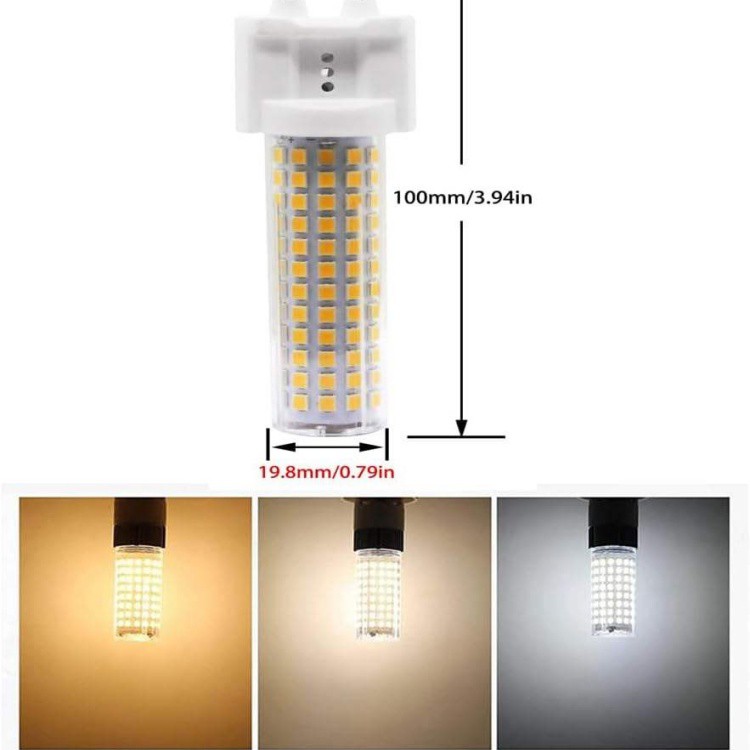
The corn light gets its name from its resemblance to corn kernels-the lamp body is cylindrical, with multiple rows of LED beads evenly arranged on its surface, densely distributed like corn kernels. Its structure is more complex than a light bulb. In addition to the lamp holder and heat sink, it also includes a ring or strip-shaped LED light panel. The LED beads are distributed around the lamp body 360°. Some models are equipped with a transparent protective shell. The overall size is larger than a light bulb of the same wattage, and the heat dissipation structure is also more prominent.
Luminous Characteristics: Differences in Brightness, Angle, and Uniformity
The differences in appearance and structure directly lead to differences in the luminous characteristics of the two types of lamps. Luminous effect is a core consideration when choosing lighting fixtures, especially in commercial settings where the requirements for brightness and uniformity are higher.
Beam Angle
Bulbs have a relatively limited beam angle, mostly between 120° and 180°. They are directional or semi-directional light sources, with the light mainly concentrated in one direction. They are suitable for scenarios requiring localized lighting, such as table lamps, bedside lamps, and spotlight replacements. They cannot achieve 360° omnidirectional illumination.
Corn lamps, on the other hand, have a beam angle of up to 360°. The LED beads are evenly distributed around the lamp body, allowing the light to diffuse in all directions without obvious dark areas. They are omnidirectional, achieving large-area uniform illumination. This is the most fundamental difference between corn lamps and bulbs.
Brightness and Uniformity
At the same wattage, corn lamps are generally brighter than bulbs. Because corn-shaped LED lights have more LEDs and a denser distribution, they have higher light utilization and 360° illumination without blind spots, resulting in better lighting uniformity and avoiding the "bright center, dark periphery" phenomenon. In contrast, bulbs, limited by their shades and beam angles, produce concentrated light with noticeable brightness at the edges, resulting in poorer uniformity.
Core Performance: Differences in Energy Consumption, Lifespan, and Compatibility
Besides appearance and lighting effects, the energy consumption, lifespan, and compatibility of the lights directly affect usage costs and user experience. These are key dimensions compared during industry procurement, and the differences between the two are significant.
Energy Consumption Performance
Both are LED lights, and their energy consumption is far lower than traditional incandescent bulbs. However, at the same brightness, corn-shaped LED lights consume slightly less energy than bulbs. This is because corn-shaped LED lights have a more rational LED arrangement, better heat dissipation, and a higher energy conversion rate. At the same brightness, corn-shaped LED lights can save 10%-20% of electricity, effectively reducing electricity costs over the long term, making them particularly suitable for large-scale, mass-use applications.
Lifespan
The lifespan of a light bulb is typically 20,000-30,000 hours, while a corn bulb can last over 50,000 hours. The core reason is that corn bulbs have a more efficient heat dissipation structure. The dispersed arrangement of the LEDs allows for rapid heat dissipation, reducing chip aging. In contrast, the concentrated light source of a light bulb results in relatively poor heat dissipation, leading to faster brightness decay and a shorter lifespan over time.
Compatibility
Light bulbs offer greater compatibility. Their standardized base specifications allow for direct replacement of traditional incandescent and energy-saving bulbs without requiring socket modifications. This makes them suitable for quick upgrades in homes and small shops, and installation is convenient, requiring no professional assistance.
Corn bulbs have more specific compatibility requirements. They often use large-sized bases such as E27 and E40, and some require specialized bases or brackets. They are more suitable for large-area lighting applications such as industrial plants, warehouses, outdoor streetlights, and large shopping malls. Simple modifications may be required during installation, making them more suitable for bulk purchases and installations.
Applicable Scenarios: Precisely Matching Different Lighting Needs
Based on the differences mentioned above, the applicable scenarios for both types of lights are clearly defined. Choosing the right light fixture according to your needs will maximize its value and avoid selection errors, which is where many users easily make mistakes.
Applicable Scenarios for Bulbs: Primarily designed for localized lighting and easy replacement, suitable for small-area, low-brightness scenarios:
Home Scenarios: Living room table lamps, bedroom bedside lamps, kitchen localized lighting, hallway lights;
Small Commercial Scenarios: Convenience store checkout counters, small clothing store shelves localized supplemental lighting;
Temporary or Renovation Scenarios: Scenarios requiring quick replacement of traditional light fixtures without complex installation.
Applicable Scenarios for Corn Lights: Primarily designed for large-area, high-brightness, omnidirectional lighting, suitable for scenarios requiring high uniformity:
Industrial Scenarios: Large-area lighting in factories, warehouses, workshops, etc.;
Outdoor Scenarios: Community streetlights, park courtyard lights, parking lot lighting;
Large Commercial Scenarios: Large supermarkets, shopping malls, exhibition halls, stadiums, etc., large-area uniform lighting.
Summary
In summary, the core difference between light bulbs and corn lamps lies in the distinction between "local lighting" and "large-area omnidirectional lighting." Neither is inherently superior; the key is matching your specific lighting needs. The core differences can be summarized as follows: light bulbs are convenient and widely adaptable, suitable for local lighting; corn lamps are bright, uniform, and have a long lifespan, suitable for large-area omnidirectional lighting.
If you are still unsure how to choose between light bulbs and corn lamps for your specific scenario, or if you need to purchase suitable lighting products in bulk, please feel free to contact our professional team. We not only offer high-quality LED bulbs and corn lights, but also provide one-on-one selection guidance and customized procurement solutions based on your specific needs (home, industrial, outdoor, etc.) to help you reduce procurement costs and improve lighting effects. Contact us now to unlock cost-effective lighting solutions!
www.benweilighting.com/professional-lighting/corn-light/mini-g12-led-corn-bulb-light.html
Our address
No. 5-3 Niujiao Road, Yanchuan Community, Yanluo Subdistrict, Bao'an District, Shenzhen
benwei10@benweilighting.com