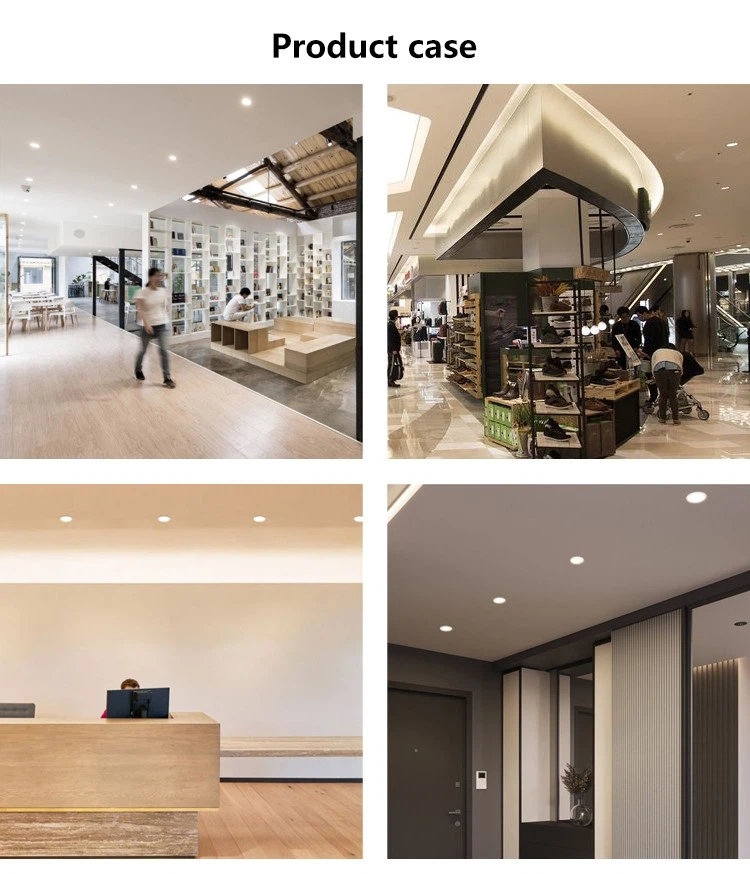
When designing indoor lighting for residential, commercial, and office spaces, downlights and panel lights are two of the most widely used recessed lighting solutions. At first glance, they look quite similar; both are installed flush into the ceiling, deliver clean modern lighting, and can replace traditional bulky ceiling fixtures.
However, many buyers, contractors, and interior designers fail to distinguish their core differences in light distribution, installation requirements, lighting performance, and application scenarios. Choosing the wrong fixture often leads to uneven brightness, poor spatial layering, wasted budget, or unsatisfactory lighting effects. To help you make accurate lighting selections, this article clearly explains the differences, pros and cons, and suitable usage scenarios of downlights and panel lights.
1. Basic Overview: What Are Downlights and Panel Lights?
What is a Downlight?
A downlight, also known as a recessed ceiling light, is a point-source lighting fixture that is embedded into the ceiling. It is mostly circular with a compact opening, hiding most of the body inside the ceiling for a minimalist and integrated look.
Downlights deliver focused downward lighting. They are extremely versatile, working well for both ambient background lighting and targeted task lighting. Therefore, they are commonly used in living rooms, kitchens, hallways, bathrooms, and bedrooms for modern home decoration.
What is a Panel Light?
A panel light is a flat, ultra-thin surface lighting fixture, mainly designed in square and rectangular shapes. Adopting advanced light guide and diffuser technology, panel lights produce uniform, soft, and shadow-free surface lighting with a wide coverage area.
Different from point-type downlights, panel lights focus on overall space illumination. They are widely installed in offices, schools, hospitals, supermarkets, and large public areas that require consistent and bright general lighting. In addition, panel lights feature high energy efficiency, effectively reducing long-term electricity costs.
Core Differences Between Downlights and Panel Lights
Light Distribution & Lighting Effect
Downlights provide directional, concentrated point lighting. The light beam is focused with clear light layers, which can highlight local areas and create spatial depth. This feature makes downlights perfect for accent lighting and task lighting.
Panel lights offer wide-angle, diffused surface lighting. The light spreads evenly across the entire space without obvious dark areas or glaring spots. They ensure overall uniform brightness and are ideal for full-room general illumination.
Installation Requirements
Both fixtures require ceiling cutting and recessed installation, but their space requirements differ greatly. Downlights need enough vertical ceiling depth for internal placement. For ceilings with limited height, installing multiple downlights may face structural restrictions.
Panel lights demand larger horizontal installation space due to their flat and large-area design. They are not suitable for narrow corridors or small ceilings where layout is limited.
Design & Aesthetic Performance
Downlights feature a tiny opening and low-key appearance, blending naturally with ceiling decoration without breaking the overall interior style. Many adjustable downlights can flexibly target specific lighting angles for customized decoration effects. They come in various sizes and styles to match diverse home designs.
Panel lights have a larger visible area, making them more architectural and noticeable. They can simplify ceiling decoration and create a neat, high-end, and tidy commercial space atmosphere. Besides regular square and rectangular shapes, panel lights are also available in round and hexagonal styles for personalized design needs.
Pros and Cons of LED Downlights
Pros
Flexible point lighting creates rich light and shadow layers
Supports local accent lighting and task lighting
Mini and concealed design fits most home decoration styles
Various sizes, colors, and adjustable beam angles for options
Cons
Multiple units are required for full-room illumination
Demands higher vertical ceiling depth for installation
Pros and Cons of LED Panel Lights
Pros
Ultra-wide uniform lighting with no dark zones or harsh glare
High energy efficiency, effectively lowering long-term power consumption
Ultra-thin body saves ceiling space with simple installation
Perfect for large-area and high-brightness lighting scenarios
Cons
Lack of light layering, unable to achieve partial accent lighting
Large size limits application in narrow or small ceilings
How to Choose: Downlight or Panel Light?
Choose Downlights if: You need layered interior lighting, local accent lighting, or task lighting for residential spaces, including living rooms, bedrooms, kitchens, display areas, and hallways. Downlights are the best choice for creating a comfortable and textured home atmosphere.
Choose Panel Lights if: Your project requires stable, uniform, and high-brightness general lighting for large and flat spaces, such as offices, classrooms, hospitals, shopping malls, and public corridors. Panel lights ensure consistent brightness and better energy-saving performance.
Summary
To put it simply, downlights focus on layered and focused local lighting, while panel lights focus on uniform and efficient overall lighting. There is no absolute good or bad between the two fixtures - the best choice depends entirely on your space size, lighting purpose, and decoration style.
For home decoration that pursues a sense of hierarchy and localized lighting, downlights are more suitable. For commercial and public spaces that prioritize high brightness, uniformity, and energy saving, panel lights are more practical and cost-effective.
Looking for high-quality LED downlights and panel lights for your project or wholesale business? We provide a full range of size, color temperature, and CRI customization solutions. All products feature stable performance, high brightness, low power consumption, and long service life. Feel free to contact us for product parameters, wholesale quotations, and professional lighting layout solutions!
|
Power |
4W/6W/9W/12W/16W/18W/24W |
| Luminous effiency | 110-120lm/W |
| Color Temperature(CCT) | 3000K,4000K,5000K,6000K |
|
Input Voltage(V) |
85-265V,100-277VAC |
|
Warranty(Year) |
5Year |
|
Shape |
Round |
|
PF |
>0.9 |
|
Lifespan (hours) |
>50000 |
|
Material |
Aluminum +PMMA |
| Frame Cover | White |
|
Certification |
TUV,CE, ROHS |