

Definition and Scope of Lifespan Metrics
The lifespan of a T8 LED tube light is not a single number but a statistical parameter defined by industry standards (IESNA LM‑80, TM‑21). The most commonly cited metric is L70, the operating time at which the luminous flux declines to 70% of its initial value. A nominal rating of 50,000 hours means that, under specified test conditions, 90% of a large sample population will maintain at least 70% of initial lumens after 50,000 hours (B10, L70). For comparison, a conventional T8 fluorescent tube typically has an L70 of 15,000–20,000 hours, though fluorescent lamps often fail catastrophically (ballast or electrode burnout) rather than gradual lumen depreciation.
In LED engineering, two additional metrics are relevant:
L80 (time to 80% lumen maintenance) – typically 70–80% of L70.
Useful lifetime – defined by end‑of‑life criteria such as driver failure (electrolytic capacitor degradation) or catastrophic LED failure. Many T8 LED tubes reach driver end‑of‑life before L70 due to thermal stress on the power supply. Thus, the system lifetime is the minimum of LED chip maintenance and driver reliability.
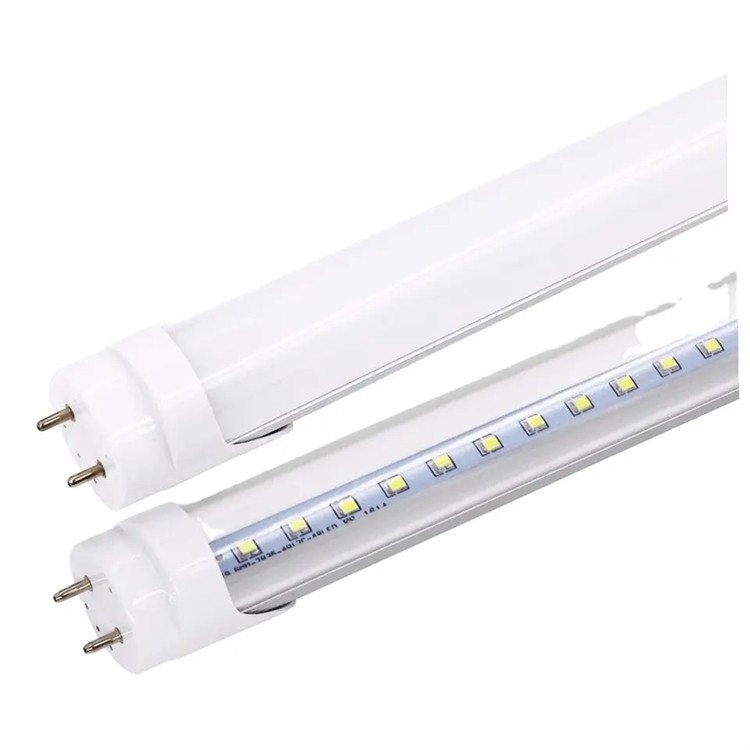
Average Rated Lifespan and Comparative Benchmarks
The vast majority of reputable T8 LED tubes marketed for general lighting (4000K–5000K, 120–150 lm/W) are rated at 50,000 hours L70. At a typical daily use of 8 hours (e.g., office or warehouse lighting), this translates to approximately 17.1 years (50,000 ÷ (8 × 365) ≈ 17.1). In continuous operation (24/7) such as cold storage or parking garages, the same tube would last about 5.7 years.
Product surveys show a wide spread:
Economy (no‑name brands) : Claimed 30,000–35,000 hours, but actual L70 often <20,000 hours due to inferior LED packages and poor thermal design.
Standard mid‑tier : 50,000 hours (e.g., Philips, Osram, GE).
Premium high‑life : 70,000–100,000 hours, achieved with ceramic‑based LED packages, active cooling fins on the tube housing, and remote phosphor technology.
Fluorescent T8 lamps (e.g., 32W T8) have a typical rated life of 20,000–30,000 hours under 3‑hour switching cycles, but frequent on/off cycles (e.g., occupancy sensors) reduce fluorescent life sharply, whereas LED tubes are largely unaffected by switching frequency.
Determinant Factors Affecting T8 LED Tube Lifespan
Intrinsic Parameters: LED Chip Quality and Packaging
The LED chip itself is the primary light source. High‑quality chips (e.g., from Nichia, Cree, Samsung, Lumileds) employ:
GaN‑on‑SiC or GaN‑on‑GaN substrates for reduced threading dislocation density (<10⁶ cm⁻²) compared to low‑cost GaN‑on‑sapphire (defects >10⁸ cm⁻²).
Phosphor formulation – premium chips use ceramic or glass‑encapsulated phosphor that resists thermal quenching and humidity ingress. Low‑cost chips often use organic silicone‑based phosphor that yellows or delaminates after 10,000 hours, causing colour shift (Δu'v' >0.007) and efficacy drop.
Field data indicate that an LED tube using uncertified chips can experience 30% lumen loss by 10,000 hours – effectively failing L70 at 15,000 hours instead of 50,000.
For a T8 LED tube (diameter 26 mm), the linear geometry limits heat sink area. Quality tubes embed LED strips on an aluminium‑core PCB (MCPCB) that is thermally coupled to the aluminium tube body via thermal grease. Poor designs use a thin flexible PCB (no metal core) and rely solely on natural convection from the plastic tube – resulting in junction temperature (Tj) of 95 °C or higher.
According to the Arrhenius model, every 10 °C reduction in Tj doubles lifetime. A well‑designed tube keeps Tj ≤75 °C at 25 °C ambient, achieving L70 >70,000 hours. A poor design with Tj =95 °C may achieve only 25,000 hours even with the same LED chips.
Operating Environment: Temperature, Humidity, and Contaminants
Manufacturers specify a permissible ambient range, typically –20 °C to +45 °C. Exceeding these limits degrades the tube in distinct ways:
Below –20 °C: Electrolytic capacitors in the driver lose capacitance (electrolyte freezing), leading to high ripple current, flicker, and eventual driver failure. Some premium tubes use solid polymer capacitors rated to –55 °C.
Above +45 °C: The LED junction temperature rises beyond the design point. Even a 5 °C increase in ambient can raise Tj by 8–10 °C, halving L70 per the 10 °C rule. In enclosed luminaires (e.g., troffers with no ventilation), ambient inside the fixture can reach 60 °C, accelerating lumen depreciation by factor 3–4.
Moisture ingress causes:
Electrochemical migration on the LED PCB, forming dendrites that short circuit traces.
Corrosion of silver‑plated lead frames inside the LED package, increasing contact resistance and causing open circuits.
For environments with >80% RH or condensing humidity (e.g., swimming pools, unventilated basements), a T8 LED tube must have IP65 or higher rating (sealed end caps with gaskets). Standard IP20 tubes (open end caps) will fail within 6–12 months under such conditions.
Corrosive agents (H₂S, SO₂, Cl₂) – common in wastewater treatment plants or industrial chemical storage – attack the reflective silver layer inside LED packages, turning it black (tarnishing) and reducing light output by 50% in as little as 2,000 hours. Tubes with gold‑plated lead frames or conformal coating are required for these environments.
Electrical and Driver‑Related Factors
The internal LED driver converts line voltage (AC 120–277 V or 220–240 V) to constant current (typical 60–120 mA per string). Lifetime‑limiting components are:
Electrolytic capacitors – rated for 5,000–10,000 hours at 105 °C. Under actual operating conditions (driver internal temperature 70 °C), a good capacitor may last 50,000 hours, but a cheap capacitor (85 °C rating) will fail at 15,000–20,000 hours.
MOSFETs and rectifier diodes – subject to voltage spikes from power line surges. Without sufficient surge protection (e.g., varistor or TVS diode), a single lightning‑induced transient can destroy the driver instantly.
Driverless (linear) T8 LED tubes – which use a simple resistor‑capacitor dropper – have no electrolytic capacitors and thus can theoretically last longer. However, they suffer from poor power factor (PF <0.5), high harmonic distortion, and sensitivity to line voltage fluctuations, which cause excessive LED current and overheating.
Operating a T8 LED tube outside its specified voltage range (e.g., 120 V tube on 277 V line) will overdrive the LEDs, raising current and temperature dramatically – leading to catastrophic failure within hours. Conversely, undervoltage may cause the driver to enter a hiccup mode or brownout, damaging the input rectifier.
If the tube is dimmable (0‑10 V or phase‑cut), using an incompatible dimmer (e.g., leading‑edge triac with a trailing‑edge driver) can produce oscillation, audible noise, and elevated driver temperature, reducing lifespan by 30–50%.
Installation and Mechanical Integrity
T8 LED tubes are designed as direct replacements for fluorescent tubes in existing fixtures, but with important caveats:
Ballast bypass (Type B) tubes require removal of the fluorescent ballast and direct wiring of mains to the tube's end caps. If the ballast is left in place (Type A or hybrid tubes that work with ballasts), a failing ballast can output high voltage spikes (up to 1,000 V) that destroy the LED driver.
Shunted vs. non‑shunted tombstones – Type B tubes need non‑shunted lampholders (separate contacts for line and neutral). Shunted tombstones (common in instant‑start fluorescent fixtures) create a short circuit when used with LED tubes, causing immediate driver damage.
T8 LED tubes are more robust than glass fluorescent tubes, but excessive vibration (e.g., near heavy machinery or overhead doors) can loosen solder joints on the LED strips or cause the aluminium‑core PCB to fatigue. Vibration‑rated tubes use flexible silicone‑encapsulated strips and strain‑relief end caps. For high‑vibration environments (garages, car washes), a T8 LED tube with IP65 and silicone potting is recommended.
Quantitative Models for Lifespan Estimation
LM‑80 test data (6,000–10,000 hours at three case temperatures) are extrapolated using TM‑21 to predict L70 at 25 °C ambient. The formula:
text
L70 = t_test × 10^((T_test - T_use) / θ)
where θ is the Arrhenius activation energy for the specific LED package (typically 0.3–0.5 eV). For a tube operating at T_case = 65 °C vs. test at 85 °C, the lifetime multiplier can be 3–5×. Reputable manufacturers publish TM‑21 reports; economy brands do not.
Assume an LED tube with LM‑80 data: at 85 °C, time to 70% lumen maintenance is 25,000 hours. Activation energy 0.35 eV. Ambient 25 °C, measured T_case = 65 °C. The acceleration factor (AF) from 85 °C to 65 °C is:
AF = exp[(Ea/kB) × (1/T_use – 1/T_test)]
where Ea = 0.35 eV, kB = 8.617×10⁻⁵ eV/K, T in Kelvin.
T_test = 85+273 = 358 K, T_use = 65+273 = 338 K.
AF = exp[(0.35 / 8.617e-5) × (1/338 – 1/358)] ≈ exp[4062 × (0.002958 – 0.002793)] = exp(4062 × 0.000165) = exp(0.670) ≈ 1.95.
Thus, predicted L70 = 25,000 × 1.95 ≈ 48,750 hours – very close to the 50,000 h rating.
Recommended Practices to Maximise Lifespan
Selection Criteria for Purchasers
Look for the following marks on the product or datasheet:
UL 1598C (USA/Canada) for LED retrofits.
EN 62776 (Europe) for double‑capped LED tubes.
LM‑80 and TM‑21 reports from a recognised laboratory (e.g., UL, VDE, TÜV).
Avoid tubes that only provide "50,000 h" as a marketing claim without supporting data.
A high‑lifespan T8 LED tube will have:
Visible heat sink fins or an aluminium housing that is exposed (not covered by a plastic diffuser that insulates).
A warranty period of at least 5 years. Shorter warranties (<3 years) correlate strongly with early driver failures.
Operational and Maintenance Guidelines
Ensure ambient temperature stays within the rated envelope. For enclosed fixtures, consider using T8 LED tubes rated for "enclosed luminaire" operation (driver specifically designed for higher internal temperatures).
Keep end caps clean and dry. If moisture is present, use IP65 tubes with silicone sealing.
Replace shunted tombstones with non‑shunted types when converting from fluorescent ballast to direct mains wiring.
Use a surge protective device (SPD) at the panel if the site experiences frequent lightning or power grid transients.
Conclusion: Synthesising the 50,000‑Hour Benchmark
Summary of Deterministic Limits
The nominal lifespan of a T8 LED tube light is 50,000 hours (L70) under optimal conditions: good quality LED chips, driver with electrolytic capacitors rated for 105 °C, aluminium housing for heat dissipation, ambient temperature 25 °C, no humidity extremes, and correct electrical installation. Under less favourable but still common conditions (enclosed fixture, 35 °C ambient, daily 12‑hour operation), the effective lifespan may drop to 25,000–35,000 hours. In harsh environments (high humidity, corrosive gases, >45 °C), even premium tubes may fail before 15,000 hours.
For any commercial or residential application requiring long‑life lighting, do not rely on the advertised 50,000 h alone. Require LM‑80/TM‑21 documentation, inspect the thermal path, and match the tube's environmental rating (IP, temperature range) to the installation site. With proper selection, a T8 LED tube will outlast three generations of fluorescent lamps and deliver a total cost of ownership that is 60–70% lower over a 15‑year period. However, ignoring the factors detailed above will result in premature failure and a poor return on investment.

How To Cooperate With Us?
Our firm prides itself on owning its own factory, guaranteeing complete control over the production process and the quality of our goods. We are not only agents; we are manufacturers committed to offering our clients the most competitive rates available. We invite consumers to evaluate our samples first, as we are assured that the quality and pricing of our items are self-evident. Our dedication to excellence and client satisfaction compels us to consistently perform at our best and provide superior quality products.
Our address
3rd Floor, 5th Building, Hebei Industrial Park, Hualian Community, Longhua District, Shenzhen, China





