

Construction site lighting refers to a specialized auxiliary safety lighting system set up for construction operation scenarios, which is an indispensable core part of construction site safety management and on-site construction guarantee system. Different from ordinary civil and commercial lighting systems, construction site lighting has distinct characteristics of mobility, temporariness, environmental adaptability and operational pertinence. Construction sites are typical complex operation scenarios with open-air environment, variable working conditions, scattered operation points and frequent personnel and mechanical flow. Sufficient and standardized lighting can eliminate visual blind areas, reduce operational misjudgment, and effectively warn personnel of potential safety hazards such as foundation pits, trenches, mechanical passages and high-altitude operation areas. Reasonable lighting layout not only guarantees the visual operation conditions of construction workers in day and night shift construction, but also improves the overall construction efficiency, standardizes on-site operation order, and provides basic technical support for realizing safe, high-quality and efficient construction of engineering projects. This paper systematically expounds the core connotation, main classification, influencing factors of layout and optimal application strategies of construction site lighting.
Core Connotation and Functional Value of Construction Site Lighting
Basic Definition of Construction Site Lighting
Construction site lighting is a temporary professional lighting system customized for building construction, municipal engineering, road and bridge engineering and other construction scenarios. It takes on-site construction safety guarantee as the core goal, covers full-area environmental illumination and fixed-point operational auxiliary lighting, and adapts to the complex and changeable construction site environment. The system is composed of lighting fixtures, light source equipment, power supply lines and fixed installation structures, which can dynamically adjust the layout and power according to the construction progress, operation area conversion and environmental changes, so as to meet the lighting requirements of all construction stages and all operation types.
Core Functional Value of Standardized Lighting System
The functional value of construction site lighting is mainly reflected in two dimensions of safety guarantee and construction efficiency improvement. In terms of safety management, effective lighting can eliminate visual obstacles in low-light environments, avoid safety accidents such as falls, collisions, mechanical injuries and trench falling accidents caused by insufficient light, and improve the overall safety management level of the construction site. In terms of construction operation, stable and uniform lighting provides accurate visual conditions for workers to complete concrete pouring, pipeline laying, electrical installation, steel bar binding and other refined operations, reduces operation errors and construction quality defects, and ensures the standardization and accuracy of on-site construction. In addition, perfect lighting conditions support 24-hour continuous construction operation, effectively shorten the project construction cycle and ensure the project is delivered on schedule.
Systematic Classification and Functional Characteristics of Construction Site Lighting
General Ambient Lighting for Overall Site Coverage
General lighting, also known as ambient lighting, is the basic lighting module of the construction site lighting system, which undertakes the full-area uniform lighting task of the whole construction site. This type of lighting mainly adopts large-area coverage lighting equipment such as floodlights, outdoor spotlights and high-bay industrial lamps, which are installed on high poles, tower cranes and peripheral support structures of the site. The core design purpose of general lighting is to eliminate the overall dark area of the construction site, realize continuous and uniform illumination of the construction area, passage area and stacking area, and meet the basic walking, patrol inspection and overall on-site management lighting needs. With the characteristics of wide coverage, high power and long irradiation distance, it is the basic guarantee for the normal development of all on-site activities.
Special Task Lighting for Fixed-Point Operation Scenarios
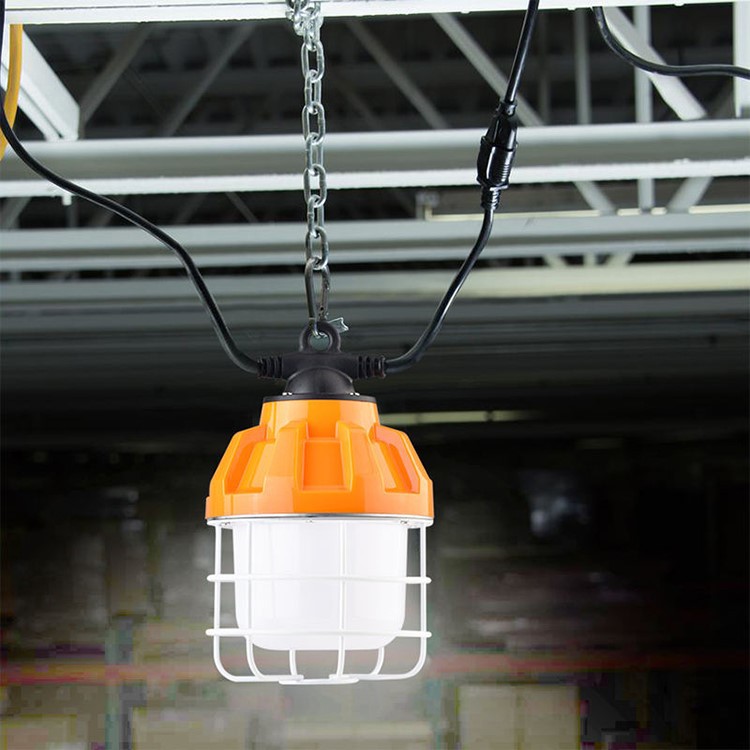
Task lighting is a targeted auxiliary lighting set for specific construction operation areas and refined construction processes, which makes up for the deficiency of local illumination accuracy of general lighting. Different from the wide-range diffuse lighting of general lighting, task lighting focuses on providing high-brightness, focused and directional illumination for key operation points. Common equipment includes portable mobile work lights, handheld construction lights, vehicle-mounted auxiliary lighting lamps and wall-mounted fixed task lights. It is widely used in narrow operation scenarios such as foundation pit excavation, pipeline trench construction, internal electrical installation of buildings, steel structure welding and concrete surface finishing. It can effectively eliminate local shadow areas, ensure the clarity of operation vision, and provide lighting support for high-precision construction operations.
Emergency Lighting for Risk Response and Accident Rescue
Emergency lighting is a key safety guarantee module of the construction site lighting system, which is specially used for emergency illumination under abnormal working conditions such as sudden power failure, equipment failure and natural disaster impact. Different from conventional lighting, emergency lighting equipment is mainly powered by built-in storage batteries, with automatic switching function of power failure. Under normal power supply conditions, the equipment is in standby charging state; when the construction site suffers sudden power outage, line failure and other emergencies, the emergency lights will be automatically turned on in real time. This type of lighting is mostly installed on site passage poles, wall surfaces of temporary buildings and key evacuation passages, which can provide continuous and stable emergency illumination for personnel evacuation, on-site rescue and fault troubleshooting, and minimize personnel safety risks and property losses caused by sudden lighting failure.
Key Influencing Factors of Construction Site Lighting Layout
Project Scale and Construction Complexity
The scale and functional complexity of the construction project are the primary basis for the overall planning of the lighting system. For large-scale construction projects with wide operation area, scattered functional partitions and multiple cross-operation processes, it is necessary to match multi-point distributed general lighting equipment, and set up independent task lighting modules for different operation partitions separately. For small and medium-sized single-building construction projects, the lighting layout can be appropriately optimized and integrated on the premise of meeting the illumination standard, so as to avoid equipment redundancy and resource waste. The complex construction links such as high-altitude operation, underground trench construction and mechanical synchronous operation also require hierarchical and classified lighting design to adapt to diversified operation needs.
Time Period and Environmental Condition Changes
Construction lighting layout needs to fully adapt to the changes of natural light conditions in different time periods. In daytime construction, natural light can be fully utilized, and auxiliary task lighting is only supplemented for indoor dark areas, foundation pits and other light-deficient areas. In night construction, it is necessary to start the full-coverage general lighting system, and cooperate with high-brightness task lighting to ensure that the illumination intensity of all operation areas meets the national construction safety standards. At the same time, bad weather conditions such as fog, rain and dust will reduce light transmittance, so the lighting power and layout density need to be dynamically adjusted to ensure the stability of on-site illumination effect.
Differences in On-Site Construction Processes
Different construction processes and operation types have distinct requirements on lighting form, illumination intensity and installation position. For open and large-area operations such as concrete pouring and earthwork backfilling, overhead high-pole floodlights with wide coverage are required to ensure continuous lighting of the operation surface. For refined operations such as electrical component installation, circuit debugging and internal decoration construction, wall-mounted embedded lights and portable close-range task lights are needed to avoid light shadow affecting operation accuracy. The differentiated lighting demand of working procedures determines the diversified collocation mode of construction site lighting equipment.
Light Source Selection and System Optimization Strategy
Advantages of LED Light Source in Construction Lighting
In the current construction site lighting system, LED light sources have gradually replaced traditional halogen lamps, fluorescent lamps and incandescent lamps and become the mainstream configuration. LED lighting equipment has significant technical advantages such as high energy efficiency, ultra-long service life, strong structural durability and low heat generation. Compared with traditional light sources, LED lamps can reduce energy consumption by more than 50%, which greatly reduces the power operation cost of the construction site. Meanwhile, its shockproof and drop-resistant structural characteristics adapt to the harsh mobile operation environment of construction sites, avoiding frequent equipment damage and replacement. In addition, the low heat generation characteristic of LED light sources can reduce the hidden danger of high-temperature ignition in special construction scenarios and improve the safety level of the lighting system.
Overall Optimization Strategy of Lighting System
The optimization of construction site lighting system needs to adhere to the principles of safety standardization, high efficiency and energy saving, and dynamic adaptability. In the overall layout, hierarchical coverage design is adopted to realize the organic combination of full-area general lighting, regional task lighting and key emergency lighting, eliminating lighting blind areas and overlapping illumination waste. In equipment management, according to the construction progress and operation area conversion, the lighting equipment position and power are dynamically adjusted to ensure the matching degree between lighting configuration and on-site operation demand. At the same time, strengthen the daily maintenance of lighting equipment and lines, regularly check the battery performance of emergency lights and the integrity of lighting fixtures, to ensure the long-term stable operation of the whole lighting system.
Conclusion
Construction site lighting is a systematic safety guarantee system integrating environmental illumination, operational assistance and emergency risk prevention, which plays an irreplaceable role in standardizing on-site construction management, ensuring personnel operation safety and improving project construction efficiency. The construction site lighting system is mainly composed of general ambient lighting, professional task lighting and safety emergency lighting, with clear functional division and complementary advantages. The layout and configuration of the lighting system need to comprehensively consider the project scale, construction complexity, environmental conditions and process operation differences. The reasonable selection of high-efficiency and durable LED light sources and the implementation of dynamic optimized layout can further improve the scientificity and economy of the lighting system. A scientific and standardized construction lighting system is an important prerequisite for realizing safe, orderly, efficient and high-quality construction of engineering projects, and is the key basic guarantee for the smooth completion of project construction tasks on schedule and within budget.

How To Cooperate With Us?
Our firm prides itself on owning its own factory, guaranteeing complete control over the production process and the quality of our goods. We are not only agents; we are manufacturers committed to offering our clients the most competitive rates available. We invite consumers to evaluate our samples first, as we are assured that the quality and pricing of our items are self-evident. Our dedication to excellence and client satisfaction compels us to consistently perform at our best and provide superior quality products.
Our address
3rd Floor, 5th Building, Hebei Industrial Park, Hualian Community, Longhua District, Shenzhen, China





