

One of the most common queries I get as an LED tube light provider is about an LED tube light's maximum wattage. Customers must answer this question since it directly affects their lighting needs, energy use, and the overall cost-effectiveness of their lighting solutions. In this article, I'll examine the variables that affect LED tube lights' maximum wattage, look at the normal market ranges, and talk about how it affects your lighting decisions.
Factors Influencing LED Tube Light Maximum Wattage
1. The dissipation of heat
The adversary of LED lights is heat. Electrical energy is transformed into light by LEDs, but a significant amount of that energy is also transformed into heat. The LEDs may overheat and have a shortened lifetime, colour change, or even failure if the heat produced is not adequately drained.
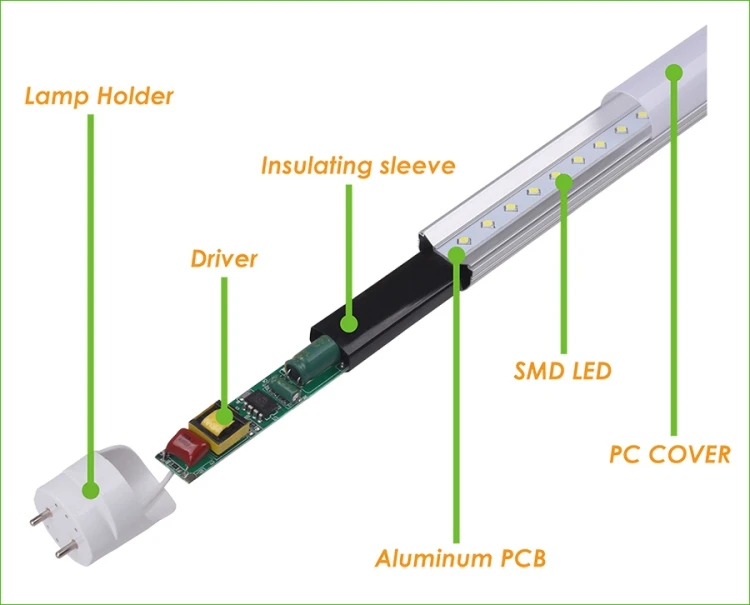
The maximum wattage of an LED tube lamp is mostly determined by the design of its heat sink. The tube light may run at greater wattages if a well-designed heat sink effectively transfers heat away from the LEDs. For instance, aluminium heat sinks with finned shapes are used in certain high-end LED tube lights to improve heat dissipation by increasing surface area.
2. Technology for Drivers
The part that controls the electrical current passing through the LEDs is called the driver. It guarantees a steady and suitable power supply for the LEDs. Higher wattages won't cause a high-quality driver to overheat or fail.
Modern driver technologies are more effective in supplying power to the LEDs, such as constant-current drivers. The LED tube light can safely run at its maximum wattage thanks to its ability to modify the current in response to temperature and other variables.
3. Quality of LED Chips
The maximum wattage is also influenced by the quality of the LED chips utilised in the tube light. Superior LED chips can provide more light per watt and manage more power. They also have a longer lifetime and are more heat-resistant.
Different grades of LED chips are often used by manufacturers, and the maximum wattage for a given LED tube light may be determined by the choice of chips. For example, chips from reputable manufacturers that are intended for high-power applications are used in certain high-end LED tube lights.
Typical Market Maximum Wattage Ranges
1. Conventional T8 LED Tube Lights
One of the most popular kinds of LED tube lights is the T8 model. Both household and commercial lighting applications make extensive use of them. Standard T8 LED tube lights typically have a maximum power between 18 and 36 watts.
These tube lights are appropriate for common lighting applications, including retail establishments, workplaces, and schools. For instance, a small to medium-sized room may be adequately illuminated by an 18W 4FT LED T8 Tube Light.
2. T8 LED Tube Lights with High Output
High-output T8 LED tube lights are available for applications that need more lighting. The highest power of these tube lights is 54W, or often even more.
Large warehouses, industries, and sports facilities often employ high-output T8 LED tube lights. They are perfect for places where high-intensity lighting is required since they can provide a lot brighter light than regular T8 tube lights.
3. LED tube lights with specific features
Additionally, there are LED tube lights that are specifically made for certain uses. The wattage of the Fresh LED T8 Tube Light, for instance, varies according on the model and is intended to provide a more natural and healthful light.
Another specialised kind is the IP66 T8 Waterproof LED tube light. It might have a maximum wattage appropriate for its intended usage and is made for outdoor or damp conditions. In order to provide sufficient brightness, these tube lights must be able to endure challenging circumstances.
Maximum Wattage's Effect on Lighting Selections
1. Lighting Conditions
The quantity of light that an LED tube light can generate is directly impacted by its maximum wattage. You may need to choose a tube lamp with a larger maximum wattage if you need to light a vast area.
For instance, high-wattage LED tube lights would be required if illuminating a warehouse in order to guarantee that the whole space is well-lit. However, a lower-wattage tube light can be enough for a tiny closet or corridor.
2. Use of Energy
LED tube lights with higher wattages use more energy. Even though LED lights are often more energy-efficient than conventional lighting sources, energy consumption should still be taken into account when selecting a tube light.
You can wish to select a tube lamp with a lesser wattage that yet satisfies your lighting needs if you want to save your energy expenses. For instance, you may produce comparable levels of lighting in a small room using an 18W LED tube light rather than a 36W one.
3. Price
The maximum wattage of an LED tube lamp also affects its price. Because higher-wattage tube lights utilise better heat sinks, drivers, and LED chips, they are often more costly.
But it's crucial to take the long-term cost into account. Long-term cost savings might be achieved by using a higher-wattage tube light as it could last longer and provide more light. For instance, a high-quality 54W LED tube light could be more expensive initially, but over time it might save you money on energy bills and replacement expenses.
In conclusion
In conclusion, heat dissipation, driver technology, and LED chip quality are some of the variables that affect an LED tube light's maximum wattage. Depending on the kind of tube light, the normal maximum wattage ranges vary. High-output tube lights may have a maximum wattage of 54W or more, while regular T8 tube lights typically have a maximum wattage of 18W to 36W.





