

Construction sites are typical comprehensive operation scenarios characterized by open space, complex working conditions, variable operation types and harsh environmental factors. On-site construction operations involve high-altitude work, mechanical operation, material handling, foundation construction and other high-risk processes, where good lighting conditions are the basic guarantee for construction workers to complete operational tasks accurately, avoid safety accidents and improve construction efficiency. Unreasonable lighting configuration, including insufficient illumination, uneven light distribution, excessive glare and unsuitable light color temperature, is one of the important hidden dangers leading to construction accidents such as falls, collisions and operational errors.
Construction site lighting configuration is not a simple layout of lighting equipment, but a systematic technical work that needs to comply with industry safety specifications, adapt to on-site operation characteristics, and balance safety, durability and energy conservation. In the construction industry, the Occupational Safety and Health Administration (OSHA) has formulated unified mandatory lighting specifications for construction operation scenarios, which define the illumination standards, layout requirements and safety indicators for different functional areas of construction sites. On this basis, with the continuous upgrading of green construction and energy-saving technology, energy efficiency, environmental adaptability and humanized lighting design have also become core components of modern construction site lighting standards. This paper systematically sorts out the core technical standards of construction site lighting, analyzes the key control points of lighting configuration in different scenarios, and explores scientific optimization strategies for construction site lighting systems, so as to provide technical reference for standardized and safe construction site lighting layout.
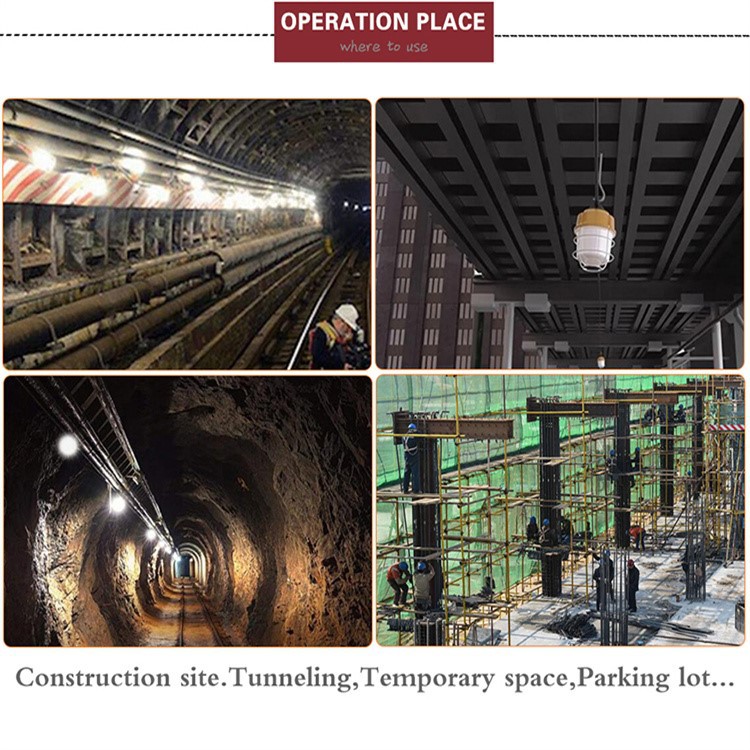
Core Compliance Standards for Construction Site Lighting
Basic Specification Requirements of OSHA Lighting Standards
OSHA's construction safety lighting specifications are the most authoritative industry compliance standard for on-site lighting configuration, focusing on the core principle of "safe operation and visible clarity". The standard clearly stipulates that all construction operation areas, pedestrian passages and auxiliary functional areas must be equipped with sufficient lighting equipment to meet the visual operation needs of construction workers, and eliminate safety hazards caused by insufficient light. At the same time, the specification strictly restricts excessive lighting design, pointing out that super-standard high-brightness lighting will produce strong glare, reflected light and local shadow areas on the construction site.
Glare and shadow interference will seriously affect the visual judgment of workers, reduce operation accuracy, and easily lead to misoperation and safety accidents. Therefore, OSHA requires that the construction site lighting system must realize uniform light distribution in the whole operation area, avoid local over-brightness or insufficient light, and ensure the continuity and stability of on-site lighting. In terms of equipment layout, the standard puts forward clear requirements for the installation height and spacing of lighting fixtures. Lighting equipment shall be installed at a reasonable height according to the site space scale and operation height, to avoid shielding by construction machinery, materials and temporary facilities, and maximize the effective irradiation range of light sources.
Graded Illumination Standards for Different Functional Areas
Construction sites include multiple functional areas with different operation attributes, and OSHA has formulated differentiated graded illumination standards based on operation risk level, operation precision and personnel activity frequency, which are quantified by foot-candle (fc) as the basic illumination unit.
1. Passage and Auxiliary Traffic Areas
The access passages, stairways, temporary walkways and material transit channels of construction sites are the main areas for personnel and equipment flow, with frequent pedestrian activities but low operation precision requirements. OSHA stipulates that the minimum illumination standard for such areas is 5 foot-candles. This illumination intensity can fully meet the basic visual needs of personnel walking, material handling and vehicle slow traffic, and effectively avoid fall and collision accidents caused by dim light. At the same time, the lighting of passage areas needs to ensure continuous coverage, and there shall be no blind spots or dark areas at stair corners, passage intersections and temporary ramp positions.
2. On-Site Construction Operation Areas
The formal construction operation areas such as structural construction, steel bar processing, concrete pouring and mechanical operation are high-risk and high-precision operation areas on the construction site. OSHA clearly requires that the minimum illumination of all formal work areas shall not be lower than 10 foot-candles. For special precision operation links such as pipeline installation, electrical wiring and equipment debugging, the illumination level needs to be further improved according to actual operation requirements, so as to ensure that workers can clearly identify operation details, equipment parameters and construction marks, and reduce construction quality defects and safety risks caused by unclear vision.
3. Staff Rest and Auxiliary Functional Areas
Construction site break rooms, temporary offices and rest areas belong to non-operation functional areas, with no strict high illumination requirements. Different from the operation areas, the lighting standard of such areas focuses on human comfort, without mandatory high foot-candle indicators. The lighting design should avoid harsh high-brightness light, and appropriately adopt soft light to create a relaxed rest environment, relieve the visual fatigue of workers after long-term construction operation, and meet the basic daily lighting needs of staff.
Key Technical Indicators of Modern Construction Site Lighting
Light Color Temperature Matching Standard
Light color temperature is a key technical indicator affecting construction vision effect and worker comfort, which directly determines the clarity of on-site vision and the degree of visual fatigue. Color temperature refers to the color perception of light source, measured in Kelvin (K). At present, neutral white light with a color temperature of 4000K–6000K is the mainstream recommended light source for construction site operation areas. White light has high color rendering and clear vision effect, which can truly restore the color and texture of construction materials, mechanical equipment and operation interfaces, help workers accurately judge operation conditions, and effectively reduce visual fatigue caused by long-term operation under dim and distorted light.
For non-operation areas such as staff break rooms and temporary rest cabins, warm light with a color temperature of 3000K–3500K is more suitable. The soft warm light can relieve physical and mental fatigue, reduce visual pressure, and build a comfortable rest environment, which is conducive to adjusting the working state of construction personnel. The differentiated matching of color temperature according to functional areas has become an important part of standardized construction site lighting design.
Environmental Durability Standard of Lighting Equipment
The construction site belongs to a harsh outdoor and semi-outdoor operation environment, with typical characteristics such as large dust accumulation, frequent debris flying, variable weather and mechanical vibration. Therefore, construction site lighting equipment must meet strict durability and environmental adaptability standards, which is an important prerequisite for ensuring long-term stable lighting effect.
1. Dust and Impact Resistance
In the process of foundation excavation, concrete construction and material cutting on construction sites, a large amount of dust and debris will be generated. The lighting fixtures must have a closed protective structure and high shell hardness, with good dust-proof and anti-impact performance, to avoid light source damage and light transmittance reduction caused by dust accumulation and debris impact. At the same time, the equipment shell needs to have anti-corrosion performance to adapt to the humid and dusty on-site environment and delay equipment aging.
2. Weather Adaptability
Construction site lighting equipment is mostly exposed to the outdoor environment, which needs to adapt to extreme weather such as high temperature, low temperature, rain and snow. Qualified construction lighting fixtures must have waterproof, rainproof and high and low temperature resistance functions, which can maintain stable lighting performance in rainy days, cold winter and hot summer, and avoid equipment failure, light attenuation and short circuit hazards caused by weather changes. All outdoor lighting equipment must reach a certain IP protection level to ensure safe and stable operation in harsh environments.
Energy Conservation and Green Environmental Protection Standards
Modern construction site lighting design not only meets safety and functional requirements, but also takes energy conservation and green construction as important evaluation standards. Construction sites have a large demand for lighting equipment, long daily lighting time and wide coverage area. The traditional incandescent lamps and fluorescent lamps have the defects of high energy consumption, fast light attenuation and short service life, resulting in high operation cost and resource waste.
LED lighting has become the standard configuration of modern construction site lighting due to its significant energy-saving advantages. Compared with traditional light sources, LED lamps have the characteristics of low power consumption, high luminous efficiency, long service life and low heat generation, which can reduce the overall energy consumption of site lighting by more than 50% on the premise of meeting OSHA illumination standards. At the same time, LED lighting has no ultraviolet and infrared radiation, no stroboscopic phenomenon, and will not cause secondary damage to workers' vision and physical health, which conforms to the green construction and sustainable development concept of the construction industry. In addition, LED lamps have small volume and strong applicability, which can adapt to the complex and changeable layout of construction sites and facilitate flexible installation and adjustment.
Comprehensive Optimization Strategy for Construction Site Lighting System
Scenario-Based Precision Layout
Combined with the differentiated illumination standards of OSHA, construction site managers should carry out precision layout of lighting equipment according to the site scale, operation type and time period. For large-scale open construction areas, high-power LED floodlights are adopted for overall coverage to ensure uniform illumination and no blind spots; for narrow passages and stair areas, small embedded or wall-mounted LED lights are used for continuous lighting; for precision operation areas, auxiliary local lighting equipment is added on the basis of overall lighting to improve local illumination intensity and operation accuracy. At the same time, according to the night construction and cloudy day operation scenarios, the lighting quantity and power are dynamically adjusted to ensure that the illumination level always meets the standard requirements.
Daily Maintenance and Safety Management
To maintain the long-term compliance of construction site lighting standards, a perfect daily maintenance and management mechanism must be established. Special personnel should be arranged to regularly inspect the lighting equipment, check the damage, dust accumulation and aging of lamps and lines, and replace faulty equipment in time to avoid insufficient illumination caused by equipment failure. Regular cleaning of lamp shell dust and debris is required to ensure the light transmittance and stable luminous efficiency. In addition, the installation position and height of lighting equipment should be adjusted in real time according to the progress of construction engineering and the change of on-site layout, to avoid equipment shielding and lighting blind spots caused by construction progress changes.
Balanced Optimization of Safety, Efficiency and Energy Conservation
The core of construction site lighting standardization is to realize the balanced unity of safety, practicality and economy. In the equipment selection and layout process, it is necessary to take OSHA safety specifications as the bottom line, prioritize the lighting quality and safety performance of the operation area, and avoid glare, shadow and insufficient illumination risks. On this basis, fully promote high-efficiency and energy-saving LED lighting equipment, reduce the energy consumption and operation cost of construction lighting, and reduce the carbon emission of construction projects. Through reasonable color temperature matching, precision layout and standardized maintenance, the lighting environment of the construction site is comprehensively optimized, which not only ensures the personal safety and operation efficiency of construction workers, but also meets the green development requirements of modern construction industry.
Conclusion
The standardization of construction site lighting is a systematic engineering problem integrating safety specifications, technical indicators and on-site management, and its core goal is to eliminate lighting-related safety hazards and improve construction operation efficiency. The modern construction site lighting standards take OSHA mandatory specifications as the basic compliance basis, clarify the differentiated graded illumination requirements of different functional areas, and standardize the light distribution and equipment layout principles. At the same time, with the development of green construction technology, equipment durability, light color temperature adaptability and energy-saving performance have become indispensable core indicators of construction site lighting standards.
In the actual construction site management, managers should strictly abide by industry safety specifications, select high-quality and high-adaptability LED lighting equipment, carry out personalized lighting layout according to on-site operation characteristics, and establish a perfect daily maintenance mechanism. By realizing the precise matching of illumination intensity, light color temperature and equipment performance with construction scenarios, the safety, stability, energy saving and comfort of construction site lighting can be fully guaranteed, which provides a solid foundation for the safe, efficient and green development of construction engineering.

How To Cooperate With Us?
Having its own factory gives our firm complete control over the production process and the quality of our goods, which we take great pride in. We are manufacturers, not only brokers, committed to offering our clients the lowest costs. We invite consumers to evaluate our samples first since we are certain that the cost and quality of our items are evident. Our dedication to excellence and client happiness motivates us to consistently provide superior products.
Our address3rd Floor, 5th Building, Hebei Industrial Park, Hualian Community, Longhua District, Shenzhen, China
E-mail:bwzm09@ledbenweilighting.com





