

The wavelengths of commercially available UVA light fixtures normally fall between 365 and 405 nm, with 365 and 395 nm being the most popular options. In UV black light and fluorescence detection applications, it is frequently taken into account while deciding between 365 nm and 395 nm.
The wavelengths of light in the UV spectrum are 365 nm and 395 nm. Because they may cause some materials to fluoresce or produce visible light, these wavelengths, which are in the UVA region, are sometimes referred to as "blacklight."
But are 365 nm and 395 nm used for the same thing? What distinguishes them from one another? Together, let's examine this.
Black and UVA Light
Blacklight is a unique kind of UV lighting that creates a distinctive look by using mostly UVA light. Blacklight illumination uses UVA light to stimulate a substance's fluorescent qualities, leading it to release visible light.
Fluorescent materials like fluorescent paints, fluorescent inks, and fluorescent stickers may produce a very vivid visual impression in dark surroundings by emitting bright colors when exposed to black light. Black lights are widely used in the entertainment, decorative, and special effects industries because to this effect.
Due to its strong penetrating strength and cheap energy, UVA light is frequently employed in black light. The ultraviolet A band, which has a wavelength between 315 and 400 nanometers and is regarded as invisible light, is referred to as UVA light in the solar spectrum.
Why is the wavelength value so crucial even if light with wavelengths shorter than 400 nm is undetectable to the human eye? This is due to the fact that the UV light's application category is determined by its wavelength. For instance, 365 nm and 395 nm are both in the UVA category, but 300 nm is in the UVB category and 270 nm is in the UVC category.
Applications for UVA lights include fluorescence detection, spotting security marks, counterfeit currency, blood and bodily fluids, etc.; curing inks, coatings, glues, and resins; and capturing insects.
Applications for UVB lights include treating skin conditions like psoriasis and eczema, treating Seasonal Affective Disorder (SAD), treating chemical treatments for other light-related psychological and physiological disorders, and tanning to make up for the body's lack of natural sunlight exposure.
Applications for UVC lights include food processing, water treatment, air purification, medical device disinfection, and disinfection and sterilization.
395 vs. 365 nm
Although there is only a 30 nm difference between 365 and 395 nm UVA lamps, which both create black light and curative effects, 395 nm UV light looks purple to the unaided eye because it is closer to visible light, or violet, than 365 nm.
365 nm UV light appears as a drab blue-white hue to the unaided eye because it is "deeper" into the invisible UV spectrum than 395 nm, contains less visible light, and has a shorter wavelength.
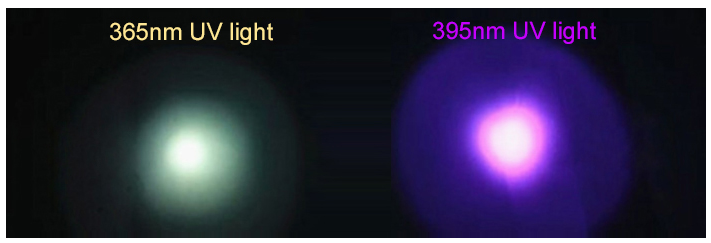
Why is there a difference in visible light between 365nm and 395nm?
395 nm does not just emit light with a wavelength of 395 nm, and 365 nm does not only emit light with a wavelength of 365 nm.
Though they also generate significant energy in the nearby 350 nm to 380 nm and 390 nm to 410 nm ranges, 365 nm and 395 nm UV light emit the maximum energy at 365 nm and 395 nm, respectively. Along both sides of the 365 nm and 395 nm spectra, the energies of these wavelengths diminish.
Because a greater percentage of the 395 nm spectrum output falls in the visible violet area than at 365 nm, it produces a more powerful visual experience and may be used in ornamental lighting or entertainment venues.
On the other hand, there is less energy the closer the 365 nm spectral output is near the visible 400 nm. Because of this distinction, 365nm LEDs are the best option for the majority of UV-A applications.
Due to restrictions in the LED's design or material qualities, a 365 nm LED may emit a limited amount of visible "leakage" or radiation beyond the 365 nm wavelength, despite the fact that this wavelength is deep within the invisible spectrum.
Instead of the pure UV output of the required single wavelength of 365 nm, these visible components may be in the blue or white spectral region, giving the lights you see a drab blue-white coloring.
Therefore, in order to reduce the impacts of visible light "leakage" and get a UV output closer to the pure 365nm, it might be required to use a better quality, professionally built LED for specific applications, particularly those that need accurate UV output.
365nm for Fluorescence Detection
When exposed to UV light at 365 nm, fluorescent dyes and markers, banknotes and security marks, minerals and gemstones, white clothes, and dental bleach absorb the greatest energy and re-emit it as bright fluorescence. This means that when these materials are seen at 365 nm, the fluorescence effect is most pronounced and powerful.
395nm for Black Light Illumination
At 395 nm, UVA lights give a faintly noticeable purple hue. Applications where a balance between fluorescence and visibility is sought, as well as entertainment venues and ornamental lighting, frequently utilize this color effect.
Compared to the shorter 365nm UVA wavelength, the 395nm UVA wavelength is less energetic and comparatively harmless. It often doesn't seriously affect people or the environment with the right UV protection.
Our address
3rd Floor, 5th Building, Hebei Industrial Park, Hualian Community, Longhua District, Shenzhen, China
Phone Number
+8618878216759
bwzm6@ledbenweilighting.com






