

For job safety in volatile regions, industrial LED lighting must exceed OSHA illumination standards. Many site managers and safety officials struggle to understand explosion-proof lighting certification, installation, and maintenance.
Safety regulations, testing, and real-world applications are covered in this thorough introduction to explosion-proof LED lighting systems. Learn how these specialised lighting solutions safeguard people and assets in the toughest industrial settings, from chemical processing plants to oil and gas installations.
Explosion-Proof LED Light Fundamentals
First and foremost, explosion-proof LED lights serve a unique role. In harsh industrial environments, these devices illuminate and prevent internal explosions from spreading.
What Makes Light Explosion Proof?
Explosion-proof LED fixtures use sturdy architecture to prevent internal sparks and explosions from igniting the environment. Explosion forces must be absorbed by the housing without igniting outside. These fixtures run from -30°C to +50°C (-22°F to +122°F).

Key Safety Design Elements
The safety architecture of explosion-proof LED lights includes many crucial components:
- Robust Housing: Cast aluminium, stainless steel, or fiberglass-reinforced plastic housings protect against corrosion.
- Flame Path Design: Cools expanding gases before they leave the container via properly designed holes.
- Advanced thermal management systems actively and passively disperse heat for safe operation.
- These fixtures also use high-quality seals and gaskets that are tested for 28 days at 95-150°C and -20 to -65°C.
Common LED Safety Myths
Misconceptions concerning explosion-proof LED lighting abound. "Explosions proof" does not indicate the fixture can endure external explosions. Instead, it means containing internal sparks or explosions to prevent them from igniting the environment. LED bulbs create less heat than conventional lights, but without enclosures, they are not explosion-proof.
For EPL Ga equipment, magnesium and titanium must be below 10% by mass, whereas for EPL Gb equipment, they must be below 7.5%. These exact standards optimise hazardous environment safety.
Testing and Certification for Safety
Explosion-proof LED lighting surpasses worldwide safety standards via rigorous certification. NEC, ATEX, and IECEx regulations control these certifications in North America, Europe, and internationally.
Essential Safety Standards
UL 844 is North America's explosion-proof lamp standard. ATEX regulations set health and safety standards for EU market items and assign protection levels. Unified testing and a worldwide database enable global certification under the IECEx system.
Different Environment Testing Protocols
Certification testing evaluates many safety aspects:
- Thermal Assessment: External surface temperature evaluation, heat management capability testing, thermal shock resistance verification.
- Structural Verification: Hydrostatic pressure tests, vibration resistance evaluation, rust resistance verification.
- Safety Validation: Dust penetration testing, chemical compatibility assessment, electrical resistance measurement.
Required Documentation and Compliance
Compliance management relies on detailed maintenance records. Complete documentation is required from manufacturers:
- Inspection dates, results
- Corrective measures taken
- Parts utilised
- Regulatory compliance testing
Verification by a Third Party
OSHA-accredited NRTLs test and certify safety. To assure testing quality and uniformity, these labs must be ISO/IEC 17025 accredited. OSHA and the Standards Council of Canada need four yearly production inspections for certification.
Importantly, firms seeking certification must give precise specifications, construction drawings, and materials lists. Certification documents must provide model numbers and standards compliance. International markets may need extra documents based on local restrictions.
Thus, developing goods that satisfy ANSI/UL 1203 and EN/CSA/UL/IEC 60079 standards enables for one round of testing to attain explosion- and flame-proof certification. This uniform method simplifies certification and ensures global market acceptability.
Installation Requirements in Hazardous Areas
Explosion-proof LED lighting safety starts with proper installation. Mounting and wiring parameters are carefully considered to maximise performance and safety certifications.
Safety Checks Before Installation
Disconnect all electricity and check the installation area for environmental compliance. Operating temperatures must be between -30ºC and +50ºC (-22°F to +122°F). Preparation requires tools, PPE, and manufacturer-specified supplies.
Inspect the fixture for damage or faults during the first inspection. Installation must be at least 3.0 inches (7.6 cm) wide and 40.0 inches (101.6 cm) tall. Installation should begin with a clean, ignitable-free environment.
Mounting and Wiring Tips
The right mounting arrangement affects safety and illumination. Common mounting options:
- Vertical poles for wide-area lighting
- Heavy-duty trunnion mounts
- Surface/wall mounts for direct attaching
- Hook pendants for overhead installations
Flexible coupling mounting surfaces must have a minimum bend radius of 10 inches (25.4 cm). Trunnion or U-bracket mounts stabilise high-vibration settings.
Electrical connections must be carefully maintained for explosion-proofing. Licensed electricians must wire according to state, municipal, and National Electrical Codes. Basically, every electrical connection requires explosion-proof junction boxes and conduit.
Vital wiring needs include:
- UL/IEC input/output wires
- Connect wires per schematics.
- Correct electrical enclosure grounding
- NEC and local electrical code compliance
The installation verification method must examine seal integrity and gasket conditions for watertightness and dustproofness. Thus, frequent component monitoring maintains the lighting system's explosion-proof classification.
Stainless steel mounts are used in corrosive environments. While maintaining explosion-proof characteristics, the system should be straightforward to maintain.
Real-World Performance Analysis
Explosion-proof LED lighting systems function in the field after lab testing. Critical investigation of these fixtures shows outstanding performance across several criteria.
TempControl Systems
LED explosion proofing relies on advanced thermal management. Specialised interior cooling fins actively extract heat from LED components in these lamps. The advanced thermal control systems sustain light output from -40°C to 85°C.
The heat management design mostly includes:
- Active heat dissipation fins inside
- Heat sinks for thermal load distribution are rugged.
- Advanced low-temperature electronics
- Double-pitch acme threaded pre-stressed glass dome
- Impact Resistance Test Results
Impact resistance testing seems to meet EN 60079-0 procedures. Every fixture is tested with a 1kg mass dropped from particular heights on at least two specimens. Impact points target susceptible exterior locations.
Meanwhile, the fixtures' materials are quite durable. Housing is usually die-cast, high-strength copper-free aluminium alloy with baked powder epoxy. These materials and stainless steel hardware safeguard against physical damage, vibration, and corrosion.
Operating Lifetime Data
Explosion-proof LED fixtures outlast conventional lighting. LED explosion-proof lights endure 50,000 hours, compared to 1,000 and 10,000 hours for incandescent and fluorescent lights. This longer longevity is supported by IES LM-80 and TM-21 estimates.
Multiple protection measures keep these fixtures performing well. They are IP66 dust and moisture-proof and IK10 impact-resistant. Their strong structure helps them survive 3G vibration pressures and 1,200 hours of salt spray.
These systems save up to 80% more energy than typical lighting. Reduced energy usage lowers operating temperatures, improving safety in volatile settings where excessive heat might ignite gases or dust particles.
Industry-Specific Applications
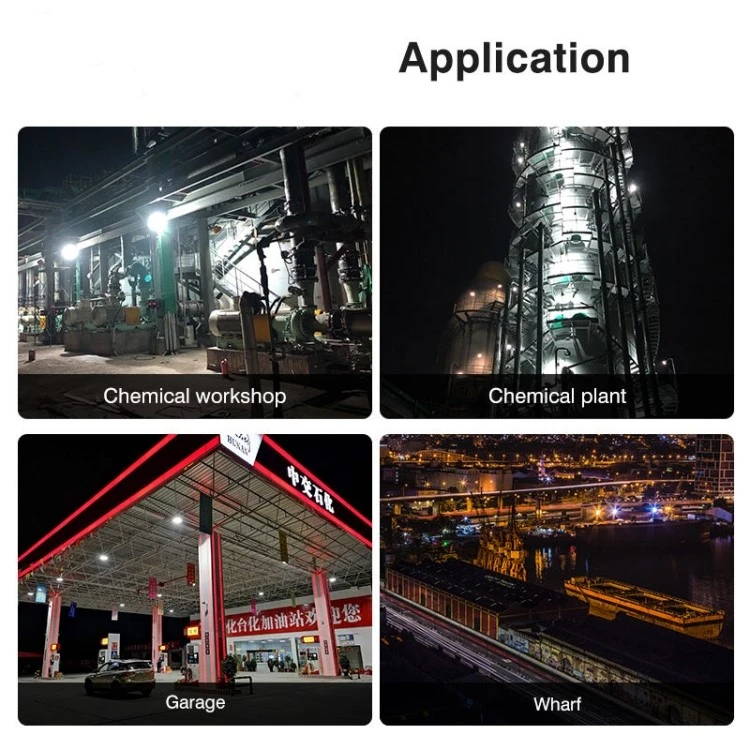
Explosion-proof LED lighting is needed in specialised industrial areas with specific operating and safety constraints.
Oil and Gas Facilities
Flammable gases and vapours pose safety issues in oil and gas operations. Class 1 Division 1 illumination is needed in refineries and drilling rigs with constant exposure to volatile chemicals. These facilities mostly use explosion-proof LED systems in drilling, processing, and storage areas with combustible materials.
Offshore platforms and land-based facilities need extreme-condition illumination. In distant areas with adverse weather, these systems must work dependably. Unlike normal industrial lights, explosion-proof LED solutions may dim to 50% during rest times, optimising energy efficiency in petrochemical facilities and oil rigs.
Chemical Processing Plants
Chemical processing requires fixtures that can function safely at 65°C (149°F). Corrosive environments and chemical reactions may damage ordinary fixtures, yet lighting systems must work consistently.
Mine Work
Confined places, explosive gases, and abrasion make mining difficult. Underground mining requires particular lighting:
- Main mining areas: 20–50 foot-candles
- 50–100 foot-candles for drilling and blasting
- Transport and access tunnels: 10–30 foot-candles
In potentially explosive environments, these requirements provide visibility and safety. Inherently safe mining lights are designed for flammable or explosive settings. After installation, these lights operate without bulb and ballast changes in hard-to-reach regions, proving their usefulness.
The lighting systems must work in underground and surface mining. In locations containing dust and explosive gases, explosion-proof fixtures are required unless intended for open-pit activities. These mining lights have strong impact ratings and work well in damp situations, including several IP69K-rated fixtures.
Conclusion
Explosion-proof LED lighting is essential in many hazardous industrial settings. These specialised fittings safeguard personnel and facilities against catastrophic catastrophes via rigorous testing and certification.
From sturdy housing to efficient heat management, the safety measures assure dependable operation under harsh situations. Testing shows that operating lifespans may approach 50,000 hours and operate well from -40°C to 85°C.
Installation is crucial since these lighting systems must fulfil particular mounting and wiring standards to maintain safety ratings. These innovative lighting systems provide steady illumination and prevent ignition sources in volatile atmospheres, benefiting chemical industries, oil and gas facilities, and mining activities.
Safety officers and site managers must recognise that explosion-proof certification covers interior containment, not blast resistance. Selecting hazardous area lighting requires this difference. Over the fixture's lifespan, routine maintenance and documentation maintain safety compliance.





