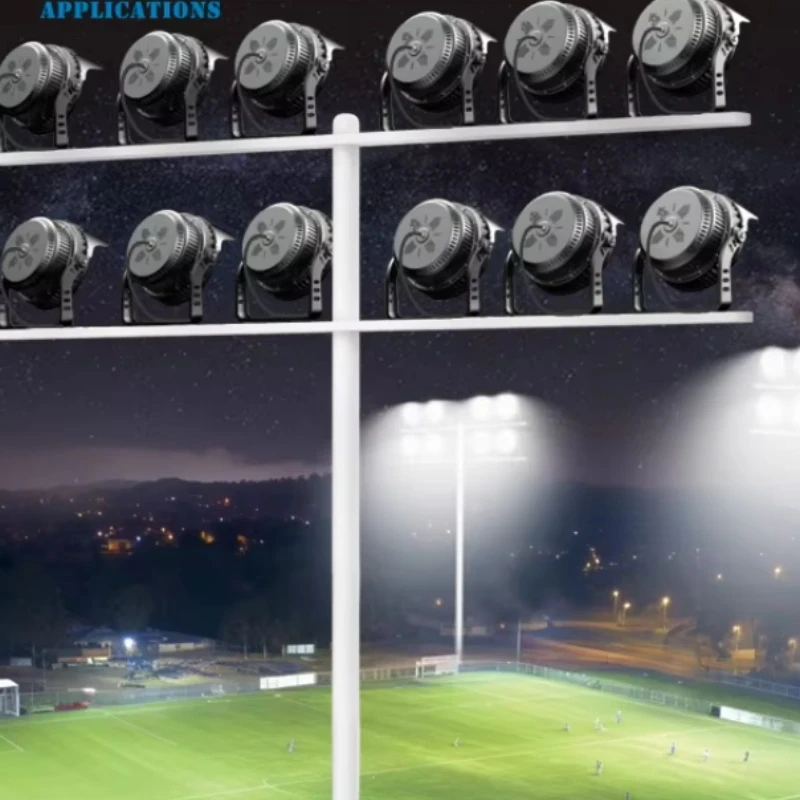
Stadium lighting differs significantly from standard industrial lighting; issues arising during night matches, broadcast filming, or the spectator experience are often magnified. While many products on the market are marketed as "professional stadium lights," determining which ones can truly withstand high-intensity events and long-term outdoor operation requires looking at several key technical benchmarks. This article breaks down the capabilities required for a truly qualified LED stadium light from a technical perspective, serving as a reference for your selection process.
Luminous Efficacy and Energy Efficiency
Stadium lights typically range from 500W to 1,500W in power; given their long operating hours, electricity costs can be substantial. Therefore, luminous efficacy (lm/W) is the primary parameter to consider. Currently, mainstream LED stadium lights generally achieve an efficacy of over 150–160 lm/W, with some high-end models exceeding 170 lm/W. Compared to traditional metal-halide lamps (which typically offer only 80–90 lm/W), these LEDs can reduce energy consumption by more than 50% while maintaining the same illuminance levels.
A frequently overlooked point here is that one should not rely solely on laboratory data for individual LED chips; instead, consider the efficacy of the complete luminaire. Luminous efficacy inevitably drops after the assembly of the fixture, driver, and optical lenses. Consequently, when selecting products, it is best to request third-party test reports (such as efficacy tests from TUV or UL) from the manufacturer.
Anti-Glare Optical Design
Stadium lights are positioned close to the lines of sight of both spectators and athletes. Poor optical design can easily lead to glare, which not only impairs an athlete's ability to track the ball but also poses risks to eye health from prolonged exposure to intense light.
To evaluate the quality of glare control, focus on two main factors:
UGR (Unified Glare Rating): Professional stadium lighting generally requires a UGR ≤ 50, while indoor arenas often demand even lower levels.
Lens Optical Angles: High-quality products feature light distribution curves customized for specific installation heights and angles, rather than relying on a single, universal lens design for every application. Additionally, stadiums used for broadcasting have stringent requirements for the Color Rendering Index (CRI) and the Television Lighting Consistency Index (TLCI). Generally, a CRI of ≥80 is required, while high-standard events may demand a CRI of ≥90 to ensure that the colors captured by cameras remain undistorted.
Protection Rating and Structural Strength
Stadium lights are installed outdoors year-round and are constantly exposed to wind, sun, and rain; the protection rating directly determines the fixture's service life.
Water and Dust Resistance: Mainstream products should have an IP rating of at least IP65; for coastal or humid regions, IP66 is recommended.
Corrosion Resistance: Fixture housings are typically made of die-cast aluminum with an anodized or powder-coated finish. They should ideally pass a salt spray test of over 500 hours to ensure durability in high-salinity coastal environments.
Wind Resistance: With installation heights typically ranging from 15 to 40 meters, both the light pole and the fixture itself must withstand loads at the design wind speed. This must be verified with a structural engineer during the installation planning phase rather than relying solely on the manufacturer's claims.
Heat Dissipation System Design
The greatest enemy of LED fixtures is not light decay, but heat. Poor temperature control significantly shortens the lifespan of both the LED chips and the driver power supply.
Stadium lights operate at high power and require substantial heat dissipation surface areas. Consequently, heat sinks often feature large-area finned structures combined with internal airflow channels to facilitate natural convective cooling, avoiding active cooling methods like fans, which have limited lifespans. To evaluate heat dissipation performance, one can consult the manufacturer's LM-80 and TM-21 reports. These provide industry-standard test data for assessing LED light decay curves and expected lifespan-metrics far more reliable than a manufacturer's simple claim of a "50,000-hour lifespan."
Smart Dimming and Control Solutions
Modern stadium lights generally support smart control systems; key considerations here include two capabilities:
Dimming Protocol Compatibility: Common protocols include 0-10V, DALI, and DMX512. Compatibility depends on the venue's existing control system; it is best to verify this before selection to avoid purchasing equipment with incompatible protocols. Scene Switching Capability:
Illuminance requirements differ across training, competition, and broadcast modes. A high-quality control system enables one-touch switching between zones and scenarios, eliminating the need for manual, individual adjustments.
While this feature isn't a "visible" hardware specification, it significantly impacts the convenience of daily venue operations and long-term electricity cost management.
Certification and Warranty Systems
The final point is also the one most easily overlooked: certification and warranty.
Stadium lighting represents a major investment, and repair costs can be exorbitant if issues arise. Consequently, the scope of certifications and the duration of the warranty serve as direct indicators of a manufacturer's reliability. Key certifications to look for include CE, RoHS, and CCC; products destined for the North American market also require DLC certification. Regarding warranties, mainstream brands typically offer five years of coverage, with some high-end products extending to ten years. A longer warranty period often reflects the manufacturer's confidence in their product's durability.
Conclusion
Determining whether an LED stadium light is truly "excellent" requires looking beyond superficial specifications like wattage and brightness. Instead, one must evaluate the product across six dimensions: luminous efficacy, optical design, protective structure, thermal management, smart control capabilities, and certification/warranty terms. These factors are interconnected: insufficient luminous efficacy drives up long-term operating costs; poor optical design compromises broadcast quality; and inadequate thermal management or protection directly determines the fixture's lifespan. When selecting products, it is advisable to request third-party test reports rather than relying solely on the manufacturer's promotional data.
If you are planning a lighting upgrade for a stadium, training facility, or outdoor sports field, please feel free to share your site specifications (mounting height, field dimensions, and illuminance requirements) with us. We can provide tailored product recommendations and price quotes based on your specific needs-please don't hesitate to contact us.