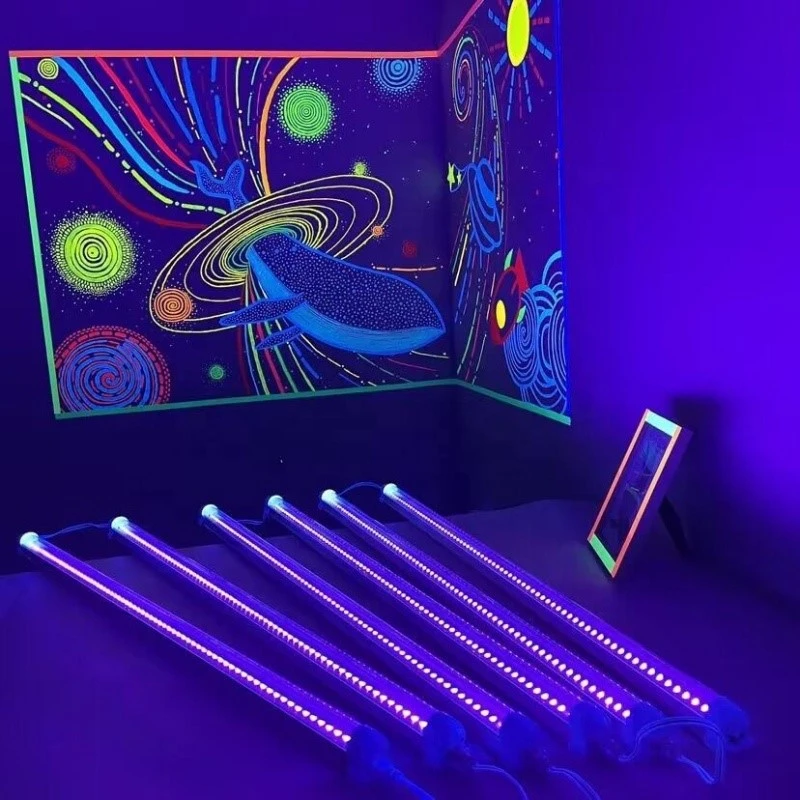
There are many types of ultraviolet (UV) lamps on the market, with various combinations in terms of wattage and wavelength, making selection quite challenging. This article discusses the T8 395nm UV LED lamp-a niche category that is unique and why many customers in industries such as ink curing, fluorescence detection, and insect trapping specifically request this wavelength and lamp specification. If you are comparing different UV light source solutions, hopefully the following points will help clarify your thinking.
What exactly is the concept of a 395nm wavelength?
395nm is a segment of ultraviolet light that is relatively close to visible light. In the industry, it is generally classified as the edge of the UV-A (long-wave ultraviolet) range, and some call it "near-ultraviolet." Unlike the shorter wavelength UV-C (such as 254nm used for sterilization), the energy density of 395nm is not particularly high, but its penetration and fluorescence excitation effect are relatively balanced. Therefore, it is not the kind of lamp used for "sterilization and disinfection," but rather more suitable for inducing fluorescence reactions in certain materials or curing photosensitive resins. This is actually quite crucial. Many customers initially treat all UV lamps as the same thing, but in reality, a difference of tens of nanometers in wavelength completely changes the application.
The Compatibility Advantages of T8 Lamp Specifications
T8 is a well-established industry standard for lamp diameter (approximately 26mm). This means that these UV LED lamps can generally be directly installed into existing T8 fluorescent lamp holders without additional modifications to the lamp holder or rewiring-a significant saving for factories or stores looking to upgrade older UV lamps to LED solutions. The lamp length also largely follows the standard T8 size series (e.g., 2 feet, 4 feet), so you can simply choose the length of your existing holder when purchasing; there's no need to redesign the installation structure.
Several Practical Differences Between LED Light Sources and Traditional UV Lamps
Traditional UV fluorescent lamps require a short "warm-up" time after being powered on, and their brightness gradually decreases over time. Furthermore, they contain mercury, requiring hazardous waste disposal procedures. LED light sources generally achieve stable brightness immediately upon power-on, without flickering or preheating issues. Their lifespan typically reaches 30,000 to 50,000 hours, and their decay curve is smoother-resulting in less wavelength shift and light decay over time compared to traditional tubes. Furthermore, LEDs are mercury-free, a significant advantage for customers with environmental compliance requirements (such as factories exporting to Europe and America). Of course, the initial purchase cost of LED tubes is generally higher than that of traditional UV tubes. This should be acknowledged, as not all scenarios necessitate LEDs; it depends on usage frequency and long-term maintenance costs.
Common Applications of These Tubes
395nm UV LED T8 tubes are commonly used in: UV adhesive/resin curing (e.g., post-3D printing processing, some industrial bonding processes), fluorescence detection (mineral identification, anti-counterfeiting document detection, pet urine/stain detection-also common in civilian applications), and as a light source in insect trapping lamps. Some nail industry curing equipment also utilizes light sources with wavelengths close to this. It's important to note that this wavelength is not specifically for sterilization and disinfection. If the customer's requirement is disinfection, a UV-C band solution must be used; these cannot be confused.
Details to Note During Purchase and Use
Before purchasing, it's recommended to confirm whether your existing lamp holder uses an electronic or magnetic ballast. Different driving methods have different compatibility requirements for LED tubes. Some LED tubes require the removal of the original ballast before connecting directly to mains power. Also, while 395nm is not considered strong ultraviolet light, prolonged close-range viewing or long-term skin exposure still warrants wearing protective eyewear and avoiding direct irradiation, especially in continuous industrial settings. The lamp's power and luminous flux must also match the actual area being used. Higher wattage does not necessarily mean better performance; excessively high wattage may lead to uneven material curing or energy waste.
Summary
The advantages of 395nm UV LED T8 tubes can be summarized in three points: accurate wavelength positioning (suitable for curing and fluorescence detection, not disinfection), installation compatibility due to the T8 specification, and the improved lifespan and environmental friendliness of LED light sources compared to traditional tubes. Of course, it's not a panacea. Before selecting a model, it's best to clearly define your specific application scenario and existing lighting fixtures, and then decide on the power, length, and driving method.
If you are selecting a suitable UV light source for curing, testing, or insect-attracting projects, please send us your specific requirements (such as application scenario, existing lighting fixture models, required length, and power). We can recommend suitable specifications based on your actual situation and provide detailed parameters and a quote.