When developing lighting solutions for clients, I am frequently asked a fundamental yet often overlooked question: how exactly should one choose between flexible LED strips and rigid LED strips? Many purchasers focus solely on brightness and color temperature when reviewing specifications, missing the essential differences in structure, installation methods, and application scenarios. This article clarifies these distinctions from a practical application perspective to help you avoid common pitfalls during the selection process.
Differences in Substrate Material and Structure
Flexible LED strips typically use FPC (Flexible Printed Circuit) as the base material, protected by a silicone or PU casing; this allows them to bend or even be installed in circular patterns. In contrast, rigid LED strips utilize an aluminum substrate (PCB on Aluminum); they cannot bend and are manufactured as straight strips of fixed length.
This structural difference dictates their respective roles: flexible strips function more like "cables," whereas rigid strips are closer to "structural profiles."
Installation Methods and Application Scenarios
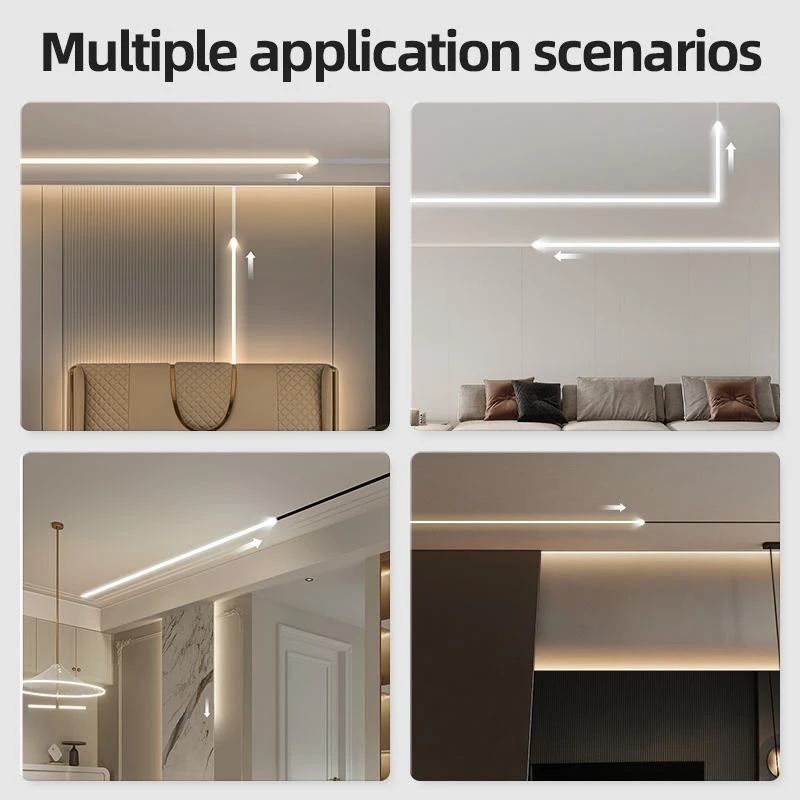
Flexible strips are secured using adhesive backing or mounting clips and can conform to curved surfaces and corners, making them ideal for cabinet accent lighting, signage outlines, and irregular decorative shapes. Rigid strips require dedicated aluminum channels for installation; once installed, they offer greater structural integrity and are commonly used for shelf lighting, linear fixtures, and industrial lighting applications where structural strength and heat dissipation are critical.
In short, if your project involves curves or corners, flexible strips are essentially the only choice. Conversely, for long, straight runs requiring superior heat dissipation and light output efficiency, rigid strips are the more reliable option.
Comparison of Heat Dissipation and Lifespan
This is a point many clients overlook. Rigid strips feature an integrated aluminum substrate that acts as a heat sink; when paired with aluminum channels, heat dissipation efficiency increases, resulting in lower LED chip operating temperatures, slower lumen depreciation, and better luminous flux maintenance over the long term.
Because flexible strips use FPC as a substrate, their thermal conductivity is inherently lower than that of aluminum substrates. This is particularly true for high-power products (such as 24V high-density strips); without additional heat dissipation measures, they will experience more noticeable lumen depreciation than rigid strips after prolonged operation. Therefore, for high-wattage projects, we usually recommend that clients pair flexible LED strips with aluminum channels or switch to a rigid LED bar solution.
Brightness and Luminous Efficacy
Given identical chips and power ratings, rigid LED bars often deliver more stable actual lumen output and exhibit a flatter lumen depreciation curve due to superior heat dissipation. The maximum brightness of flexible LED strips is limited by the load-bearing capacity of the substrate; the higher the LED density (e.g., over 120 LEDs/meter), the greater the reliance on effective heat dissipation.
However, this does not mean flexible LED strips are necessarily dim; there are many high-density flexible strip products on the market. The key is to pay close attention to heat dissipation specifications and measured lumen depreciation data during selection, rather than relying solely on the initial lumen rating listed on the packaging.
Cost and Procurement Considerations
Flexible LED strips involve relatively simple manufacturing processes, offer flexible minimum order quantities (MOQs), and generally have a lower unit price than rigid LED bars. Rigid LED bars entail higher overall costs due to the processing of aluminum substrates and the need for matching aluminum channels; however, they offer longer lifespans and more stable luminous efficacy, potentially making them more cost-effective when amortized over the long term.
When purchasing, one should not compare unit prices in isolation but must calculate the total cost of ownership by factoring in the project's expected lifespan and maintenance expenses.
Choosing the Right Type of LED Strip for Your Project
Based on the points above, here is a simple decision-making framework:
Requires bending, irregular shapes, or a limited budget → Prioritize flexible LED strips
Requires long, straight runs, high brightness stability, and longevity → Prioritize rigid LED bars
High-power or high-density projects → Regardless of the type chosen, using aluminum channels for heat dissipation is recommended
Conclusion
There is no absolute "better" or "worse" option between flexible LED strips and rigid LED bars; the choice depends primarily on the project's installation environment, power requirements, and expected lifespan. Flexible LED strips excel in versatility and adaptability, while rigid LED bars offer superior heat dissipation and longevity. When finalizing a solution, it is essential to evaluate specific parameters-such as power, color temperature, and waterproof rating-to select the product that best fits the project's needs. If you are working on a relevant project and are unsure whether to choose a flexible or rigid solution, please feel free to send us your project requirements (such as installation environment, length, and power specifications). We can then provide specific recommendations and a price quote tailored to your actual needs.
Our address
No. 5-3 Niujiao Road, Yanchuan Community, Yanluo Subdistrict, Bao'an District, Shenzhen
bwzm18@ledbenweilighting.com