LED panel lights are the mainstream lighting fixtures for commercial ceiling installations in offices, shopping malls, hospitals, schools, and office buildings. Currently, the most common types on the market are side-lit (side-lit) panel lights and backlit (direct-lit) panel lights.
Many purchasing and engineering companies easily confuse the two when placing orders, assuming they are both panel lights and interchangeable. However, after actual installation, problems often arise such as glaring light, insufficient brightness, dark spots on the panel, excessively thick fixtures, and high repair rates. In fact, the two types of lights differ significantly in their light-emitting principle, thickness, appearance, light quality, cost, and suitable application scenarios. This article provides a comprehensive comparison of their structure, brightness, workmanship, lifespan, and applicable scenarios to help you choose the right model and avoid engineering pitfalls.
Core Differences in Light-Emitting Structure and Working Principle
This is the most fundamental difference between the two types of panel lights, directly determining all subsequent performance differences.
Side-lit LED Panel Lights (Side-lit): The LED beads and light strips are arranged around the perimeter of the fixture, not emitting light directly downwards. Light is refracted and evenly distributed through layers of built-in light guide plates, reflective films, and diffusers before being uniformly emitted from the entire panel. This is an "indirect light emission" structure, relying on optical components to disperse the light source and achieve a planar light emission effect.
Backlit LED Panel Lights (Direct-down): LED beads are directly and evenly arranged on the back of the light fixture, emitting light vertically downwards. The light is then softened by a diffuser. No light guide plate is needed; the light passes directly through the light surface, making it a "direct light emission" structure with a more intuitive and simple light source arrangement.
Differences in Fixture Thickness, Appearance, and Weight
In commercial ceiling projects, the thickness of the light fixture directly affects its adaptability to ceiling height and overall aesthetics.
Side-lit Panel Lights: Featuring an ultra-thin design, with a standard thickness of only 8-12mm, these lights are lightweight and flat, with a slim frame. After installation, the panel fits snugly against the ceiling, creating a minimalist and sophisticated look, suitable for shallow ceilings and interior spaces with limited ceiling height. They are also lighter, placing less stress on the ceiling joists and ensuring high installation stability.
Backlit panel lights: These have a thicker structure, typically 35-50mm thick. Sufficient cavity space must be maintained at the back to allow for LED light emission and prevent glare. The lights are heavier and have a bulkier appearance, making them prone to protrusion and looking heavy in shallow ceilings, resulting in a less aesthetically pleasing appearance compared to side-lit models.
Brightness, Luminous Efficacy, and Lighting Quality Comparison
Lighting effect is the most direct experience for end users, and the difference in light and shadow performance between the two types of lights is quite significant.
Side-lit panel lights: Light undergoes multiple layers of optical refraction, resulting in relatively greater light loss and slightly lower brightness at the same wattage. However, the advantages are extremely soft light, no glare, no flicker, and uniform and delicate illumination across the entire surface, without localized bright spots or LED shadows. They offer excellent eye protection, making them suitable for long periods of office work or study without eye strain. Well-crafted side-lit lights provide a clean and transparent surface, giving a more premium feel.
Backlit panel lights: Without a light guide plate to prevent light loss, they have higher luminous flux, are brighter at the same wattage, and have stronger penetration. Suitable for venues requiring high illumination. However, the disadvantages are obvious. If the LED beads are sparsely arranged and the diffuser plate is of poor quality, the shadows and bright/dark spots of the dotted LED beads are easily visible at close range. The uniformity of the light is not as good as that of side-emitting LEDs, and the appearance is slightly rough at close range.
Differences in Heat Dissipation Performance and Lifespan
Heat dissipation directly determines the light decay rate of LED beads and the overall lifespan of the lamp.
Side-emitting panel lights: The LED beads are concentrated around the four edges, resulting in a small heat dissipation area and limited heat dissipation space due to the ultra-thin structure. After long-term high-load lighting, the edge temperature is relatively high, and the light decay rate is slightly faster over long-term use. The normal lifespan can reach 3-5 years. At the same time, it requires high-quality manufacturing processes, and dust accumulation on the light guide plate can easily cause bright spots and defects.
Back-emitting panel lights: The LED beads are evenly distributed on a large aluminum base plate, resulting in uniform heat dissipation, higher heat dissipation efficiency, and no localized heat accumulation problems. The LED beads operate at a lower temperature, have slower light decay, and stronger stability. They are less prone to yellowing and dimming under long-term lighting. The typical lifespan can reach 5-7 years, and the long-term engineering stability is better.
Differences in Cost, Process, and Return Rate
When purchasing in bulk for engineering projects, cost and after-sales return rate are the core considerations. Side-emitting panel lights: Complex structure, requiring light guide plates, reflective films, and precision dot matrix processing. Multiple production steps result in a lower yield rate and a higher unit price for the same specifications. Common after-sales issues include light guide plate deformation due to transportation compression, bright edges on the panel surface, and localized dark areas. Careful handling is required during transportation and installation.
Back-emitting panel lights: Simple structure, fewer components, mature technology, lower mass production cost, and a significant cost-performance advantage. Robust and durable structure, resistant to deformation, extremely low transportation damage, low failure rate, and few repairs. Suitable for large-scale commercial projects, with virtually zero maintenance pressure in the later stages.
Precisely Differentiated Applicable Scenarios
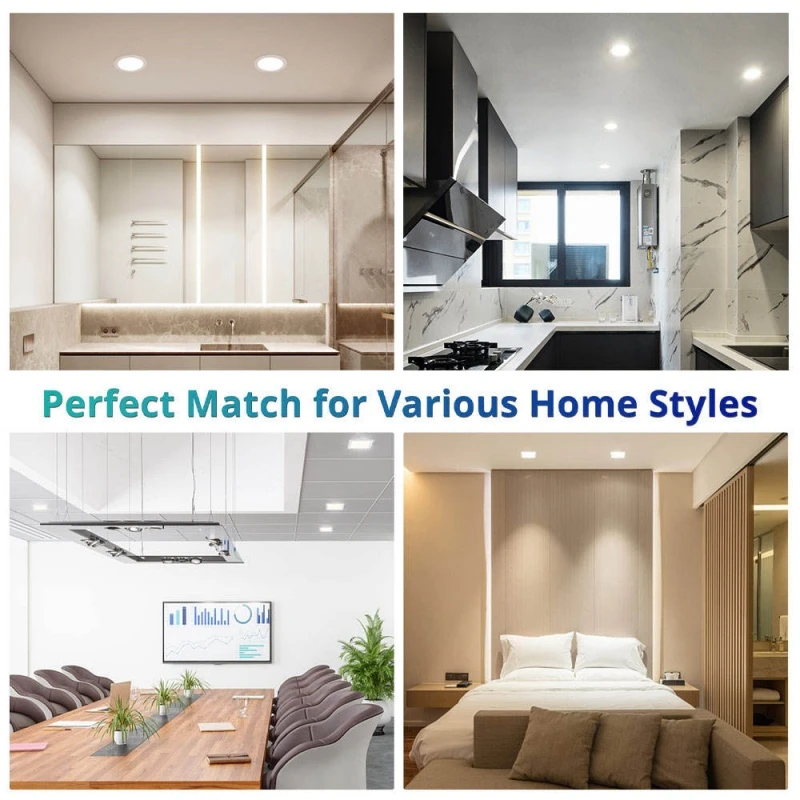
Based on differences in appearance, brightness, and texture, the applicable scenarios for both types of lights can be clearly defined. Selecting the appropriate model perfectly matches project requirements.
Scenarios for Side-Emitting LED Panel Lights: High-end office buildings, brand offices, hospital wards, school classrooms, boutique shopping malls, showrooms, shallow ceiling decorations, indoor scenarios with high requirements for lighting quality and aesthetics, and prolonged eye strain. The main features are soft, eye-friendly light, high-end appearance, and aesthetically pleasing ceiling integration.
Backlit LED panel lights are suitable for: general offices, basements, corridors, kitchens and bathrooms, factory workshops, supermarkets and warehouses, projects requiring high brightness, with moderate budgets, and seeking high cost-effectiveness and low repair rates. They emphasize high brightness, durability, high cost-effectiveness, and stable performance.
The advantages and disadvantages of the two types of lights
Side-lit panel lights: Advantages: Ultra-thin and lightweight, high-end appearance that fits the ceiling perfectly, soft light without glare, uniform light emission without shadows, eye-friendly and comfortable, highly suitable for high-end decoration.
Disadvantages: Lower brightness for the same power, higher cost, average heat dissipation, high manufacturing requirements, easily damaged during transportation, and slightly faster light decay over time.
Backlit panel lights: Advantages: High brightness, good luminous efficiency, uniform heat dissipation, sturdy and durable, extremely low failure rate, high cost-effectiveness, suitable for large-scale projects.
Disadvantages: The lamps are relatively thick, have an average appearance, are prone to glare at close range, and the light softness is not as good as side-emitting lamps, resulting in a slightly weaker high-end interior design feel.
Summary
A simple summary of selection logic: Consider the decoration level, the ceiling space, and the lighting needs. For those seeking a high-end interior design feel, eye-friendly soft light, a smooth and aesthetically pleasing ceiling, and a sufficient budget, prioritize side-emitting LED panel lights. For those prioritizing high brightness, practicality, cost-effectiveness, low repair rates, and stable and durable installations, and for basic commercial lighting needs, prioritize back-emitting LED panel lights.
Neither type of lamp is inherently better or worse; it's all about suitability for the specific scenario. Choosing the right style can enhance the decoration effect and effectively reduce after-sales costs, avoiding rework and modifications.
If you are working on a commercial ceiling lighting project and are unsure whether side-emitting or back-emitting panel lights are suitable for your space, and need to match lamp specifications, wattage, and quantity based on area, ceiling height, and decoration level, please feel free to contact us for a free consultation. We offer a full range of high-quality LED panel lights, support bulk customization for projects, provide stable supply, and can provide free professional lighting selection solutions and accurate quotes.
www.benweilighting.com/professional-lighting/led-panel-light/recessed-square-led-panel-light.html
Our address
No. 5-3 Niujiao Road, Yanchuan Community, Yanluo Subdistrict, Bao'an District, Shenzhen
benwei10@benweilighting.com