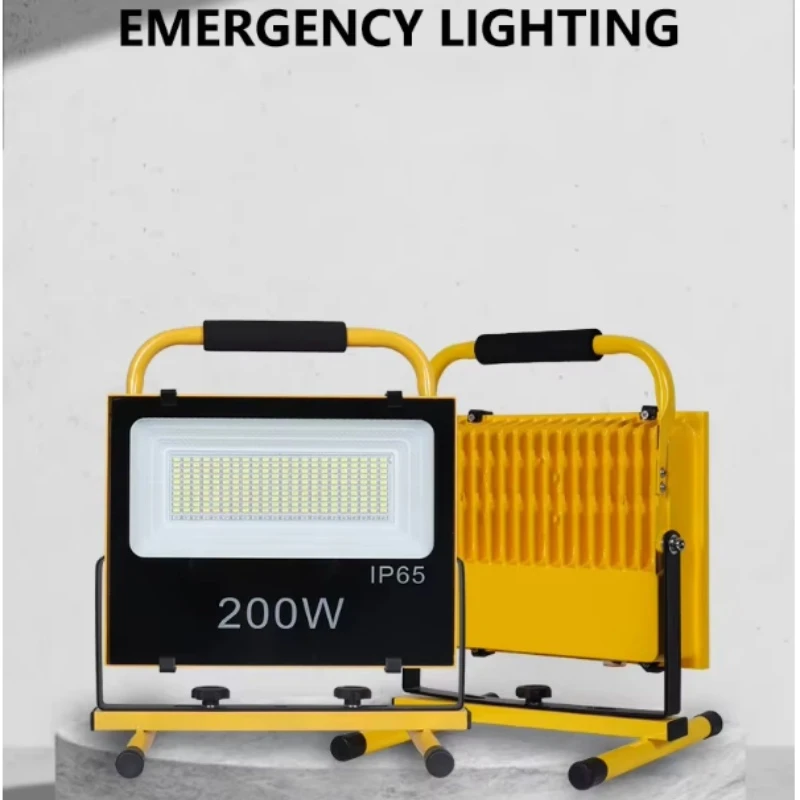
LED floodlights are currently the mainstream lighting fixtures for outdoor and industrial applications, widely used in warehouses, factories, parking lots, construction sites, and commercial billboards. When purchasing floodlights, many buyers struggle with the choice between SMD and COB types. Many purchasers only use brightness as a criterion, neglecting the core differences between the two in terms of luminous effect, heat dissipation, lifespan, and applicable scenarios.
Choosing the wrong type can easily lead to various usage problems: SMD floodlights can produce grainy and uneven illumination at close range; inferior COB floodlights experience faster light decay and higher replacement costs. In fact, SMD and COB floodlights each have their advantages; there is no absolute superiority or inferiority, only differences in suitability for project requirements.
This article will break down the core differences between the two types of floodlights in an easy-to-understand way, outlining their respective advantages, disadvantages, and applicable scenarios to help you quickly select the most cost-effective and suitable floodlight product.
Basic Definitions and Light Emitting Principles
The most fundamental difference between SMD and COB floodlights lies in the LED packaging process, which is also the core factor determining the luminous effect, heat dissipation capacity, and lifespan of the light fixture.
SMD LED Floodlights
SMD, or Surface Mount Device, is a mature and widely used LED packaging technology. Manufacturers package LED chips into individual LED beads and then solder them one by one onto an aluminum substrate. Each SMD LED bead is an independent point light source, emitting light independently without interference.
COB LED Floodlights
COB, or Chip on Board, is a highly integrated packaging process. It eliminates the need for individual LED beads; instead, multiple micro bare chips are densely bonded onto a substrate, encapsulated and cured as a whole, forming a continuous surface light source without individual LED beads.
Core Differences Between SMD and COB Floodlights
Visual Effects of Light Emitting Light
SMD floodlights are point light sources with strong directional light and concentrated brightness, but the spacing between the LEDs is noticeable. At close range and low angles, this results in noticeable graininess and shadow gaps. Large-area illumination is prone to uneven lighting, and slight glare is common.
COB floodlights are integrated surface light sources, producing soft and uniform light. They have no LED particles, no dark areas, better diffused light, effectively eliminate glare, and offer superior overall lighting quality, making them suitable for high-standard uniform lighting scenarios.
Heat Dissipation and Light Decay Performance
Heat dissipation directly determines the lifespan of the luminaire. SMD LEDs are independently distributed with heat dissipation gaps, dispersing heat from each LED and ensuring a stable heat dissipation path. This results in slow light decay and high brightness retention during long-term continuous operation.
COB chips are densely packed, leading to concentrated heat accumulation during illumination. Although the substrate has good thermal conductivity, continuous high-power operation puts greater pressure on heat dissipation, resulting in slightly faster light decay over long-term use compared to SMD luminaires.
Structural Stability and Failure Rate
SMD's independent LED structure boasts extremely high stability. The failure of a single LED will not affect the normal operation of other LEDs; the luminaire will only experience a slight decrease in brightness and can continue to be used. The failure rate is low, and subsequent maintenance is simple.
COB, on the other hand, is an integrated light source structure, requiring extremely high integrity. Damage to a local chip or encapsulation layer will directly cause the entire light source to dim or even turn off, resulting in higher repair difficulty and replacement costs.
Energy Efficiency and Brightness Performance
SMD's mature packaging technology achieves a luminous efficiency of 180 lm/W and above, offering low power consumption, high lumens, and outstanding energy-saving effects. It also boasts higher peak brightness at the same power.
COB's integrated structure reduces light loss and provides better illumination uniformity, but the luminous efficiency of a single LED is slightly lower than that of SMD. At the same wattage, SMD has a higher upper limit for brightness, while COB provides more balanced overall light.
Cost and Price
SMD's simple process and mature technology result in low production costs and high cost-effectiveness, making it suitable for large-scale engineering projects.
COB (Chip-on-Board) LED floodlights utilize high-precision integrated packaging technology, requiring high yield rates and resulting in higher manufacturing costs. Therefore, COB floodlights are slightly more expensive than SMD (Single-Device) floodlights of the same power and configuration.
Comparison of Advantages and Disadvantages of SMD and COB Floodlights
SMD LED Floodlights
Advantages: High luminous efficiency, energy saving, slow light decay, stable heat dissipation, low failure rate; single LED failure does not affect overall use, convenient maintenance, and extremely high cost-effectiveness.
Disadvantages: Can produce a grainy appearance from the LED beads; uneven light at close range; prone to slight glare; average close-range fine lighting effect.
COB LED Floodlights
Advantages: Surface light source, soft and uniform light, no grainy shadows, low glare, high light utilization, and high-quality lighting.
Disadvantages: Higher purchase cost; faster light decay with long-term continuous operation; partial damage leads to overall failure; high maintenance costs.
Applicable Scenarios for Both Types of Floodlights
The core of selection is to match the usage scenario, the performance of the luminaire, and maximize the lighting effect and cost-effectiveness.
SMD Floodlight Application Scenarios
SMD floodlights emphasize high stability, energy efficiency, and cost-effectiveness, making them the preferred choice for industrial engineering. They are suitable for large-area outdoor basic lighting scenarios such as warehouse exterior walls, factory courtyards, roadside areas, temporary construction site lighting, and large parking lots, as well as industrial projects requiring 24-hour continuous lighting and batch installation.
COB Floodlight Application Scenarios
COB floodlights emphasize high-quality lighting effects, suitable for scenarios with high requirements for light uniformity and visual appeal. They are suitable for fine lighting scenarios such as commercial landscape lighting, billboard supplemental lighting, plaza and stadium lighting, exhibition hall outdoor lighting, villa courtyards, and high-end factory exterior wall decorative lighting.
Summary
In general, the core difference between SMD and COB floodlights lies in their packaging technology, resulting in completely different product positioning. SMD floodlights lean towards practical engineering, emphasizing stability, energy efficiency, and cost-effectiveness, suitable for industrial, outdoor basic, and large-scale long-term lighting projects; COB floodlights lean towards visual experience, emphasizing uniform, soft, and high-quality light, suitable for commercial landscapes and high-end lighting scenarios. For most warehouse, factory, and industrial lighting projects, SMD floodlights are the more practical and cost-effective choice. However, for commercial displays, landscaping, and high-end lighting projects, COB floodlights offer superior visual effects. There is no single best-fit lighting fixture; only the most suitable option for your project's needs.
Still struggling to decide between SMD and COB floodlights for your project? Our professional lighting team offers free one-on-one project assessments and customized selection solutions. We'll precisely match lighting fixtures based on your usage scenario, lighting area, brightness requirements, and budget, avoiding the problems of choosing the wrong lights and wasting money. Feel free to contact us anytime!
Our address
No. 5-3 Niujiao Road, Yanchuan Community, Yanluo Subdistrict, Bao'an District, Shenzhen
benwei10@benweilighting.com