LED light strips are currently the most widely used flexible lighting product in interior decoration, commercial lighting, engineering lighting, and cabinet lighting. Many buyers, designers, and cross-border sellers struggle with the choice between traditional SMD LED light strips and newer COB LED light strips when selecting products.
Many people mistakenly believe that the two products differ only in appearance. In reality, they differ significantly in packaging technology, luminous effect, lifespan, applicable scenarios, and cost-effectiveness. Choosing the wrong light strip can lead to problems such as light spots, dark areas, and uneven lighting, and also increase after-sales repair costs. To help you choose the right product and avoid pitfalls, this article provides a comprehensive comparison of the advantages and disadvantages of ordinary LED light strips and COB LED light strips, clearly outlining applicable scenarios to help you quickly determine the appropriate solution.
Differences in Core Manufacturing Principles Between the Two Types of Light Strips
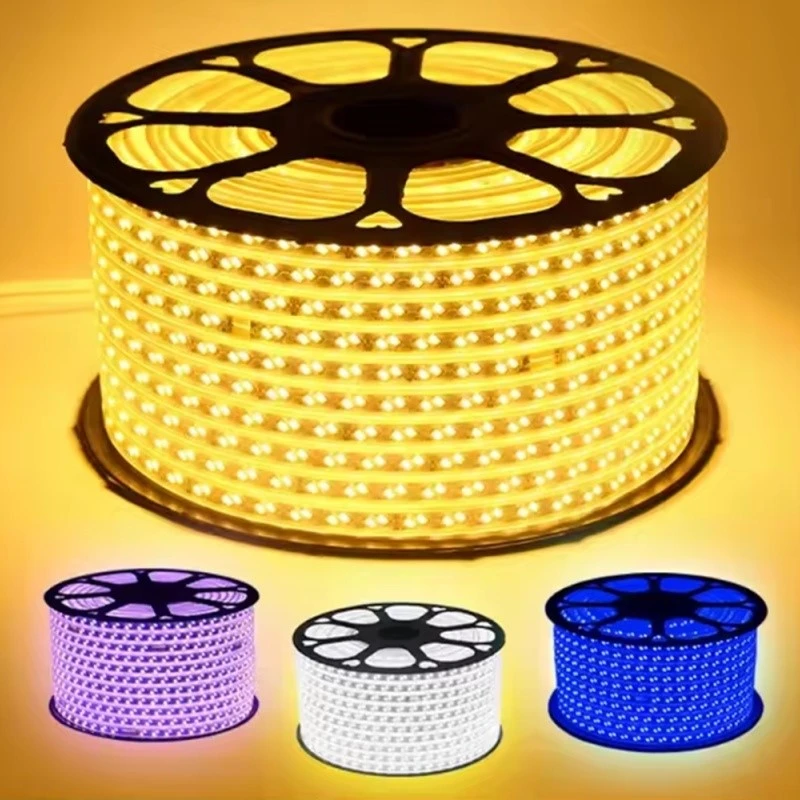
Traditional ordinary LED light strips mostly use SMD surface mount technology, which involves soldering individual LED chips onto an FPC flexible circuit board. Traditional LED strips have a fixed spacing between the LED beads, forming a point-based light-emitting structure. The entire strip relies on individual LED beads for illumination, resulting in a simple structure and mature technology, making it the most basic type of LED strip on the market.
COB LED strips utilize on-board chip packaging technology, abandoning the traditional independent LED bead structure. It directly mounts dozens or even hundreds of micro-LED chips onto a circuit board substrate, then covers the entire surface with a layer of phosphor encapsulant, allowing the light from all the chips to merge into a continuous surface light source structure. This is currently the mainstream product for high-end flexible lighting.
Comparison of Lighting Effect and Visual Experience
Lighting effect is the most intuitive difference between the two types of LED strips and a core factor in selection.
Traditional LED strips emit light in a point-like manner. When viewed up close or installed without obstruction, noticeable graininess, light spots, and uneven brightness appear-the common "LED bead spots" problem. If installed inside acrylic lampshades or linear lights, uneven light and shadow are likely to occur, only meeting basic lighting needs with a generally poor visual quality.
COB LED light strips feature continuous, integrated light emission, eliminating LED breakpoints, dark areas, and graininess. The light is soft and delicate, achieving a seamless linear illumination effect. Furthermore, its beam angle exceeds 120°, far surpassing ordinary LED light strips, resulting in wider light coverage, more uniform light mixing, and smoother, more natural color transitions in RGB color modes, maximizing aesthetics and ambiance.
Flexibility and Installation Compatibility Comparison
Both light strips feature a flexible, bendable design, adaptable to irregular shapes, corners, and curved installation scenarios, but there are significant differences in details.
Traditional SMD LED light strips, due to their protruding individual LEDs, concentrate stress at the LED solder joints during bending. Excessive bending, repeated bending, or right-angle bending can easily lead to solder joint detachment and LED damage, resulting in a lower tolerance for errors when installed in confined or irregularly shaped spaces.
COB LED light strips are flat and without protrusions, with tiny, densely packed chips, resulting in a thinner overall strip and greater flexibility. It can be bent and twisted freely, supporting right-angle, curved, and multi-angle irregular shape installations. The bending process will not damage the light-emitting chips, resulting in a very high installation tolerance and suitability for complex decorative lighting scenarios.
Comparison of Heat Dissipation Performance and Lifespan
The lifespan of lighting products depends primarily on their heat dissipation capacity. The difference in heat dissipation structures between the two light strips directly determines their durability.
Traditional LED light strips have dispersed LED chips, resulting in concentrated heat generation per chip. Heat can only be dissipated through the chip pins and a small portion of the substrate, leading to generally low heat dissipation efficiency. After prolonged high-brightness operation, issues such as accelerated light decay, brightness reduction, and color temperature shift can easily occur, with a typical lifespan of approximately 30,000-50,000 hours.
COB LED light strips utilize a multi-chip, evenly distributed heat distribution, resulting in more uniform heat distribution. Combined with a large-area substrate heat-conducting structure, the overall heat dissipation efficiency is more stable. Although the power of each chip is low, the overall heat generation is balanced, preventing localized high temperatures and effectively slowing down light decay. Under normal operating conditions, the lifespan can reach 50,000-80,000 hours, far exceeding the durability of ordinary LED light strips.
Comparison of Power Consumption, Brightness, and Color Rendering Performance
In terms of brightness, under the same power and length, traditional LED single-point lamp beads have higher focused brightness and stronger single-point burst brightness; while COB light strips are surface light sources, with uniform and transparent overall brightness, without the problem of localized over-brightness and glare, resulting in higher overall luminous efficiency and better light energy utilization.
In terms of color rendering, COB light strips have a significant advantage, with a standard color rendering index reaching CRI90+, and high-end models reaching CRI95+, capable of highly reproducing the true colors of objects with accurate and natural color reproduction. Ordinary LED light strips typically have a color rendering index of around CRI80, with generally lower color reproduction, and are prone to color cast and distortion.
In terms of power consumption, COB light strips have higher luminous efficiency and lower power consumption for the same lighting effect, resulting in greater energy savings over long-term use; ordinary LED light strips have relatively higher light energy loss, resulting in slightly weaker energy-saving effects.
Price and Cost-Effectiveness Differences
In terms of price, traditional LED light strips have mature technology and low production costs, resulting in a more affordable overall price and a significant cost advantage, making them a high-performance, cost-effective basic lighting choice.
COB LED strips have a more complex packaging process and higher quality control standards, resulting in higher raw material costs than ordinary LED strips and a higher final price. However, considering their longer lifespan, better lighting effects, and lower after-sales losses, they offer better overall cost-effectiveness for long-term projects and high-end projects.
Recommendations for Different Scenarios
Scenarios where traditional LED strips are preferred:
- Basic engineering lighting, outdoor contouring, simple cabinet auxiliary lighting
- Limited budget, no high requirements for lighting quality, only basic lighting needs
- Large-area, long-line, low-cost lighting projects seeking high cost-effectiveness
Scenarios where COB LED strips are preferred:
- High-end interior decoration, hotels, villa ceilings, recessed linear lighting
- Jewelry display cases, luxury goods counters, refined lighting for home cabinets
- RGB ambient lighting, trendy light and shadow decorations, scenarios requiring uniform color transitions
- High-end commercial spaces, custom-designed projects, projects with high requirements for lighting quality and durability
Summary
In summary, there is no absolutely better product, only the choice that best suits the scenario. Traditional LED light strips excel in low price, stable manufacturing process, and versatility, making them suitable for all basic lighting and low-cost lighting scenarios, thus offering the best value. COB LED light strips, on the other hand, excel in uniform light, high-quality texture, flexibility, durability, and excellent color rendering, making them suitable for high-end decoration, refined lighting, and aesthetically pleasing ambient lighting scenarios.
If your project prioritizes low cost, basic lighting, and general illumination, ordinary LED light strips are perfectly adequate. However, if you value lighting effects, spatial texture, long-term durability, and a high-end lighting experience with zero glare and no dark areas, COB light strips are the optimal solution.The specifications, brightness, color temperature, and waterproof ratings of light strips on the market vary considerably, often leading to problems such as incorrect selection and substandard quality. We have a full range of LED and COB light strips in stock, supporting customization of color temperature, brightness, length, and waterproof rating to meet various needs, including residential, commercial, engineering, and cross-border shipments.If you are unsure which light strip to choose for your scenario or require a customized solution, please feel free to contact us for consultation.
Our address
No. 5-3 Niujiao Road, Yanchuan Community, Yanluo Subdistrict, Bao'an District, Shenzhen
benwei10@benweilighting.com