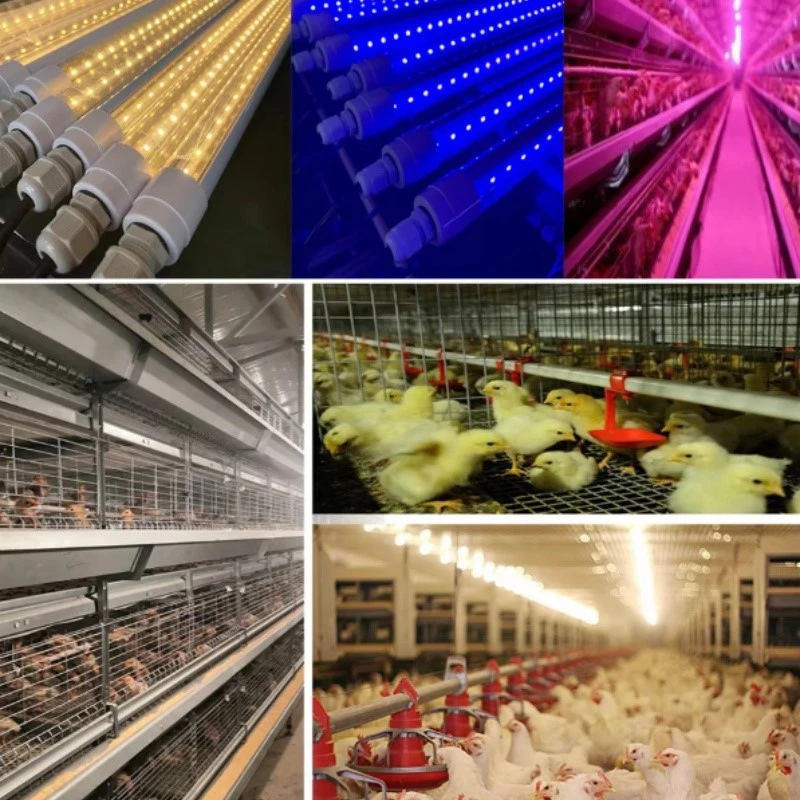
Anyone who has done poultry house lighting renovations knows that lighting in a poultry farm is never as simple as just "brightness." The duration of illumination, spectral composition, color rendering index, and even the lamps' ability to withstand dust and ammonia corrosion within the house all significantly impact egg production, feed conversion rate, and even the overall health of the poultry. In recent years, more and more farms have replaced old incandescent and fluorescent lamps with LED tri-proof lamps. Is this simply following the trend, or is there a genuine reason behind it? Let's discuss this from several perspectives.
The Impact of Light on Poultry Growth and Egg Production
Poultry are actually quite sensitive to light. The duration of illumination directly controls the endocrine rhythms of poultry, especially laying hens. The length of the photoperiod affects the secretion of gonadotropins, thus influencing the initiation and maintenance of egg production. Insufficient light intensity leads to decreased activity and reduced feed intake in the flock; while light sources with a cool spectrum or poor color rendering can easily cause problems such as feather pecking and increased stress responses in poultry. In other words, lighting is not just a tool for illumination; it's more like an invisible "production regulator" in poultry farms.
Shortcomings of Traditional Lighting Fixtures in Poultry Housing Environments
Many poultry houses previously used incandescent bulbs or ordinary fluorescent tubes. While these are fine for home use, they reveal numerous problems in poultry farms. Incandescent bulbs generate a lot of heat, have a short lifespan, and break down quickly, resulting in high labor costs for replacement. Fluorescent tubes generally suffer from flickering, and prolonged exposure to flickering environments makes poultry more prone to stress. Furthermore, traditional lighting fixtures generally have low protection levels. Poultry houses have high concentrations of dust, feathers, and ammonia, making the bulb casings and interfaces susceptible to moisture and corrosion, requiring repairs or even complete replacement after a short period.
Core Advantages of LED Tubes in Poultry Housing Applications
Tri-proof Structure, Adaptable to Harsh Environments
Pig farming-specific LED tubes generally adopt an IP65 or higher protection design. The tubes are waterproof, dustproof, and corrosion-resistant, capable of withstanding humid, dusty, and ammonia-corroded environments, significantly reducing the failure rate.
Flicker-free, reducing poultry stress
High-quality LED drivers can achieve constant current output, essentially eliminating the flicker problem of traditional fluorescent lamps. Under stable lighting, poultry are more calm, reducing feather pecking and startling.
Adjustable spectrum, tailored to farming needs
Some LED tubes support customized color temperature and color rendering index, more closely matching the spectral range sensitive to poultry vision. This helps maintain normal physiological rhythms and allows for more precise control over egg production and growth stages.
Energy-saving and lower long-term operating costs
Compared to incandescent and fluorescent lamps, LEDs have higher photoelectric conversion efficiency, significantly reducing power consumption at the same brightness. For farms requiring long-term supplemental lighting, this difference in electricity costs can add up to a substantial amount annually.
Long lifespan, low maintenance frequency
Poultry houses are inherently difficult to maintain frequently. LED tubes generally have a much longer lifespan than traditional lamps, reducing the frequency of manual replacements and downtime for maintenance, indirectly reducing the risk of light interruptions due to lamp replacements.
Several Details to Consider When Choosing Lighting for Poultry Houses
When purchasing dedicated LED light tubes for poultry farming, it is recommended to focus on whether the protection level meets standards, whether the driver power supply has a constant current anti-flicker design, whether the shell material can resist ammonia corrosion, and whether the installation method of the light fixture facilitates daily cleaning and disinfection. These details may seem trivial, but they actually determine how long the light fixtures can be used stably in the poultry house.
Summary
In summary, replacing poultry house lighting with LED light tubes is not just about saving electricity. More importantly, their protective performance, light stability, and spectral adaptability are better suited to the physiological needs of poultry, indirectly helping farms improve egg production and overall health while reducing maintenance costs. For farms planning to upgrade their poultry house lighting systems, this is indeed a worthwhile investment.
If you are currently selecting poultry house lighting, or would like to learn about LED light tube specifications and customized solutions suitable for your farm environment, please feel free to contact us. Our team will provide specific advice and quotations based on your house environment and farming needs.