

In the field of modern outdoor lighting engineering, flood lamps are classified as core wide-area illumination fixtures and are widely applied in public infrastructure, industrial sites, sports venues, residential security and other scenarios. As a professional terminology in the lighting industry, "flood lamp" has been universally recognized and adopted in global industrial standards and market applications. However, the etymological origin and semantic connotation of this term have not been fully elaborated in conventional lighting research. Different from spotlights, downlights and other directional lighting fixtures with intuitively semantic names, the naming logic of flood lamps is closely related to optical characteristics, functional attributes and practical application scenarios.
This paper systematically explores the origin background, semantic connotation and industrial definition logic of the term "flood lamp", sorts out mainstream academic and industrial theories on its naming source, and further verifies the rationality of the terminology based on the structural characteristics and application value of flood lamps. The research aims to clarify the professional definition of flood lamps, distinguish their semantic differences from other lighting fixtures, and provide a standardized theoretical reference for the professional cognition and industrial application of outdoor lighting terminology.
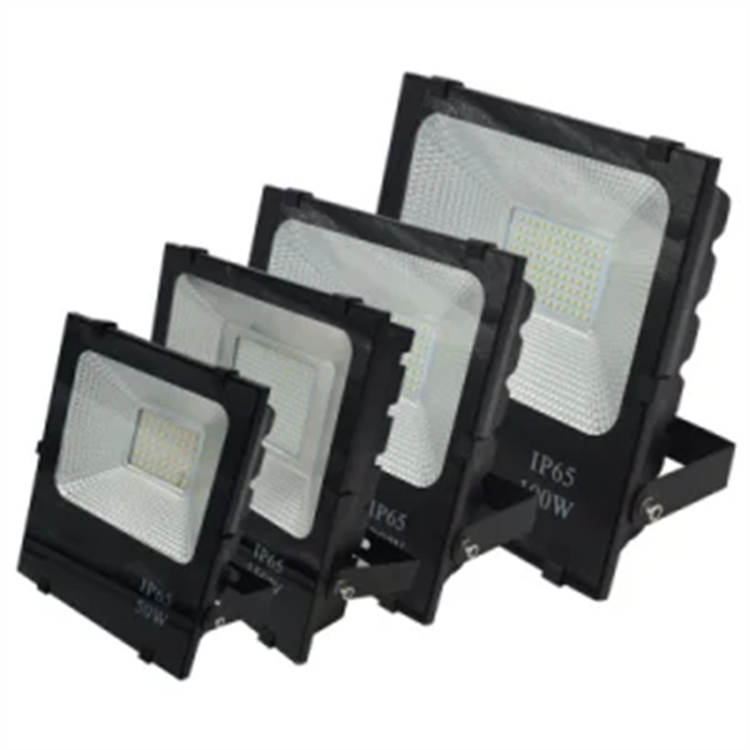
Professional Definition and Optical Characteristics of Flood Lamps
Core Structural and Optical Attributes
A flood lamp is a high-power, high-luminous-flux outdoor lighting fixture designed for large-scale regional illumination. Equipped with optimized optical diffusion lenses and high-efficiency light source modules, the fixture possesses an ultra-wide beam angle, which breaks through the narrow-range irradiation limitation of traditional directional lighting equipment. Different from spotlights that focus light on a fixed point and form high-intensity concentrated beams, flood lamps adopt a uniform light diffusion design, which can disperse light evenly in a large spatial range without obvious light spots, dark areas or glare dead zones.
In terms of industrial technical parameters, qualified flood lamps feature high luminous uniformity and strong environmental coverage capability. Their effective irradiation range far exceeds that of conventional household and commercial lighting fixtures, enabling full-coverage illumination of large open spaces such as sports fields, parking lots, building facades and construction sites. This unique optical diffusion characteristic is the core physical basis for its special naming mode and also the fundamental difference between flood lamps and other functional lighting fixtures.
Functional Positioning in Outdoor Lighting Systems
In the professional outdoor lighting system, flood lamps are positioned as panoramic auxiliary lighting equipment, undertaking the core functions of environmental visualization enhancement, site safety protection and regional scene shaping. Different from decorative lighting fixtures that focus on aesthetic presentation and directional lighting fixtures that focus on local precision illumination, flood lamps take "full-area coverage" as the core functional goal. They can realize synchronous lighting of ground space, building surfaces and spatial corners, completely eliminate low-light visual blind areas, and meet the high-brightness and high-uniformity lighting needs of large open outdoor scenarios.
Mainstream Etymological Theories of the Term "Flood Lamp"
Natural Metaphor Theory Derived from Hydrological Flood Characteristics
The most widely recognized and academically plausible origin theory of the term "flood lamp" is the natural metaphor based on flood diffusion characteristics. In natural environments, flood water presents typical characteristics of wide diffusion, full coverage, no dead corners and rapid regional penetration, which can completely cover all spaces and objects in a specific area in a short time. The optical diffusion law and spatial coverage effect of flood lamps are highly consistent with the propagation characteristics of flood water, forming a unique semantic mapping relationship.
Professional lighting industry terminology evolution shows that early lighting technicians and engineers borrowed the spatial diffusion concept of "flood" to define this type of wide-area lighting fixture. The high-intensity light emitted by flood lamps spreads outward in an all-round way just like surging flood water, flooding every corner of the working area and exposing all environmental details to visible light. This vivid metaphor accurately summarizes the most prominent optical feature of the fixture, and gradually evolved into a unified professional term in the lighting industry, distinguishing it from point-type, line-type and directional surface-type lighting equipment.
Emergency Rescue Scenario Functional Naming Theory
Another influential etymological theory focuses on the functional application scenario of flood lamps in emergency rescue and disaster relief. In the early stage of flood lamp application, this high-power wide-area lighting equipment was mainly put into emergency disposal scenarios such as night rescue, disaster site cleaning and accident emergency response. Different from conventional lighting used for daily scene decoration and basic illumination, flood lamps in emergency scenarios need to quickly form large-area high-brightness lighting coverage in complex and dim environments.
In emergency work, rescue personnel need to "flood the entire disaster area with intense light" in a short time to break through the visual limitation of night low-light environment, quickly locate trapped personnel, identify disaster obstacles, and carry out efficient rescue operations. The term "flood" is used to emphasize the rapid diffusion, large coverage and emergency practicality of light sources, highlighting the core functional value of flood lamps in crisis scenarios. With the continuous expansion of fixture application scenarios, this scenario-based naming logic has been retained and gradually become an important connotation of the term "flood lamp".
Semantic Connotation and Industrial Value of the Term "Flood Lamp"
Inherent Semantic Correlation Between Terminology and Product Attributes
The term "flood lamp" essentially summarizes the two core attributes of the product: spatial coverage and light diffusion. The word "flood" accurately conveys the core characteristics of wide-range diffusion, full-space coverage and no blind-area irradiation, while "lamp" defines its essential attribute as a lighting functional fixture. Compared with other vague and generalized lighting terminology, this naming method integrates product optical characteristics and functional advantages, with strong professionalism and scenario recognition.
In the industrial classification standard, the definition of flood lamps has always centered on the "flooding optical effect". All products conforming to the characteristics of wide-beam diffusion, large-area uniform illumination and panoramic coverage can be classified as flood lamps, which forms a clear technical classification boundary for the lighting industry and avoids the confusion of terminology application.
Practical Application Value Derived from Naming Connotation
Based on the core connotation of "light flooding coverage", flood lamps have formed a mature industrial application system, covering commercial public scenarios, industrial engineering scenarios and residential security scenarios. In sports venues, parking lots, logistics docks and other public commercial areas, flood lamps rely on their flooding light effect to realize all-site uniform illumination, ensuring the safety and order of personnel and vehicle activities.
In construction sites, outdoor engineering and other industrial scenarios, the full-coverage lighting advantage of flood lamps eliminates construction visual blind areas, guarantees the safety and efficiency of night construction operations. In residential outdoor security scenarios, the flooding high-brightness light can effectively illuminate courtyard corners, building peripheries and other hidden areas, deter illegal intrusion behaviors, and improve residential safety defense capabilities.
Conclusion
To sum up, the term "flood lamp" is a professional industry terminology formed based on the optical diffusion characteristics and functional attributes of lighting fixtures, with unique etymological connotation and practical industrial value. Although the exact historical origin of the terminology cannot be completely verified due to the limitations of early industrial literature records, the two mainstream theories of natural flood metaphor and emergency rescue functional definition can effectively explain its naming logic.
The core essence of the name lies in the unique "flooding" optical effect of the fixture, that is, the light can diffuse and cover the target area in an all-round and large-scale manner just like flood water. As a special wide-area outdoor lighting equipment, flood lamps have been widely recognized in the industry by virtue of their accurate terminology positioning and superior functional performance. They play an irreplaceable role in public safety, industrial construction, residential security and other fields, and have become an indispensable core component of modern outdoor lighting engineering systems.

How To Cooperate With Us?
Our firm prides itself on owning its own factory, guaranteeing complete control over the production process and the quality of our goods. We are not only agents; we are manufacturers committed to offering our clients the most competitive rates available. We invite consumers to evaluate our samples first, as we are assured that the quality and pricing of our items are self-evident. Our dedication to excellence and client satisfaction compels us to consistently perform at our best and provide superior quality products.
Our address
3rd Floor, 5th Building, Hebei Industrial Park, Hualian Community, Longhua District, Shenzhen, China





