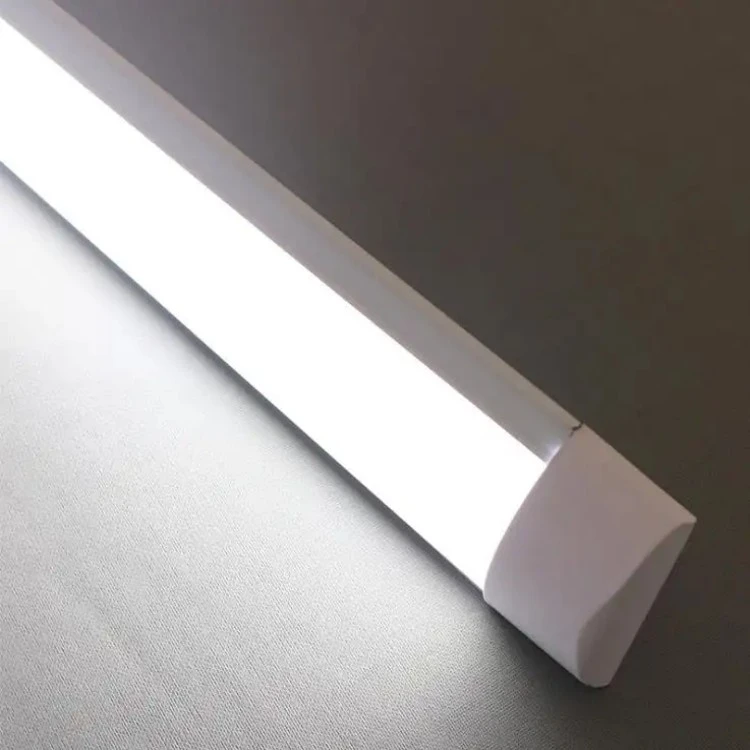
When video production professionals transition to LED ceiling lighting, they often experience the same unpleasant surprise: when examined at full resolution, film taken under lights that seem perfectly steady to the unaided eye reveals rhythmic banding, strobing, or exposure fluctuation. The LED driver's current management is directly responsible for the issue, which is temporal light modulation. In order to choose the best LED batten fixture for a studio operator, podcast presenter, corporate videographer, or content producer equipping a specialised production area with overhead battens, it is necessary to comprehend five distinct technical factors that are seldom highlighted in typical luminaire datasheets. This tutorial explains what those requirements are, what figures to ask for, and how to confirm them before making a transaction.
The Reasons Behind LED Batten Fixtures' Camera Flickering
Pulse Width Modulation (PWM), a technology that quickly shifts the LED between completely on and totally off at a predetermined frequency to provide a dimmed look, is used for dimming in the majority of white LED lighting intended for broad commercial usage. The percentage of time spent in the "on" state (the duty cycle) is correlated with the perceived brightness. Flicker appears as a strobe effect to the human eye at PWM frequencies lower than around 100 Hz. Most people cannot see it between 100 Hz and 1.25 kHz, but cameras can still detect it, especially at higher frame rates or when paired with certain shutter speeds. Sources with 100% modulation depth, such PWM dimmers, become typically acceptable beyond 1.25 kHz, although residual stroboscopic effects on moving objects are still conceivable up to 3 kHz and perhaps higher.
The presence of banding in video is determined by the relationship between PWM frequency and camera shutter speed. The camera records different parts of the LED's on/off cycle in different frames if the PWM cycle and the camera's shutter cycle are not in perfect synchrony or a whole-number ratio. This results in frames with varying brightness and the distinctive rolling bands or flickering exposure that ruin otherwise clear footage. The issue is exacerbated with high-frame-rate video (120 fps, 240 fps, or higher for slow-motion applications) since frequency mismatches are more common due to the shorter inter-frame gap.
The Risk Particular to Cameras: High Shutter Speeds and Frame Rates
With fixtures running at 500 Hz PWM, a frequency frequently advertized as "flicker-free" for human eye comfort, standard broadcast video at 24 or 30 frames per second may cause issues. Because the camera takes 120 pictures per second, each of which integrates over a relatively brief shutter window, 500 Hz PWM is still inadequate for high-speed video at 120 frames per second. Lighting professionals that specialise in cinema and photography applications advise using LED drivers with PWM frequencies of at least 25,000 Hz (25 kHz). This frequency eliminates the secondary issue of PWM-induced buzzing from driver components and is beyond the human auditory range, so even high-frame-rate and high-shutter-speed applications are free of visual modulation effects.
The Five Factors Affecting Flicker Performance
The LED batten's suitability for video production applications is determined by five technical criteria.
1. PWM Dimming Frequency: at least 25 kHz
The most crucial need for camera situations is this one. For almost all realistic frame rate and shutter speed combinations in professional video production, a driver running at 25 kHz or above removes camera-visible flicker. Fixtures sold with PWM frequencies between 200 and 400 Hz are appropriate for both human visual comfort and broad commercial usage, however they can cause artefacts when captured by high-speed cameras. The PWM frequency should always be requested from the driver datasheet rather than the luminaire specification sheet, which often leaves this information out.
2. Flicker Percentage: ≤ 5%
The amplitude of light output modulation is measured by Percent Flicker (PF), which is a percentage that represents the ratio of the difference between maximum and minimum brightness to their total. A number of 100% implies that the source moves from completely on to fully off every cycle, while a value of 0% shows output that is entirely constant. The objective threshold for video environments is a PF of 5% at any frequency below 200 Hz; this corresponds to the "flicker-free" classification used in California's Title 24 building rules, which continue to be among the strictest built-environment flicker requirements worldwide. It should be noted that PF by itself is insufficient: a source with 10% modulation at 50 Hz is troublesome, but a source with 100% modulation at 30 kHz is both camera-safe and human-safe. Frequency and PF must always be assessed together.
3. SVM (Stroboscopic Visibility Measure): < 0.4
The stroboscopic effect, or the possibility that moving objects would seem to stutter, freeze, or create ghost pictures under flickering light, is measured by SVM, a perceptual metric. In the region of 80 Hz to 2 kHz, where stroboscopic effects are most physiologically active, it incorporates modulation depth and frequency weighted against human visual system sensitivity. The average observer's visibility threshold is represented by an SVM value of 1.0; values greater than 1.0 indicate observable stroboscopic artefacts. The aim for video studios and broadcast situations is SVM ≤ 0.4, which offers a substantial buffer against stroboscopic effects for both moving subjects caught on camera and human inhabitants. For high-precision industrial jobs requiring spinning equipment, this level is also advised.
4. Colour Rendering: R9 ≥ 50, CRI ≥ 90

Only when the light source precisely depicts all of a subject's spectral components can video cameras capture and replicate colour. Skin tones, clothing colours, product hues, and surrounding aspects are all faithfully replicated to mirror the subject's look in natural light when the CRI is 90 or above. The ideal criteria is CRI 95 or above, with R9 (deep red rendering) > 50, for studio situations where colour fidelity is a production value, such as interview settings, product presentations, and cosmetic applications. Another reason driver quality is important when choosing studio fixtures is that high-CRI phosphor LEDs usually need a little more careful driver design to maintain constant CCT under dimming. A TLCI of 90+ is recommended for professional broadcast applications. TLCI (Television Lighting Consistency Index) is a companion statistic that is becoming more and more popular and is particularly calibrated to broadcast camera response.
5. UGR < 19
The Unified Glare Rating (UGR) measures how uncomfortable glare is for those who are in a bright area. A UGR ≤ 19 reduces squinting, pupil reflexes that impact camera focus, and discomfort during long sessions in a studio setting where performers, presenters, or subjects are positioned under overhead lights and camera operators must watch monitors precisely. The brightness distribution of the light, the geometry of the room, and the reflectance of surfaces all affect UGR; nonetheless, a fixture's datasheet UGR value, which is often given for a specific room condition, offers a helpful baseline for comparison.
The Architecture Difference Between PWM Dimming and Constant Current Drivers
Constant current reduction (CCR) dimming, often known as analogue dimming, is an alternative to PWM dimming that lowers LED brightness by lowering the driving current instead of turning it on and off. By definition, CCR generates zero modulation at the driving frequency; for all dimming levels, the output is really constant. The trade-off is that as current drops, CCR produces a tiny change in CCT (LEDs move warmer at reduced currents), which may create calibration problems in studio settings where colour is crucial. A hybrid technique is used by certain high-quality LED drivers, which switch from analogue dimming at higher light levels when CCT change is noticeable to high-frequency PWM (≥ 25 kHz) at lower levels where the CCT shift from CCR is more noticeable. Knowing which dimming topology the driver use is crucial for studio batten fixtures that will be color-matched and dimmed during a production.