

Introduction: The Evolution of the Broadcast Studio
The High-Definition Imperative
The human eye is highly adaptive, but a television camera is not. When a football match is broadcast to millions of viewers, the lighting must flawlessly support the camera's sensor. From the sharpest panning shots tracking a winger down the flank to the extreme close-ups of a player's face during a goal celebration, the light must remain consistent. If the lighting is substandard, the broadcast suffers from "ghosting," flickering, washed-out colors, and distracting lens flares.
The Financial Fallacy of Substandard Lighting
When football clubs or municipalities procure lighting, the initial purchase price is often the primary focus. However, a fixture that fails to meet broadcast standards is essentially a financial liability. It prevents the stadium from hosting televised matches, thereby eliminating lucrative broadcasting revenue, sponsorships, and global exposure. Furthermore, substandard lighting often lacks the thermal durability to last, leading to a "maintenance death spiral" where fixtures are constantly failing and requiring expensive crane rentals to replace them. Broadcast-quality lighting is an investment in the venue's economic future.
The Core Physics of Broadcast-Quality Illumination
To achieve a broadcast-ready environment, the lighting system must satisfy several critical photometric and electronic parameters.
Vertical Illuminance and Uniformity
Lighting the Player, Not Just the Pitch
Traditional lighting focused on horizontal illuminance (light hitting the ground). Broadcast cameras, however, film the players from a multitude of angles. Therefore, the lighting must provide sufficient vertical illuminance-light that hits the players and the ball from all sides. This ensures that the players are not shadowed or silhouetted against the bright green grass.
The Tolerances of UHD Cameras
UHD cameras have an incredibly high dynamic range but a very low tolerance for uneven lighting. The ratio between the brightest and darkest points on the pitch must be meticulously controlled. The optical design of the fixture must ensure uniform light distribution, preventing "hot spots" that cause the camera's auto-exposure to overcompensate, thereby darkening the rest of the field.
Flicker-Free Technology
The Strobing Effect in Slow Motion
LEDs are powered by electronic drivers. If the driver is of low quality, it will output a pulsating current, causing the LED to flicker at a frequency invisible to the human eye but highly visible to high-speed broadcast cameras. When a crucial offside call is replayed in super slow motion, flickering lights result in alternating bands of dark and light, rendering the footage unusable.
High-Frequency Driver Stability
Broadcast-quality fixtures utilize premium LED drivers capable of outputting a perfectly smooth, flicker-free current. This ensures that even at frame rates exceeding 1,000 frames per second, the light output remains constant, providing crystal-clear slow-motion replays.
Color Rendering Index (CRI) and Temperature
True-to-Life Colors
A high CRI (ideally 80 or higher, approaching 90 for elite venues) ensures that the colors seen by the camera are identical to what the human eye perceives. High CRI makes the green pitch look natural, the team kits vibrant, and skin tones accurate. If the CRI is low, the broadcast will look artificially washed out or have a sickly greenish hue.
Optical Excellence: The Secret to Zero-Glare and Ultimate Clarity
The most critical optical challenge in stadium lighting is managing glare. Glare is not only a nuisance; it actively degrades the visual performance of the players and the technical performance of the broadcast cameras.
The Anatomy of Broadcast Glare
Lens Flare and Contrast Washout
When an LED fixture emits light directly into a broadcast camera lens, it causes lens flare-an artifact that scatters light across the image sensor. This effectively lowers the contrast of the entire shot, making the field look hazy and dull.
Disability Glare for Players
For a goalkeeper tracking a high ball, or a striker looking for an open goal, unshielded LED light causes disability glare. This condition temporarily blinds the athlete, posing a severe safety hazard and disrupting the integrity of the match.
The Nexus Solution: Advanced Low-Glare Optical Lenses
Micro-Lens Array Technology
To solve the glare problem, the Nexus LED Stadium Light utilizes advanced low-glare optical lenses. The surface of the lens features a highly precise micro-lens array (thousands of microscopic indentations). This array acts as a massive diffuser, shattering the harsh, concentrated "point source" of the LED chip into a soft, uniform, and highly controlled light field. This dramatically reduces both discomfort and disability glare.
UV-Stabilized Polycarbonate Material
The lenses are crafted from high-grade, UV-stabilized polycarbonate. This material offers exceptional light transmission rates while resisting yellowing and degradation from prolonged sun exposure. This ensures that the optical clarity and color temperature remain perfectly consistent for the entire 50,000-hour lifespan of the fixture, guaranteeing that broadcast quality never degrades over time.
Precision Beam Control with Various Distribution Angles
Tailoring Light to the Football Pitch
Football pitches vary in size and surrounding infrastructure. To achieve perfect uniformity and eliminate light spill (which causes glare for players and neighbors), the lighting must be precisely aimed. The Nexus series offers various light distribution angles (e.g., 10°, 25°, 45°, 60°, and asymmetrical options).
Asymmetrical Optics for Light Pollution Control
For stadiums located near residential areas, our asymmetrical lenses are a game-changer. They push light strictly forward and downward onto the pitch, completely eliminating upward light spill. This prevents glare for players, protects the night sky (Dark Sky compliance), and ensures that 100% of the lumens are utilized exactly where they are needed.
Thermal Management: The Invisible Engine of Broadcast Reliability
A broadcast-quality light must not only look good on day one; it must maintain that exact optical performance over years of use. This is entirely dependent on thermal management.
The Threat of Heat to Broadcast Quality
Lumen Depreciation and Color Shift
As LEDs heat up, their efficiency drops, and the phosphor coating degrades. This results in lumen depreciation (the light dims) and chromaticity shift (the color temperature changes). Over time, a poorly cooled stadium will develop unevenly dimmed and discolored patches on the pitch. This violates broadcast standards and requires complete fixture replacement.
The Nexus Thermodynamic Architecture
High Thermal Conductivity Materials
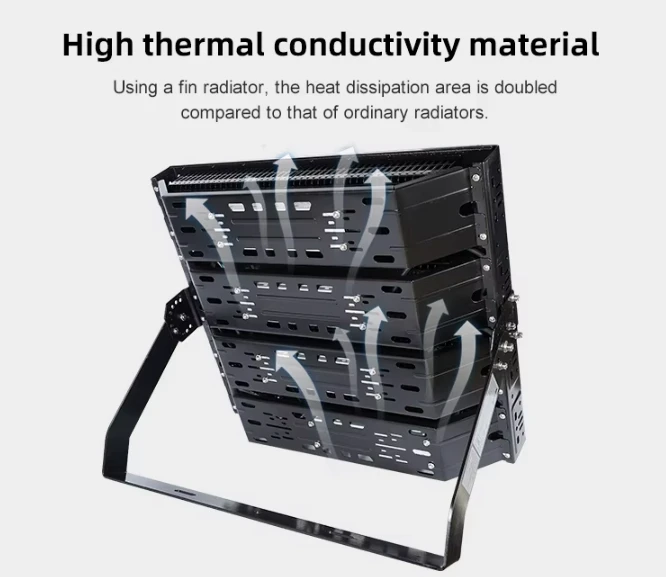
The fixture is constructed using a specialized, high-pressure die-cast aluminum alloy. This acts as a massive "thermal sponge," rapidly absorbing heat from the LED junction and spreading it evenly across the entire chassis to prevent dangerous localized hot spots.
Doubling Heat Dissipation with Fin Radiators
To dissipate this heat into the air, we utilize an advanced fin radiator design. Unlike ordinary fixtures that use flat backplates, our design features dozens of densely packed aluminum fins. This effectively doubles the heat dissipation area, providing twice the surface area for the air to interact with.
The Power of Strong Air Convection
The fin channels are vertically aligned to harness the principle of strong air convection. As the fins heat up, the air within the channels warms and rises, creating a continuous, passive updraft (the Chimney Effect). Cool air is constantly drawn in from the bottom, absorbs the heat, and exits out the top. This ensures the LED junction operates at optimal temperatures, guaranteeing consistent, broadcast-quality light output for decades.
Structural Durability: Protecting Your Broadcast Asset
Broadcast equipment is expensive; it must be protected from the elements. Weather, wind load, and thermal cycling can rapidly destroy a poorly built fixture.
The IP65 Waterproof Standard
Defeating Wind-Driven Rain
A football stadium is entirely exposed to the elements. The IP65 waterproof rating is non-negotiable. The "6" ensures the fixture is completely dust-tight, protecting the optical chamber and internal electronics. The "5" ensures protection against high-pressure water jets from any direction, meaning the fixture can survive torrential downpours driven by hurricane-force winds, as well as high-pressure washdowns from maintenance crews.
The Science of Heavy-Duty Stainless Steel Clasps
The Fatal Flaw of Standard Fasteners
Most standard fixtures use painted carbon steel screws to secure the optical lenses. Over time, the paint chips, the steel rusts, and the pressure on the waterproof gasket is lost. Water enters, and the light dies. Conversely, cheap plastic clasps become brittle under UV light and heat, eventually cracking.
The Unyielding Seal
The Nexus series utilizes heavy-duty stainless steel clasps to secure the optical modules. These clasps are highly corrosion-resistant and possess immense tensile strength. Crucially, they apply a perfectly uniform, evenly distributed pressure across the entire length of the silicone gasket. When the fixture undergoes extreme thermal cycling (expanding in the heat of the game and contracting in the cold of night), the stainless steel clasps act like microscopic springs, maintaining the seal and preventing moisture from ever entering the optical chamber.
Structural Integrity in High Winds
The Thickened 180-Degree Adjustable Bracket
Stadium lights are mounted high on masts where wind speeds are severe. The fixture acts as a massive sail. To prevent movement or structural failure, the light must be anchored securely. The Nexus fixture features a thickened 180-degree adjustable bracket. This heavy-duty mounting system allows for precise aiming of the light beam to perfectly match the stadium's geometry, while its reinforced steel construction ensures the fixture remains rock-solid, preventing drooping or swaying during high winds.
The Economic Impact: TCO and Revenue Generation
Reducing Total Cost of Ownership (TCO)
Eliminating the Maintenance Death Spiral
The most significant cost in stadium lighting is not the fixture itself, but the labor required to maintain it. Renting cranes, hiring certified electricians, and closing the facility for maintenance costs thousands of dollars per day. By upgrading to a fixture with IP65 waterproofing, doubled heat dissipation areas, and rust-proof stainless steel clasps, facility managers eliminate the cycle of premature failures. The lighting grid becomes a "fit-and-forget" asset, vastly reducing TCO.
Unlocking Broadcast Revenue Streams
Hosting Higher-Tier Events
A facility with broadcast-compliant lighting can host professional matches, tournaments, and televised events. This directly unlocks new revenue streams through ticket sales, concessions, and broadcasting rights. Upgrading your lighting is not just an expense; it is a catalyst for economic growth.
OEM/ODM Customization: Tailoring the Solution to Your Stadium
Meeting Specific Broadcast and Environmental Standards
Every football stadium presents unique challenges. Through comprehensive OEM/ODM customization, we can tailor the lighting to your specific needs.
Climate-Specific Engineering
If your stadium is located in a highly corrosive coastal environment, we can upgrade the hardware to marine-grade 316 stainless steel clasps. If you are in an extremely hot desert climate, we can optimize the fin geometry and driver specifications to ensure maximum thermal efficiency at ambient temperatures exceeding 50°C (122°F).
Smart Grid Integration
For modern "Smart Stadiums," our ODM capabilities allow for the integration of IoT thermal and power monitoring sensors. This allows facility managers to track the health of every fixture in real-time from a central dashboard, enabling predictive maintenance and proactive power management.
Conclusion: The Ultimate Broadcast Upgrade
The Standard of Excellence
Achieving broadcast-quality lighting is the ultimate goal for any premier football stadium. It requires a holistic integration of optical precision, thermodynamic engineering, and rugged structural durability. The Nexus LED Stadium Light series represents the pinnacle of this engineering. With its low-glare optical lenses, high thermal conductivity fin radiators, and heavy-duty stainless steel clasps, it is purpose-built to deliver uninterrupted, high-definition illumination for the world's most demanding sports venues.
Partner with Us
Do not let substandard lighting hold your facility back from hosting world-class events. Upgrade your stadium with lighting that is scientifically engineered for the broadcast era.

How To Cooperate With Us?
We are happy to have total control over the manufacturing process and the calibre of our products since we have our own facilities. Since we are producers rather than just brokers, we are dedicated to providing our customers with the best pricing. Since we are certain that the price and quality of our products are clear, we invite customers to see our samples first. Our commitment to quality and customer satisfaction drives us to continuously provide top-notch goods.
Our address
3rd Floor, 5th Building, Hebei Industrial Park, Hualian Community, Longhua District, Shenzhen, China





