

Introduction: The Paradigm Shift in Sports Infrastructure
The Multi-Tiered Reality of Sports Venues
Sports facilities are not monolithic. A rural training ground, a municipal multi-use sports complex, and a FIFA-certified professional stadium have vastly different operational constraints. However, they all share a common denominator: the need for reliable, high-quality, and energy-efficient illumination. Upgrading lighting is often the first step in modernizing a facility, as it offers the most immediate impact on player safety, spectator experience, and operational costs.
The High Stakes of Incorrect Procurement
Facility managers often make the critical error of buying lighting based solely on the lowest initial purchase price. This "race to the bottom" inevitably leads to catastrophic premature failures, expensive maintenance cycles (requiring cranes and specialized labor), and non-compliance with sporting regulations. True procurement must evaluate the Total Cost of Ownership (TCO) and the fixture's ability to scale with the facility's ambitions.
The Objective of This Guide
This guide is engineered to walk you through the evolutionary stages of sports lighting upgrades. From the foundational requirements of local fields to the stringent demands of pro stadiums, we will highlight exactly what technical specifications-such as IP65 waterproofing, low-glare optical lenses, high thermal conductivity materials, and heavy-duty stainless steel clasps-are required to build a lighting system that is built to endure and designed to perform.
Tier 1: Upgrading Local and Community Fields
Local fields are the bedrock of sports. While they do not host global broadcast events, they require lighting that ensures player safety, extends practice hours, and minimizes energy waste.
Basic Visibility and Player Safety
Illuminance and Uniformity
On a local field, shadows are the biggest hazard. Uneven lighting can lead to twisted ankles, missed catches, and poor spatial awareness. Upgrading from legacy metal halide systems to modern LEDs instantly provides higher uniformity. You must look for fixtures that utilize various light distribution angles to ensure that the light covers the entire field evenly, eliminating dark corners.
Eliminating Harsh Glare
Even at the community level, glare is a nuisance. It causes eye fatigue for players and annoys neighbors living adjacent to the field. By upgrading to fixtures with low-glare optical lenses (featuring micro-lens arrays), the harsh, piercing light from the LEDs is diffused into a soft, comfortable, and highly controlled beam. This also prevents light trespass into surrounding residential areas.
Environmental Resilience on a Budget
The Necessity of IP65 Waterproof Rating
Local fields often lack the maintenance budgets of professional stadiums. Therefore, the fixtures must be inherently low-maintenance. An IP65 waterproof rating is non-negotiable. It ensures that the fixture is completely dust-tight and can withstand heavy rain and high-pressure water jets. This prevents catastrophic electrical failures and internal condensation, which is the leading cause of premature LED death.
Why "Heavy-Duty Stainless Steel Clasps" Matter
While cheap plastic or painted carbon steel screws are common in budget fixtures, they inevitably rust or become brittle under UV exposure. The moment the fastening system fails, the waterproof seal is broken. Upgrading to a fixture that utilizes heavy-duty stainless steel clasps guarantees that the optical lens remains perfectly sealed to the housing for decades, protecting your investment from the elements.
Tier 2: Upgrading Semi-Professional and Academy Venues
As facilities move up the competitive ladder, the lighting requirements shift from mere visibility to performance optimization. Academy and semi-pro venues require lighting that can support intensive training, varied sports, and regional broadcasting.
Multi-Sport Adaptability
The Power of the 180-Degree Bracket
Modern academies often host multiple sports (soccer, track, tennis, field hockey). The lighting must be adaptable to these different field geometries. An absolute game-changer is the thickened 180-degree adjustable bracket. This allows maintenance crews to precisely aim the fixtures to accommodate different sports, while its heavy-duty construction ensures the light remains rock-solid in high winds without "drooping" over time.
Advanced Thermal Management for Extended Usage
The Enemy of Longevity: Junction Temperature
Academies use their lights for hours every evening. This prolonged usage generates immense heat within the LED junction. If the fixture lacks advanced cooling, the light will suffer from severe lumen depreciation (dimming) and color shifting within just a few years.
The Fin Radiator Breakthrough
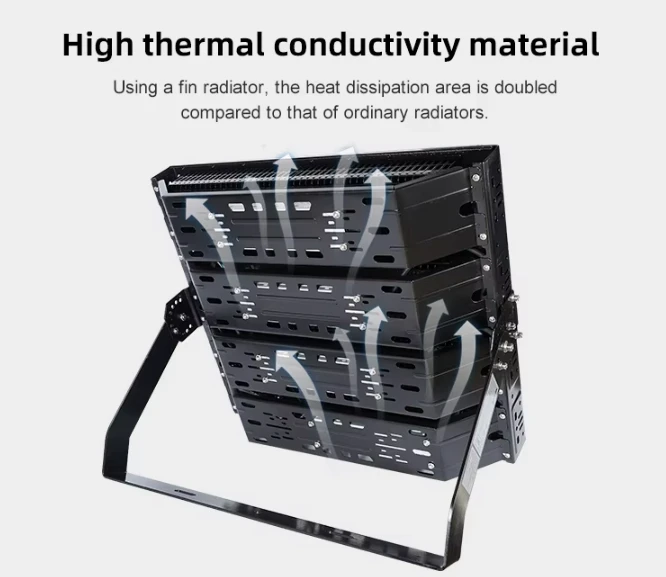
Upgrading to the Nexus series introduces high thermal conductivity materials and an advanced fin radiator design. By effectively doubling the heat dissipation area compared to ordinary radiators, the fixture pulls heat away from the LED at an incredible rate. This ensures that the light output remains consistent and vibrant, day after day, year after year.
Tier 3: Upgrading to Professional Stadiums
The pinnacle of sports lighting is the professional stadium. Here, the margin for error is zero. A flicker during a penalty kick or a glare-induced error during a live 4K broadcast is unacceptable. This tier demands the absolute zenith of optical and thermal engineering.
Broadcast-Grade Optical Excellence
Meeting FIFA and UEFA Standards
Professional stadiums must adhere to strict broadcast standards (e.g., FIFA Quality Pro). These standards dictate vertical and horizontal illuminance, uniformity, flicker control, and-most importantly-Glare Rating (GR). The low-glare optical lenses in professional-grade fixtures are engineered to direct light precisely onto the field of play while entirely eliminating upward light spill and obtrusive glare.
High-Definition Camera Compatibility
Modern 8K cameras require lighting with a high Color Rendering Index (CRI) and flicker-free drivers. By utilizing UV-stabilized polycarbonate lenses and precise micro-optics, the fixture delivers a broadcast-ready light quality that ensures viewers at home see every bead of sweat and every blade of grass without lens flare or strobing.
Extreme Thermal Engineering
Harnessing Strong Air Convection
A professional 1500W LED stadium light generates massive amounts of heat. To maintain maximum efficiency, the fixture must utilize the principle of strong air convection. As the vertically aligned fin radiators heat up, the air inside the channels becomes less dense and rises. This creates a continuous, passive "Chimney Effect"-drawing cool air in from the bottom and expelling hot air out the top. This natural thermodynamic cycle ensures maximum cooling without the need for mechanical fans that could fail.
Internal Chip Spiral Heat Dissipation
To complement the external fins, the internal architecture utilizes chip spiral heat dissipation. This distributes the thermal load uniformly across the entire aluminum mass, eliminating dangerous "hot spots" that degrade the LED phosphor. This extreme thermal management is what guarantees the fixture's 50,000+ hour lifespan.
Ultimate Structural Durability
Withstanding Hurricane-Force Winds
Stadium lights are mounted on high masts, where wind speeds are drastically higher than at ground level. The fixture acts as a massive sail. The structural integrity relies on the heavy-duty stainless steel clasps. These clasps apply uniform, unyielding pressure across the optical lenses, preventing warping or blow-outs under immense aerodynamic stress. Furthermore, they maintain the IP65 seal through thousands of thermal cycles (expansion and contraction) without losing tension.
The Financial Equation: Why Upgrading is a Smart Investment
Total Cost of Ownership (TCO) Analysis
Eliminating the Maintenance Death Spiral
The most significant cost in stadium lighting is not the fixture itself, but the labor required to maintain it. Renting cranes, hiring certified electricians, and closing the facility for maintenance costs thousands of dollars per day. By upgrading to a fixture with IP65 waterproofing, doubled heat dissipation areas, and rust-proof stainless steel clasps, facility managers eliminate the cycle of premature failures. The lighting grid becomes a "fit-and-forget" asset.
Unlocking Revenue Streams
Hosting Higher-Tier Events
A facility with broadcast-compliant lighting can host professional matches, tournaments, and televised events. This directly unlocks new revenue streams through ticket sales, concessions, and broadcasting rights. Upgrading your lighting is not just an expense; it is a catalyst for economic growth.
OEM/ODM Customization: Tailoring the Upgrade to Your Facility
Meeting Specific Environmental and Architectural Needs
Every upgrade project is unique. Through comprehensive OEM/ODM customization, we provide tailored solutions for your facility.
Climate-Specific Engineering
If your stadium is located in a highly corrosive coastal environment, we can upgrade the hardware to marine-grade 316 stainless steel. If you are in an extremely hot desert climate, we can optimize the fin geometry and driver specifications to ensure maximum thermal efficiency at ambient temperatures exceeding 50°C (122°F).
Smart Grid Integration
For modern "Smart Stadiums," our ODM capabilities allow for the integration of IoT thermal and power monitoring sensors. This allows facility managers to track the health of every fixture in real-time from a central dashboard, enabling predictive maintenance and proactive power management.
Conclusion: The Ultimate Upgrade Checklist
The Evolution of Your Facility
Upgrading sports lighting is a journey. It is the transition from merely playing in the dark to competing under world-class, broadcast-ready illumination. To ensure your investment withstands the test of time, your upgrade must include:
Optics: Low-glare optical lenses with various distribution angles.
Thermal: High thermal conductivity materials, strong air convection, and fin radiators that double the heat dissipation area.
Durability: An IP65 waterproof rating and heavy-duty stainless steel clasps to maintain the seal.
Flexibility: A thickened 180-degree adjustable bracket for precise aiming.
Partner with the Industry Leader
Do not let substandard lighting hold your facility back. Whether you are illuminating a local community pitch or upgrading a professional championship stadium, the Nexus LED Stadium Light series is engineered to deliver ultimate performance, durability, and efficiency.
Ready to begin your lighting upgrade? Contact our engineering and sales team today to request a customized photometric simulation and discover how our OEM/ODM capabilities can transform your sports facility.

How To Cooperate With Us?
We are happy to have total control over the manufacturing process and the calibre of our products since we have our own facilities. Since we are producers rather than just brokers, we are dedicated to providing our customers with the best pricing. Since we are certain that the price and quality of our products are clear, we invite customers to see our samples first. Our commitment to quality and customer satisfaction drives us to continuously provide top-notch goods.
Our address
3rd Floor, 5th Building, Hebei Industrial Park, Hualian Community, Longhua District, Shenzhen, China





