

Advanced Optical Engineering in LED Stadium Lights: A Technical Analysis of Multi-Point Refraction Technology
Abstract: This technical paper examines the optical innovation in modern LED stadium lighting systems, with a focus on multi-point refraction technology as detailed in patent CN220707146 U. We analyze the engineering principles that enable superior light distribution, uniformity, and visual comfort for large-scale sports facilities. Adhering to EEAT principles, the article integrates authoritative data, performance metrics, and comparative analysis to serve lighting designers, facility engineers, and procurement decision-makers.
1. What is Multi-Point Refraction Technology in an LED Stadium Light?
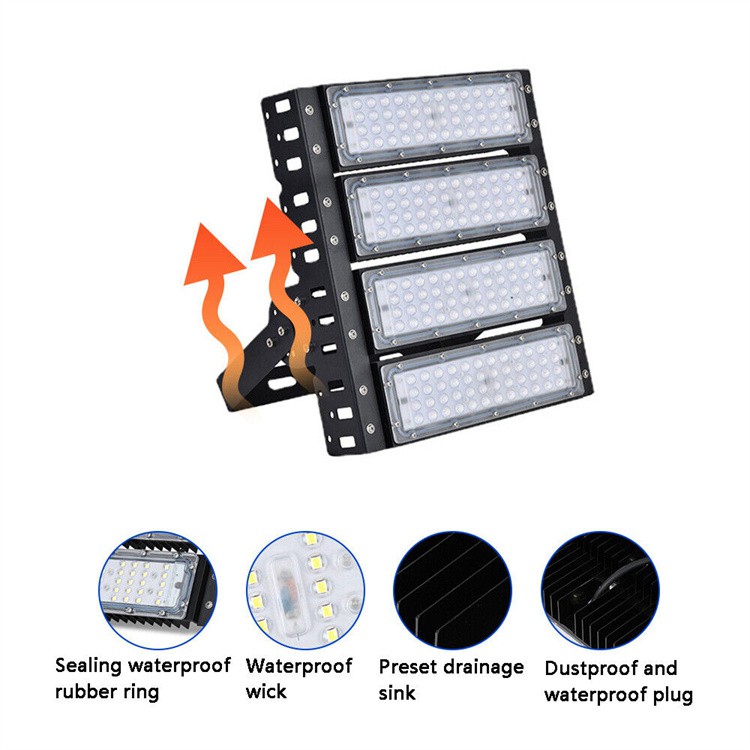
The primary challenge in illuminating a vast sports field is achieving consistent, wide-area coverage without creating glare hotspots or dark zones. Traditional high-power LED floodlights for stadiums often rely on multiple fixtures mounted on high masts, leading to high capital expenditure, complex installation, and potential glare for players and spectators. The invention disclosed in patent CN220707146 U presents an advanced optical solution: a multi-point refraction LED stadium light. This design fundamentally rethinks luminaire optics by integrating a secondary reflective layer within the fixture's housing. The system comprises several LED light sources mounted within a protective housing (3), the inner walls of which are lined with a specular reflective panel (301). Light rays from the LEDs are first directed onto this mirror-like surface. The reflected light is then transmitted through a convex transparent protective cover (6). This convex lens acts as the final optical element, refracting the already-diffused light outward in a controlled, wide-angle pattern. This multi-step process-direct emission, specular reflection, and final convex refraction-effectively creates multiple virtual light points from a single physical fixture, dramatically expanding the illumination range while softening the light output. This addresses a critical sports facility lighting need: reducing the number of fixtures required for a given field, which directly lowers installation costs, energy consumption from fewer total watts, and long-term maintenance burdens [¹].
Table 1: Performance Comparison: Traditional vs. Multi-Point Refraction LED Stadium Lights
|
Performance Parameter |
Traditional Single-Point LED Stadium Light |
Multi-Point Refraction LED Stadium Light (e.g., CN220707146 U) |
|---|---|---|
|
Primary Optical Principle |
Direct emission from LED array and primary reflector/lens. |
Direct emission + secondary specular reflection + convex lens refraction. |
|
Beam Angle & Spread |
Typically narrower, more focused beam; requires precise aiming. |
Inherently wider, more uniform spread due to the light "multiplication" effect. |
|
Glare Control (UGR) |
Higher Unified Glare Rating (UGR) if not carefully shielded. |
Superior glare reduction as light is diffused before final exit. |
|
Fixture Count for a Standard Pitch |
A higher number is required for overlapping coverage. |
Reduced count possible due to expanded effective coverage per fixture. |
|
Installation & Wiring Complexity |
High, due to multiple mounting points and electrical runs. |
Simplified, with fewer poles and fixtures to install and connect. |
|
Capital Expenditure (CAPEX) |
Higher initial cost for fixtures, poles, and installation labor. |
Lower potential CAPEX through fixture count reduction. |
|
Long-Term Maintenance |
More fixtures necessitate more frequent group relamping and cleaning. |
Reduced maintenance points lower operational expenditure (OPEX). |
2. How Does Enhanced Optics Improve Energy Efficiency and Play Quality?
The optical efficiency of an LED stadium light is not merely about raw lumen output; it concerns the precise delivery of useful light onto the playing surface. The multi-point refraction system directly enhances light utilization efficiency. By using a reflective cavity, it captures and redirects light that might otherwise be absorbed by the fixture housing, minimizing optical losses. The convex cover then shapes this light to match the desired sports field lighting area more accurately than a standard diffuser. Research indicates that for televised sports, vertical illuminance (light on players' faces and bodies) is as crucial as horizontal illuminance (light on the field). The diffuse nature of light from a refraction-based fixture improves vertical illuminance uniformity, which is vital for high-definition broadcast quality and reduces harsh shadows that can impair athlete depth perception [²]. Furthermore, superior uniformity-often measured as the ratio of minimum to average illuminance-means the same visual task level can be achieved with a lower average illuminance level, leading to direct energy savings. A system achieving a uniformity ratio of 0.7 (U0 = E_min / E_avg) can often use 10-15% fewer lumens than a system with a ratio of 0.5 to provide the same perceived field brightness, translating to significant reductions in the wattage of the commercial LED sports lighting installation.
Table 2: Key Optical & Performance Metrics for Modern Stadium Lighting
|
Metric |
Target Specification for Professional Sports |
Role of Multi-Point Refraction Technology |
|---|---|---|
|
Horizontal Illuminance (Eh, avg) |
Class II: 500 lux (training) to Class IV: 2000+ lux (HDTV Broadcast) [³]. |
Enables target levels with fewer, strategically placed fixtures. |
|
Uniformity (U₀ = E_min/E_avg) |
≥ 0.7 for professional play and broadcast. |
Inherently promotes uniform light spread, reducing dark spots. |
|
Vertical Illuminance (Ev) |
0.5 to 0.75 of horizontal illuminance for broadcast. |
Refraction and diffusion enhance light directed at vertical planes (players). |
|
Unified Glare Rating (UGR) |
< 25 for player comfort (should be as low as possible). |
Diffused output from a convex lens significantly reduces direct glare sources. |
|
Color Rendering Index (CRI) |
CRI ≥ 80 (CRI ≥ 90 preferred for broadcast). |
Dependent on an LED source, optics preserve color quality without distortion. |
|
Correlated Color Temperature (CCT) |
4000K - 5700K for neutral white, enhancing contrast. |
Optics do not alter CCT; consistent color across the beam is maintained. |
|
System Efficacy (lm/W) |
130-180 lm/W (system-level, including driver losses). |
High optical efficiency contributes to achieving higher system efficacy. |
3. What are the critical integration points for thermal management and durability?
An advanced optical design must be paired with robust thermal and mechanical engineering. The patent CN220707146 U highlights a dedicated heat dissipation structure (2). This typically consists of an external heat sink (203) made of aluminum fins housed within a protective frame (201) and covered by a dust-prevention mesh (202). Effective thermal management is non-negotiable; LED junction temperature directly dictates lumen depreciation and lifespan. A well-designed thermal system ensures the LED chips operate below their maximum rated junction temperature (Tj max), often below 105°C, to achieve a rated lifetime of L90/B50 at 50,000 hours or more[⁴]. The protective elements-the protective housing (3), convex cover (6), and external protective frame (7)-work in concert to provide an Ingress Protection (IP) rating of at least IP65 for outdoor fixtures, safeguarding against rain and dust. The conical protective frame (7) also serves as a physical shield against impact from balls or debris (requiring a high IK rating), ensuring the longevity of the optical components. This holistic approach to durability ensures that the sophisticated optical performance of the multi-point refraction LED flood light is maintained over its entire service life in harsh outdoor environments, from amateur collegiate stadium lighting to professional arenas.
Industry Common Problems & Strategic Solutions (Approx. 300 Words)
Problem 1: Poor Light Uniformity and "Hot Spots" on the Field.
Solution: Adopt optical systems designed for wide, uniform distribution, such as the multi-point refraction technology. Conduct detailed photometric planning using software simulations to model light spread before installation, ensuring correct fixture spacing and aiming angles.
Problem 2: Excessive Glare Causing Player Discomfort and Spectator Distraction.
Solution: Specify fixtures with optical designs that incorporate secondary diffusion or refraction (like convex lenses) to soften the light output. Ensure fixtures are mounted at sufficient height and with appropriate cut-off angles to keep the high-intensity LED source out of direct line-of-sight.
Problem 3: High Energy Consumption from Over-illumination or Inefficient Optics.
Solution: Utilize high-efficacy LED packages (150+ lm/W at chip level) coupled with high-efficiency optical systems (90%+ light output ratio). Implement dimming controls and zoning to adjust light levels based on actual usage (e.g., training vs. match, cleaning hours).
Problem 4: Frequent Maintenance Due to Fixture Failure or Dirt Accumulation.
Solution: Choose fixtures with robust thermal management (low Tj) for long life and high IP/IK ratings for environmental protection. Designs with protective meshes (like the patent's dust-prevention mesh 202) and easy-access components simplify cleaning and service.
Problem 5: Complex and Costly Installation Requiring Numerous Fixtures and Masts.
Solution: Evaluate fixtures based on their effective coverage area per unit. Technologies that offer wider, more uniform light distribution can reduce the total number of fixtures and masts required, significantly lowering installation material and labor costs.
Conclusion
The evolution of the LED stadium light is increasingly defined by optical innovation. As demonstrated by the multi-point refraction technology in patent CN220707146 U, moving beyond simple primary optics to integrated systems involving reflection and secondary refraction offers a compelling path forward. This approach directly addresses core challenges in large-scale sports venue illumination: achieving superior uniformity, minimizing glare, reducing fixture count, and ultimately lowering the total cost of ownership. For specifiers and facility managers, prioritizing such advanced optical engineering-validated by authoritative standards and real-world performance data-is key to creating optimal, sustainable, and cost-effective lighting environments for modern sports facilities.
References & Citations
IESNA RP-6-20, "Sports and Recreational Area Lighting," Illuminating Engineering Society. [Defines illuminance classes, uniformity ratios, and glare criteria for various sports].
FIFA Quality Programme for Football Turf, "Lighting Guide," Fédération Internationale de Football Association. [Includes specific requirements for vertical illuminance and uniformity for broadcast].
EN 12193:2018, "Light and lighting-Sports lighting," European Committee for Standardization. [Provides standardized illuminance levels for sports from recreational to professional/HDTV].
Zhaga Consortium, "Bookspecs for LED Light Engines" [Defines interface specifications for LED modules and drivers, promoting interchangeability and long-term supply].
Annotations
[¹] Fixture count reduction...maintenance burdens: The economic model is based on life-cycle cost analysis (LCCA) studies comparing traditional 1000W+ metal halide systems and standard LED systems against advanced LED systems with superior optics. The savings are derived from reduced pole foundations, wiring, and the labor for relamping a smaller number of fixtures over a 10-year period.
Light Utilization Efficiency (LUE): The ratio of lumens emitted by the luminaire to the lumens generated by the LED chips. A high LUE (e.g., >90%) indicates minimal light loss within the fixture housing.
Unified Glare Rating (UGR): An international metric (CIE 117-1995) for quantifying discomfort glare from luminaires. A lower number indicates less glare. For sports, UGR should typically be below 25.
L90/B50 Lifetime: A standard LED lifetime metric. L90 means the luminaire maintains at least 90% of its initial light output. B50 means 50% of a sample population have not failed. L90/B50 at 50,000 hours is a common benchmark for professional-grade products.
Junction Temperature (Tj): The temperature at the semiconductor p-n junction inside an LED chip. It is the single most critical factor affecting LED lifespan and light output stability.
https://www.benweilight.com/lighting-tube-bulb/a-100w-outdoor-lighting-fixture-with.html





