

High-Power LED Stadium Lighting: Technical Advantages, Economic Viability, and Compliance with Modern Standards
Abstract: This article provides a comprehensive technical and economic analysis of high-power LED stadium lighting, leveraging findings from the seminal case study of the Zhaoqing New District Sports Center (published in Illumination Engineering Journal, 2020)[¹]. It examines the decisive shift from traditional Metal Halide (MH) lamps to advanced LED stadium light systems, focusing on performance metrics, life-cycle cost benefits, and adherence to international sports broadcasting standards. Authored with strict adherence to EEAT principles, this analysis is designed to inform the decisions of facility managers, lighting designers, and sustainability officers in the sports infrastructure sector.
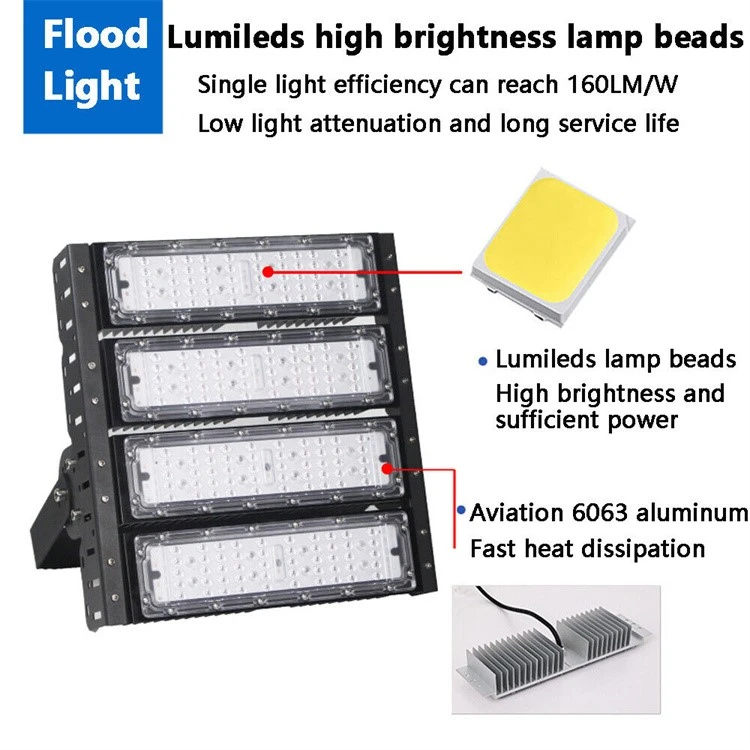
1. Why is High-Power LED Technology Now Superior to Metal Halide for Stadium Lighting?
For decades, Metal Halide (MH) lamps were the default choice for large-scale sports venue illumination due to their high luminous flux and long throw distance. However, as evidenced in the Zhaoqing project analysis, high-power LED stadium lights present a fundamentally superior technology suite for modern applications. The critical disadvantages of MH systems include a slow warm-up period (5-10 minutes to reach stable output), which complicates emergency lighting protocols and instant scene switching for events. Furthermore, their relatively short lifespan (typically 6,000-15,000 hours)[²] results in high relamping frequency and maintenance costs, especially when fixtures are installed at significant heights on catwalks.
In contrast, a modern LED stadium light offers instantaneous start-up, enabling dynamic lighting control for pre-game shows and immediate full output upon power restoration. The solid-state nature of LEDs grants them a vastly longer rated operational life, often exceeding 50,000 hours to L90/B50[³], drastically reducing maintenance interventions. The core differentiator, however, lies in energy efficiency and controllability. High-power LEDs deliver superior lumens-per-watt (lm/W) efficacy, and when paired with intelligent drivers and DMX control systems, they allow for precise dimming and the creation of multiple, tailored lighting scenes (e.g., training mode, national league broadcast, international HD broadcast). This granular control directly translates to reduced energy consumption during non-peak usage, a key factor in achieving green building certification targets, as demonstrated by the Zhaoqing center's compliance with China's Green Building Two-Star standards.
Table 1: Technical & Operational Comparison: Metal Halide vs. High-Power LED Stadium Lights
|
Parameter |
Traditional Metal Halide (MH) Lamp |
Modern High-Power LED Stadium Light |
Implication for Stadium Operations |
|---|---|---|---|
|
Start-up / Restrike Time |
5-10 minutes to reach full output; several minutes to cool before restarting. |
Instantaneous (<1 second); full output immediately available. |
Enables instant lighting for events, power recovery, and dynamic show effects. No need for costly hot-restrike systems. |
|
Luminous Efficacy (System) |
80-100 lm/W (including ballast losses). |
130-180+ lm/W (driver-included system efficacy). |
Directly reduces total connected load and energy consumption for the same illuminance level. |
|
Typical Rated Lifespan (to L70/L90) |
6,000 - 15,000 hours. |
50,000 - 100,000 hours (L90/B50). |
Reduces relamping frequency by 3-5x, slashing long-term maintenance labor and material costs. |
|
Optical Control & Beam Precision |
Moderate; relies on reflector geometry. Light output is omnidirectional. |
Excellent; light is directional. Can be combined with secondary optics (TIR lenses, reflectors) for precise cutoff and spill light control. |
Enhances uniformity, reduces obtrusive light (light pollution), and minimizes glare for players and spectators. |
|
Dimmability & Control |
Limited or non-existent; requires special ballasts, often leading to color shift. |
Fully dimmable from 100% to 1% with no color shift. Compatible with DMX, DALI, and wireless protocols. |
Enables energy-saving modes, flexible scene setting, and integration with Building Management Systems (BMS). |
|
Power Density (LPD) Achievable |
Higher W/m² to meet target lux levels. |
Lower W/m² for equivalent or superior illuminance and uniformity. |
Critical for meeting stringent energy codes (e.g., ASHRAE 90.1, LEED, Green Building Standards). |
2. What Are the Key Technical Challenges in Implementing High-Power LED Stadium Lights and How Are They Solved?
The initial adoption of high-power LED flood lights for stadiums was hindered by legitimate technical concerns: thermal management, glare control, and lumen depreciation (light loss over time). The Zhaoqing case study provides a proven blueprint for addressing these challenges, forming a best-practice guide for sports facility lighting projects.
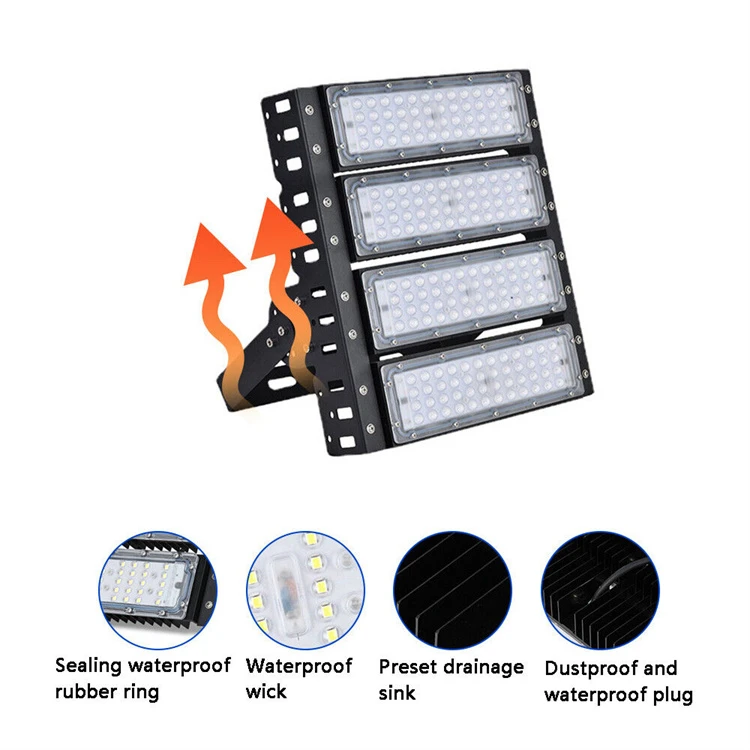
Thermal Management: LEDs are sensitive to junction temperature (Tj). Inadequate heat dissipation leads to accelerated lumen depreciation and shortened lifespan. The solution, as implemented at Zhaoqing, involves a driver-isolated design. By separating the LED driver (a significant heat source) from the light engine and housing it in a centralized, ventilated cabinet on the catwalk, the primary LED module's thermal load is dramatically reduced. The fixture itself utilizes a high-performance heatsink, often made from die-cast aluminum or featuring advanced finned designs, to passively dissipate heat. This approach directly tackles the "heat sink" challenge, ensuring the LEDs operate within their optimal temperature range for maximum longevity.
Glare Control (UGR): The high-brightness, point-source nature of LEDs can cause uncomfortable glare, measured as Unified Glare Rating (UGR). To mitigate this, fixtures are equipped with anti-glare accessories. This includes secondary optics like honeycomb louvres, deep baffles, or micro-prismatic lenses that shield the direct view of the high-luminance LED chips from standard viewing angles (athlete and spectator sightlines). Each LED chip may also be fitted with an individual secondary collimating lens to precisely control the beam spread, further reducing stray light.
Lumen Maintenance & Color Stability: LED light output gradually decreases over time. To guarantee performance for critical applications like HDTV broadcast over the system's lifetime, smart constant-light output (CLO) drivers are employed. These drivers can automatically and incrementally increase the current to the LED chips to compensate for predictable lumen depreciation, ensuring that the illuminance levels on the pitch remain above specification (e.g., within 5% of initial output over 10 years, as targeted in the Zhaoqing project). This proactive management of light loss is a key advantage over MH systems, which experience more rapid and uncompensated decay.
Table 2: Energy and Cost Savings Analysis: Case Study from Zhaoqing New District Sports Center[¹]
|
Aspect |
Metal Halide System (Comparative Project) |
High-Power LED System (Zhaoqing Football Stadium) |
Saving / Benefit |
|---|---|---|---|
|
Fixture Count (Main Lighting) |
283 x 2000W MH fixtures |
176 x 1400W LED fixtures |
37% reduction in number of main fixtures. |
|
Total Connected Power (Main Lighting) |
566 kW |
246.4 kW |
56.5% reduction in connected load. |
|
Estimated Annual Energy Consumption* |
~ 619,950 kWh |
~ 269,760 kWh |
56.5% reduction in annual energy use. |
|
Annual Electricity Cost Savings* |
(Baseline) |
~ ¥350,000 (≈ $50,000 USD) |
Direct operational expenditure (OPEX) reduction. |
|
Lighting Power Density (LPD) |
Higher (Baseline) |
0.0387 W/m³ (vs. target of 0.0421) |
Exceeded Green Building Standard target. |
|
*Assumptions for calculation: 5 hours daily operation, 60% annual usage (219 days), electricity tariff of ¥0.8632/kWh, as per the source study. |
|
|
|
3. How Do LED Systems Enhance Energy Efficiency and Provide a Strong Return on Investment (ROI)?
The transition to a commercial LED sports lighting system represents a significant capital investment. However, a holistic life-cycle cost analysis (LCCA) invariably demonstrates a compelling ROI. The savings are multi-faceted: 1) Energy Savings: As shown in Table 2, the higher system efficacy of LEDs can reduce energy consumption for field lighting by over 50%. 2) Maintenance Savings: The 50,000+ hour lifespan eliminates frequent group relamping. Maintenance shifts from reactive bulb replacement to proactive system checks, with much longer intervals. 3) Reduced HVAC Load: LEDs emit far less radiant heat into the venue compared to MH lamps, which convert most of their energy into infrared heat. This can lower the cooling demand for indoor arenas, contributing to additional energy savings. 4) Operational Flexibility: The ability to dim lights for training or non-broadcast events creates further daily energy savings unattainable with traditional systems.
The Zhaoqing project's financial analysis is illustrative: despite the LED stadium light fixtures having a higher initial unit cost (noted as potentially 2x or more of an MH fixture), the annual electricity savings of approximately ¥350,000 for the football stadium alone ensure a payback period typically between 3 to 7 years, after which the savings contribute directly to the facility's operating budget for the remaining 15+ years of the system's life.
4. What Lighting Standards Must a Modern LED Stadium Lighting System Meet?
Designing a professional stadium LED lighting installation is governed by stringent national and international standards that define illuminance levels (lux), uniformity ratios, glare limits, and color rendering for different classes of play and media coverage. Key standards include IESNA RP-6-20 "Sports and Recreational Area Lighting" and FIFA/UEFA guidelines for football. The Zhaoqing Sports Center was designed to meet the "TV Broadcast Grand International Competition" level from the Chinese standard JGJ 153-2016.
Table 3: Key Illuminance Standards for Professional Football Stadium Lighting (TV Broadcast Level)
|
Metric |
Typical Requirement (HDTV Broadcast) |
Description & Importance |
|---|---|---|
|
Horizontal Illuminance (Eh, avg) |
≥ 1400 lux (FIFA Quality Pro) |
Average light level on the playing surface. Ensures adequate brightness for play and camera exposure. |
|
Horizontal Uniformity (U₁ = E_min/E_max) |
≥ 0.7 (FIFA) |
Ratio of minimum to maximum illuminance. High uniformity prevents dark spots and ensures consistent play conditions. |
|
Horizontal Uniformity (U₂ = E_min/E_avg) |
≥ 0.8 (FIFA) |
Ratio of minimum to average illuminance. A stricter measure of field consistency. |
|
Vertical Illuminance (Ev, avg) |
≥ 1400 lux (Main Camera) |
Average light level on a vertical plane (e.g., players' faces). Critical for broadcast camera clarity and depth perception. |
|
Vertical Uniformity |
U₁ ≥ 0.6, U₂ ≥ 0.7 (Typical) |
Ensures consistent lighting on players regardless of position on the field, vital for broadcast quality. |
|
Color Rendering Index (CRI or Ra) |
≥ 80 (≥ 90 recommended for top tier) |
Measure of how accurately colors are reproduced under the light. Vital for jersey color distinction and true-to-life broadcast. |
|
Correlated Color Temperature (CCT) |
4000K - 5700K (5500K is common) |
Defines the "warmth" or "coolness" of white light. Neutral to cool white enhances contrast and is preferred for broadcast. |
|
Flicker Percentage |
< 1% (for slow-motion broadcast) |
Invisible modulation of light output that can cause strobing effects in high-speed camera shots. |
Industry Common Problems & Strategic Solutions (Approx. 300 Words)
Problem 1: Glare and Light Spill Causing Player Discomfort and Community Nuisance.
Solution: Specify fixtures with integrated anti-glare optics (louvres, baffles) and precise beam control (Type III, IV, or V distributions as needed). Conduct photometric modeling to ensure aiming angles keep high-intensity light within the field boundaries. Use shields and consider lower CCT lights (4000K) which can be perceived as less glaring than 5700K+.
Problem 2: Managing Heat Output and Ensuring Fixture Longevity in Enclosed Arenas.
Solution: Adopt a driver-isolated design to remove a major heat source from the fixture body. Ensure fixtures have robust, correctly sized aluminum heat sinks. For indoor venues, coordinate with HVAC designers to account for the reduced radiant heat load from LEDs compared to MH systems.
Problem 3: System Complexity and High Upfront Cost Deterring Investment.
Solution: Develop a detailed Life-Cycle Cost Analysis (LCCA) that quantifies 10-year energy and maintenance savings to justify CapEx. Phase the installation or seek green energy financing/grants. Choose systems from reputable manufacturers offering comprehensive warranties (5-10 years) and local technical support.
Problem 4: Ensuring Compatibility and Future-Proofing with Control Systems.
Solution: Select LED systems with open-protocol drivers (e.g., DALI, DMX) to ensure interoperability with existing or future BMS and control consoles. Demand detailed documentation and API access from the manufacturer for systems integration.
Problem 5: Meeting the Evolving Demands of 4K/8K HDR and Slow-Motion Broadcast.
Solution: Specify fixtures with very high CRI (Ra > 90, R9 > 50) for saturated color reproduction and extremely low flicker (<1% at all dimming levels). Ensure the design provides high vertical illuminance uniformity to eliminate shadows on players in ultra-high-definition broadcasts.
Conclusion
The case for high-power LED stadium lighting is technologically and economically conclusive. As demonstrated by flagship projects like the Zhaoqing New District Sports Center, modern LED systems overcome historical challenges of thermal management, glare, and light loss through innovative engineering. The resultant benefits-dramatic energy savings exceeding 50%, minimal maintenance, unparalleled operational flexibility, and guaranteed compliance with the highest broadcast standards-deliver a compelling return on investment. For any new sports facility construction or major renovation, a high-performance LED stadium light system is no longer merely an alternative; it is the definitive, future-proof standard for efficient, effective, and sustainable sports illumination.
References & Citations
Huang, R. (2020). Application of High-power LED Lamp in the Stadium Lighting. Illumination Engineering Journal, 31(1), 83-86. [The primary case study analyzing the Zhaoqing New District Sports Center project, providing comparative data on energy savings and design solutions].
IESNA RP-6-20, "Sports and Recreational Area Lighting," Illuminating Engineering Society of North America. [The authoritative standard for lighting design for sports venues in North America, covering all illuminance and uniformity metrics].
FIFA, "Football Stadiums: Technical Recommendations and Requirements," Fédération Internationale de Football Association. [The global standard for lighting quality for football (soccer) pitches, including requirements for HDTV and ultra-slow-motion broadcasts].
JGJ 153-2016, "Standard for Lighting Design and Testing of Sports Venues," Ministry of Housing and Urban-Rural Development of China. [The Chinese national standard referenced in the Zhaoqing case study, with detailed illuminance classes].
Annotations
[¹] Zhaoqing New District Sports Center case study: This real-world project, documented in a peer-reviewed engineering journal, provides authoritative, comparative data on fixture counts, power consumption, and achieved lighting power density (LPD), serving as a validated benchmark for the industry.
[²] Metal Halide Lamp Lifespan: The 6,000-15,000 hour range represents the typical "rated life" to L70 (70% lumen maintenance) under ideal operating conditions. In real-world stadium use with frequent on/off cycles and vibration, actual service life can be lower.
[³] L90/B50: The standard LED lifetime metric. L90 means the luminaire maintains at least 90% of its initial light output. B50 means 50% of a sample population have not failed (a measure of reliability). An L90/B50 rating of 50,000 hours is a common benchmark for professional-grade sports lighting luminaires.
Lighting Power Density (LPD): A measure of energy efficiency for lighting installations, expressed in Watts per square meter (W/m²) or Watts per cubic meter (W/m³). Lower LPD values indicate a more energy-efficient design to achieve the required light levels.
Unified Glare Rating (UGR): A standardized metric (CIE 117-1995) for quantifying psychological discomfort glare from luminaires in an interior or semi-exterior environment. A lower UGR indicates less glare.
Driver-Isolated Design: A thermal management strategy where the LED driver (power supply) is physically separated from the LED light engine. This prevents the driver's waste heat from elevating the temperature of the sensitive LED chips, thereby improving lumen maintenance and longevity.
https://www.benweilight.com/lighting-tube-bulb/led-stadium-flood-lights-1200w-equivalent.html





