

When compared to regular incandescent light bulbs, LED strips are a bit more complicated to set up and install. The low voltage DC they operate on means that a power supply device is necessary to transform the 120V or 240V AC (local voltage) signal into a form that LED strips can use. Here is our straightforward three-step process to assist you in choosing a power supply.
So, imagine you're interested in finding out if this power supply is compatible with the following LED strip product: Waterproof Led Strip Lights.
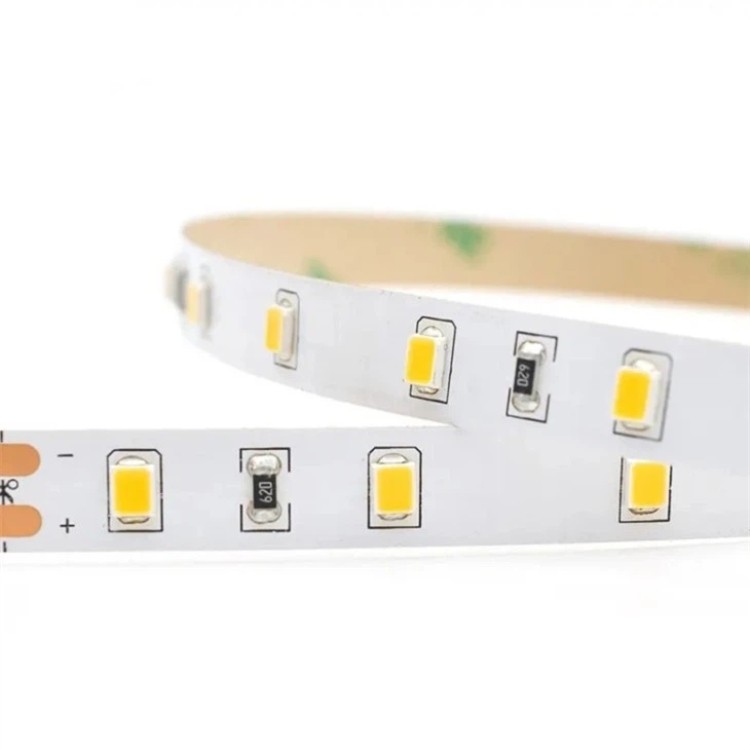
To begin, find the voltage of the LED strips.
Determine the LED strip's voltage as a first step. Most commercially available LED strips operate at 12V DC. Other voltages are typically 24V DC.
The product description includes the following information about the product:
Looking at the product image is another option to verify this if you're still not convinced. 12V or 24V is the designation you may see on most LED strips.
At this point, you should verify that the LED strip's voltage fits the specs of the power source. Here, too, the power source is 12V, so everything is in order.
Make sure the AC input voltage is accurate for your country (e.g., 120V for North America).
As an extra hint, you can also look at the label on the reverse of the power supply to see whether it lists the voltage. This is useful if you happen to have one sitting around the house.
The second step is to measure the LED strip's power consumption.
Finding the LED strip's wattage (W) or amperage (A) specification is the next step. One possible way to list this is as W/m, another as A/m, or just as W or A.
Totalling 24 Watts, or 4.8 Watts/meter, is what the LED strip says it is. Since there are 5 meters on a reel and 24 Watts (4.8 Watts/meter x 5 meters), this makes sense.
Despite its omission, we may get the amperage by plugging the wattage (P), voltage (V), and current (A) into the equation P = V x A. Using the formula 24 = 12 x A, we get 2.0 Amps, where A is the amperage and watts are the two variables.
From what we can tell electrically, this LED strip will use around 24 Watts (or approximately 2.0 Amps) per reel (5 meters) when powered by 12V.
It is time to inspect the power source.
Its rating is 36W, or 3A, as can be seen. Since it is a 12V power source, this also checks out when we utilise the formula P = V x A.
The maximum current that this power source can deliver is 36 Watts, or approximately 3.0 Amps.
The LED strip and the power supply are compatible with each other since the former has a larger capacity and the latter has a lower power draw.
Some people are scared or confused by power supply wattage and amperage ratings. A power source that injects 36 watts into an LED strip rated for 24 watts is likely to destroy the strip. What if, in the future, you chose to split that LED strip in half, transforming it into a 12 Watt version?
That is why competence and ability are up there. There is no guarantee that a power supply will actually deliver 36 Watts of power simply because it has that rating. The opposite is true: the power supply will only deliver the amount of power that is actually required, adapting to the load it is connected to. However, the power supply could operate abnormally or even be damaged if the power draw is higher than its capability.
So, any LED strip requiring power between zero and thirty-six watts can be powered by this power supply.
Step 3: Choose a method of connection
A power connector, like the one below, is probably included with the power supply:
The dimensions 5.5 mm x 2.1 mm are probably going to be seen. With LED strip plugs, 5.5 mm x 2.5 mm might not be compatible, thus proceed with caution.
Determine if the LED strip reel has a DC socket similar to this one:
If that's the case, you can just hook the power cord into the wall outlet at one end and the LED strip at the other; it should work with the connector.
However, if you want to divide your LED strip into smaller pieces or if the reel itself has only two exposed wires (usually red and black), you can do it like this:
Here, you'll have to track down an adapter that can bridge the gap between the power source and the LED strip. The remaining wires can be plugged into the power source through the adaptor.

Shenzhen Benwei Lighting Technology Co., Ltd was established in 2010. It is a national high-tech enterprise integrating design, R&D, production and sales of indoor and outdoor lighting products and also can do OEM ,ODM .For more details about our offerings, please contact us at bwzm18@ledbenweilighting.com





