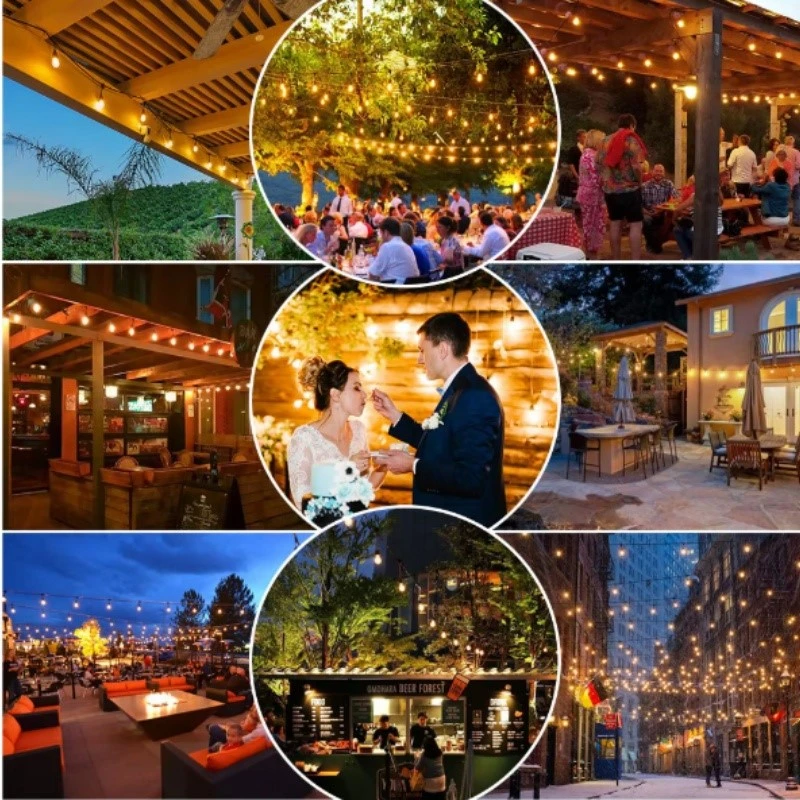
As the peak season for outdoor patio and holiday lighting approaches, one of the most frequent questions from customers is: "Can this string light be used outdoors? Will rain cause problems?" While the question seems simple, the answer involves several factors, including IP ratings, materials and manufacturing processes, and electrical safety. In this article, we examine the safety of using decorative string lights outdoors from a product perspective, helping you make informed decisions during product selection, procurement, or project quoting.
IP Ratings: The Standard for Assessment
When determining if a decorative string light is suitable for outdoor use, the first step isn't looking at its appearance, but checking its IP (Ingress Protection) rating. An IP65 rating indicates protection against water jets, making it suitable for sheltered areas like eaves or balconies; IP67 or IP68 ratings signify the ability to withstand short-term immersion in water, making them ideal for gardens and courtyards fully exposed to rain and dew. Many low-cost string lights on the market only offer IP44 protection or lack clear labeling; strictly speaking, these are suitable only for indoor or dry environments, as long-term outdoor use makes them prone to water ingress and short circuits.
Voltage Design: Low Voltage is Safer than Mains Power
Outdoor environments are inherently humid. If a string light runs directly on mains power (e.g., 120V or 220V), any damage to the connectors or wire insulation significantly increases the risk of electric shock or leakage. Most mainstream outdoor decorative string lights now utilize low-voltage designs-such as 24V, 12V, or even lower safety voltages-powered via an external transformer or adapter. With this design, even minor damage to the wiring poses no significant threat of injury to humans, making it a safer choice for outdoor settings.
Materials and Flame Retardancy
The material of the wire insulation directly determines the string light's weather resistance. PVC is cost-effective but tends to become brittle and crack in low temperatures; rubber or TPE materials offer superior flexibility, low-temperature resistance, and durability against aging, making them better suited for regions with significant seasonal temperature fluctuations. Regarding the bulb housing, flame-retardant PC (polycarbonate) offers better fire safety than standard plastics. Although customers may not always ask about these details, they are crucial factors determining product quality and lifespan.
Essential Certification Standards
Certification is a crucial factor in determining whether a product is truly suitable for outdoor use. Products destined for the European market typically require CE and RoHS certifications, while those for the North American market require ETL or UL certification; some products also feature IP rating test reports. These certifications are not mere formalities; they are based on actual testing by third-party agencies regarding properties such as water resistance, pressure resistance, and flame retardancy. When selecting suppliers, buyers are advised to request the actual test reports rather than relying solely on markings found on the packaging.
Details Regarding Installation and Use
Even if a product meets all standards, improper installation or usage can still create safety hazards. Issues such as inadequate waterproofing at connection points, connecting multiple light strings in series beyond the manufacturer's recommended maximum length, or leaving lights powered on for extended periods without a timer can all increase the risk of wiring degradation and overheating. Additionally, it is recommended to use outdoor sockets equipped with waterproof covers and to ensure that light strings do not come into direct contact with standing water or remain submerged in snow for prolonged periods.
Why LED Light Sources Are Better Suited for Outdoor Use
Compared to traditional incandescent bulbs, LED light sources generate less heat. This means the light string casings and wiring remain cooler during operation, slowing the rate of material degradation and reducing safety risks associated with high temperatures. Furthermore, LEDs are more energy-efficient and have a longer lifespan; for outdoor decorative settings that require lights to be powered on for extended periods (such as commercial districts or hotel courtyards), the overall cost of ownership is actually lower. This is a primary reason why outdoor decorative light strings are gradually shifting from incandescent bulbs to LEDs.
Conclusion
The safe outdoor use of decorative light strings hinges on three key factors: compliance with waterproofing standards, safe power supply voltage, and the quality of materials and certifications. Proper installation methods and usage habits are equally important. When selecting outdoor light string products, buyers and brands should prioritize verifying IP ratings, power supply methods, and relevant certification documents rather than focusing solely on price.
If you are sourcing decorative light strings for outdoor applications or have specific requirements regarding waterproofing ratings, certification standards, or custom solutions, please contact us. We can provide suitable product solutions and test reports tailored to your specific usage scenario.