During the process of sourcing and selecting lighting products, clients often ask a very direct question: "Is the brightness of your LED filament bulb comparable to that of a vintage Edison bulb?" While the question seems simple, the answer involves several technical nuances. This article aims to clarify the matter.
Brightness: Watts or Lumens?
Many long-time customers-especially older consumers in Europe and the US-still hold the outdated notion that "watts equal brightness." Having used incandescent bulbs for decades, they have developed a conditioned response to figures like 60 watts or 100 watts. However, wattage actually measures power consumption, not brightness; the true measure of brightness is the lumen (lm).
Traditional tungsten-filament Edison bulbs have very low luminous efficacy-roughly 10–17 lumens per watt. This means that for a 60-watt bulb, the vast majority of electrical energy is converted into heat rather than light. In contrast, LED filament bulbs achieve an efficacy of 80–140 lumens per watt (or even higher); for the same lumen output, power consumption can be reduced to about one-tenth of that of a traditional bulb.
Therefore, strictly speaking, determining whether an LED filament bulb is "bright enough" requires looking at the lumen value rather than just the wattage label.
Comparing Actual Brightness: LED Filament Bulbs vs. Traditional Edison Bulbs
Based on common industry standards, the approximate equivalencies are as follows:
40W Incandescent ≈ 470lm ≈ 4–5W LED Filament Bulb
60W Incandescent ≈ 800lm ≈ 6–8W LED Filament Bulb
75W Incandescent ≈ 1100lm ≈ 9–10W LED Filament Bulb
100W Incandescent ≈ 1500lm ≈ 12–14W LED Filament Bulb
As this table demonstrates, by selecting bulbs based on lumen values, LED filament bulbs can not only match the brightness of traditional Edison bulbs but often exceed it-all while consuming significantly less power. This is precisely why clients producing retro-industrial style fixtures-such as restaurant pendants-are increasingly opting for LED filament bulbs over traditional tungsten bulbs; they retain that vintage aesthetic without compromising on brightness.
Factors Affecting the Perceived Brightness of LED Filament Bulbs
Even with identical lumen ratings, the perceived visual brightness can vary once the bulbs are lit. Several variables come into play:
Color Temperature: At the same lumen output, warm yellow light (2200K–2700K, which mimics the hue of traditional tungsten bulbs) visually appears "dimmer" than cool white light (above 5000K). This is a subjective human perception rather than an actual difference in brightness.
Color Rendering Index (CRI): A higher CRI results in more accurate color reproduction, making the space appear visually "brighter" and more vibrant. A CRI of 80 or higher is recommended; for premium export products, a CRI of 90+ is ideal.
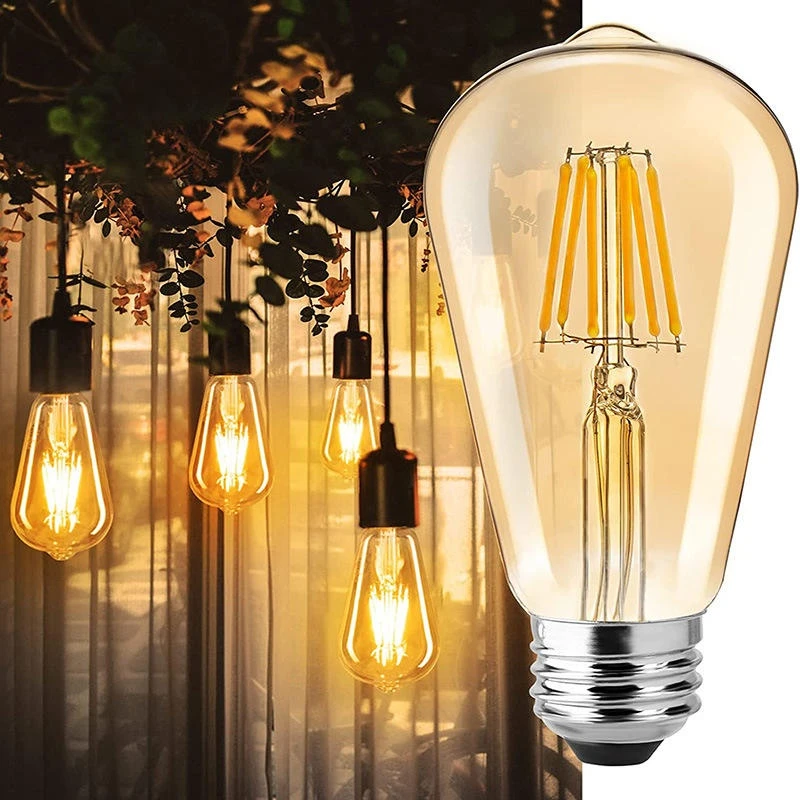
Filament Arrangement and Bulb Casing: Amber or smoke-grey glass casings absorb some light, resulting in a dimmer output compared to clear glass bulbs. It is best to clarify this to clients upfront to avoid post-sales disputes.
Driver Quality: Inferior drivers can lead to rapid lumen depreciation, causing a noticeable drop in brightness after six to twelve months of use. This explains the significant price differences between products with identical nominal lumen ratings.
Conclusion
LED filament bulbs can easily match or even exceed the brightness of traditional Edison bulbs; the key is to compare and select products based on lumen output rather than wattage. Additionally, factors such as color temperature, CRI, casing color, and driver quality directly impact the end-user experience. Addressing these details clearly during product selection and client communication is essential.
If you are selecting LED filament bulbs with the right brightness and color temperature for a project, or need product recommendations tailored to specific usage scenarios, please contact our team. We can provide lumen comparison data, sample testing, and customized solutions to help you find the perfect product for your needs.
Our address
No. 5-3 Niujiao Road, Yanchuan Community, Yanluo Subdistrict, Bao'an District, Shenzhen
bwzm18@ledbenweilighting.com