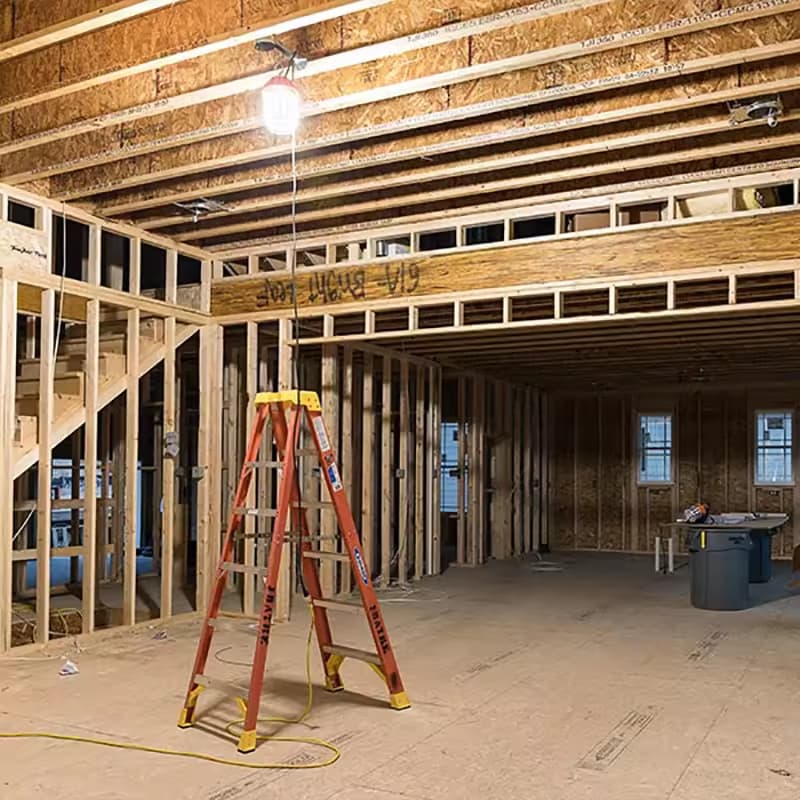
On a construction site, lighting is about much more than just "being able to see." Tasks such as rebar tying, formwork installation, electrical wiring, and nighttime concrete pouring all require a stable and reliable light source. For a long time, halogen work lights were the industry standard-they were inexpensive, provided direct, bright illumination, and were easily accessible. In recent years, however, an increasing number of construction crews, contractors, and equipment procurement teams have begun switching to LED work lights.
Is this shift merely a trend, or is there a sound, practical reason behind it? This article compares the two types of lighting from the perspective of real-world construction site use, helping you determine which is better suited for your project.
Energy Consumption and Electricity Costs
To achieve a comparable level of brightness, a halogen light typically requires four to five times the wattage of an LED light. For instance, a 500W halogen work light provides roughly the same brightness as a 100W LED work light.
On a construction site, this disparity is magnified. Projects often require multiple lights to be used simultaneously for several hours at a stretch. If powered by a generator, higher power consumption leads to greater fuel usage; if connected to the mains, it results in higher electricity costs. Furthermore, when using LEDs, a single generator can support a larger number of lights, reducing the risk of tripped breakers or electrical overloads.
Lifespan and Replacement Frequency
Halogen bulbs typically have a lifespan of 1,000 to 2,000 hours. As consumable components, they tend to darken and dim over time before eventually burning out. In contrast, LED work lights generally offer a lifespan of over 20,000 hours-with high-quality units lasting even longer.
For a construction site, replacing a bulb is not just a matter of cost; it also disrupts the work schedule. Whether the light is positioned at a height or in a temporary setup, every replacement requires halting work, moving ladders, and cutting the power. Opting for longer-lasting lighting effectively spares you from these small but frequent, time-consuming inconveniences.
Heat Generation and On-Site Safety
When in operation, the surface of a halogen lamp can reach temperatures of several hundred degrees Celsius, posing a risk of burns if touched inadvertently. Furthermore, if placed near wood, insulation materials, paint, or other flammable substances, these lamps can become a fire hazard. During construction in hot summer weather, the heat emitted by halogen lamps also makes the working environment significantly more uncomfortable.
LED lights generate far less heat; while the fixture itself may warm up, it rarely reaches dangerous temperatures. This is particularly advantageous in confined spaces, basements, utility tunnels, or renovation sites where ventilation is often poor.
Shock/Drop Resistance and Durability
The core components of a halogen lamp-a delicate tungsten filament and a glass bulb-are highly susceptible to damage from the bumps, vibrations, and handling typical of construction sites; a single mishap can shatter the glass or break the filament. Additionally, if a hot halogen bulb is splashed with water, it may shatter instantly.
LEDs utilize solid-state lighting technology, meaning they lack fragile filaments and are inherently more resistant to shock. When housed in an aluminum alloy casing with a tempered glass cover-and rated with an appropriate ingress protection (IP) level, such as IP65 or higher-these lights are well-protected against rain, dust, and mud. When purchasing, it is advisable to prioritize the IP rating and impact resistance rating, as these factors directly determine the operational lifespan of the equipment on a construction site.
Light Quality and Work Efficiency
Halogen lamps produce a warm-toned, high-intensity light, but they are prone to glare and uneven illumination, often resulting in a "bright center, dark edges" effect. As the bulb ages with use, its brightness also diminishes significantly.
LED work lights offer greater flexibility in optical design, allowing for either wide-angle floodlighting or long-range focused beams. Many models also offer a choice of color temperatures; for instance, cool white light is ideal for tasks requiring high detail, such as inspecting steel structures or performing electrical wiring. Furthermore, LEDs experience a much slower rate of brightness degradation (lumen depreciation) than halogen lamps, ensuring more consistent light output over long-term use.
Startup Speed and Ease of Use
LED lights illuminate instantly upon being powered on; there is no warm-up period, and they are unaffected by frequent switching. While halogen lights also start up quickly, frequent switching accelerates the degradation of their filaments.
Furthermore, LED work lights are more easily designed to be lightweight and portable-some even feature rechargeable lithium batteries, allowing for use in areas without a fixed power source. They also frequently incorporate features like adjustable tripods, magnetic bases, and hooks, making it easy to quickly relocate them across different work surfaces.
Purchase Cost vs. Total Cost of Ownership
It must be acknowledged that the unit price of an LED work light is generally higher than that of a halogen light. If one looks solely at the initial purchase price, halogen lights are indeed more attractive.
However, when viewed over a longer period, the equation changes: LEDs offer lower electricity consumption, require fewer replacements, have a lower failure rate, and place less strain on power generators. For construction sites where lights are used daily and intensively, the cost difference is often recouped within just a few months. For occasional, temporary use, halogen lights still have their place-a fact that should be viewed objectively.
Conclusion
Overall, LED work lights significantly outperform halogen lights in terms of energy consumption, lifespan, safety, durability, and light quality; they are at a disadvantage only regarding the initial purchase cost. For long-term, high-frequency use on construction sites, LEDs are the more sensible choice, while halogen lights may suffice for very infrequent, temporary tasks.
When selecting an LED work light, consider the following key factors:
Brightness (lumens) relative to the size of the work area
Ingress protection (IP) rating suitable for the site environment
Power supply method (mains power, battery, or dual-power capability)
Structural robustness (impact resistance) and heat dissipation efficiency
Need a lighting solution for your construction site? Contact us.
We specialize in the R&D and production of LED work lights, offering a range of products including portable, tripod-mounted, rechargeable, and high-mast models. We can recommend the ideal model based on your project scale and operating environment, and we also provide OEM/ODM customization services. If you are selecting products for a construction site, warehouse, or engineering project, please leave a message or send us an email detailing your specific use case and requirements. We will provide you with product specifications, price quotes, and sample support.
https://www.benweilighting.com/professional-lighting/construction-site-lighting/construction-site-resources-lighting.html