

Many buyers have asked us the same question: "In these areas, the lights stay on for over a dozen hours at a time, and electricity costs are impossible to bring down-would switching to sensor-equipped LED tubes actually be a reliable solution?"
The answer is: yes, it's a suitable solution, provided you choose the right setting and the correct model. These types of locations share a common trait: people or vehicles aren't always present, yet the lights often remain on all day and all night. Sensor-equipped LED tubes are the perfect remedy. However, because usage patterns vary significantly across different environments, the criteria for selecting the right model also differ. Let's break them down one by one.
How do sensor-equipped LED tubes work?
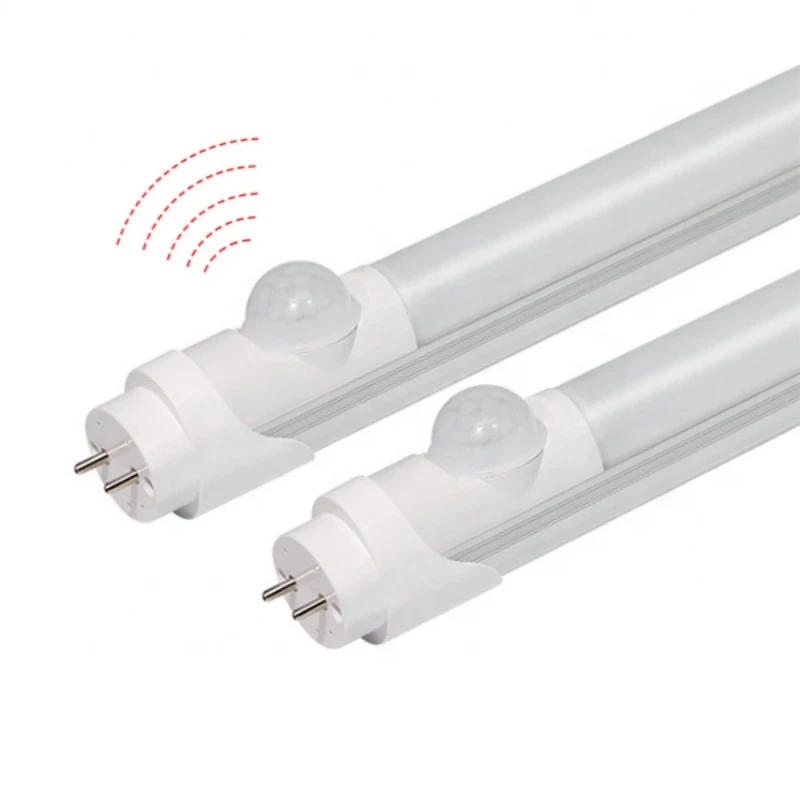
Simply put, a sensor module is integrated into the LED tube. When a person or vehicle enters the detection range, the light turns on; after a period of inactivity, it either dims or switches off completely.
There are two common types of sensing technologies on the market:
Microwave radar sensing: This works by emitting and receiving microwave signals to detect moving objects. It can penetrate thin materials like plastic or glass and offers high sensitivity; it is the most common type integrated directly into LED tubes.
PIR (passive infrared) sensing: This detects changes in heat (infrared radiation) from human bodies. It is sensitive to ambient temperature and is best suited for open spaces with few obstructions.
For most LED tube applications, microwave radar is the preferred choice because the module can be concealed entirely within the tube, making the installation process virtually identical to that of a standard LED tube.
Parking garages: The most significant energy savings at night
Parking garages are the quintessential application for sensor-equipped LED tubes. During the day, there is frequent traffic, but at night or in the early morning hours, there may be no vehicles entering or exiting for long stretches-yet entire rows of lights often remain fully illuminated, resulting in significant energy waste.
Why they are a good fit:
Long periods of inactivity offer substantial potential for energy savings.
Lights can activate as a vehicle or pedestrian approaches, providing a greater sense of security compared to arriving in a dark space.
Most parking garages have moderate ceiling heights, making it easy to align the installation height with the sensor's detection range.
A key consideration:
It is advisable to choose models that feature a "standby dimming" function-maintaining a low brightness level (around 10%–30%) during idle periods, rather than switching off completely. This prevents the entire space from shifting abruptly from pitch-black to fully illuminated the moment a vehicle enters, creating a more pleasant experience for drivers and ensuring clearer, more consistent footage for surveillance systems.
Underground parking garages are often damp; therefore, it is best to choose "tri-proof" (waterproof, dustproof, and corrosion-resistant) light fixtures-ideally with an IP65 rating or higher-to prevent the sensor modules from failing prematurely.
For lights near entrances, exits, or ramps, consider setting a longer delay time; this ensures the lights don't switch off while a vehicle is still maneuvering slowly through a turn.
Corridors: Avoid "flickering" or erratic lighting
Corridors, stairwells, hotel hallways, and office passageways are also common locations for sensor-activated lights. While people may only spend a short time in these areas during each pass, they are traversed frequently throughout the day.
Why they are suitable:
Foot traffic is intermittent, leaving these spaces empty for long stretches.
These long, narrow areas are easily covered by motion sensors.
Multiple lights can be linked together, so they illuminate progressively as a person moves through the space-a more natural visual experience.
Points to consider:
Avoid setting the delay time too short. A delay of only a few seconds can be frustrating, as the lights might turn off while someone is still halfway through the corridor. A setting of 30 seconds to 2 minutes is generally more appropriate.
If a corridor has large windows, consider models with ambient light sensors; these will remain off during the day when natural light is sufficient, further reducing energy consumption.
Do not set the sensitivity to the maximum level. High sensitivity can lead to "false triggers"-such as detecting movement in an adjacent room-causing the lights to turn on unnecessarily and undermining energy-saving efforts.
Warehouse Aisle Shelving: Consider coverage and mounting height
Warehouses present a different set of challenges. With tall shelving units and narrow aisles, personnel or forklifts often operate only in specific, localized zones; yet, in many setups, an entire row of lights remains on, even though only a small section is actually in use.
Why they are suitable:
Warehouse aisles are classic "on-demand" environments where activity is localized and intermittent.
By grouping lights by aisle, you can ensure that only the aisles currently in use are illuminated, which typically results in significant energy savings.
Lighting is generally unnecessary during the night or outside of operational hours, allowing for reduced costs-including those related to security lighting.
Points to consider:
The mounting height directly affects the effectiveness of the motion sensors. If sensor-equipped light tubes are installed too high, the detection range expands, but accuracy suffers; furthermore, shelving units may obstruct the sensors, leading to missed detections. It is best to provide your warehouse ceiling height and shelving dimensions to the supplier so they can offer expert guidance.
In aisles with frequent forklift traffic, the "delay time" (the duration the light stays on after motion ceases) should be set longer. This prevents the lights from turning off while work is still in progress, which could otherwise create safety hazards.
If you want multiple light tubes to illuminate simultaneously, look for models that support "linked" (synchronized) operation-when one unit detects motion, adjacent lights also turn on, ensuring more seamless illumination throughout the aisle.
Where Sensor-Equipped Lights May Not Be Suitable
Sensor-equipped light tubes are not a universal solution. Exercise caution in the following scenarios:
Spaces where personnel are constantly present-such as workshops with 24/7 operations-where the lights would remain on continuously, rendering the sensor function redundant.
Areas requiring extremely stable lighting, such as precision inspection zones, where fluctuations in light levels could interfere with tasks.
Locations where lights must remain on at all times for safety or warning purposes; in these cases, standard "always-on" fixtures-or a "dim-but-always-on, brightens-upon-detection" configuration-are more appropriate.
Summary
Returning to the initial question: Are sensor-equipped light tubes suitable for parking lots, corridors, and warehouse aisles?
Parking lots: Highly suitable; prioritize models that feature a "dim-mode" (standby) setting and are moisture-proof/waterproof.
Corridors: Suitable; ensure the delay time is set appropriately, and consider adding ambient light sensors if necessary.
Warehouse aisles: Suitable; pay close attention to installation height, potential obstructions from shelving, and the use of linked (synchronized) lighting.
The common thread across these three environments is the "intermittent presence" of people or vehicles-the very condition that allows sensor-equipped lights to provide real value. Conversely, in spaces with continuous occupancy, their advantages are less apparent. When selecting products, investing time in verifying sensor specifications is far more important for achieving the desired outcome than simply comparing prices.
Need help selecting the right sensor-equipped light tubes for your project?
Contact us and share your application scenario (parking lot, corridor, or warehouse), installation height, quantity required, and specific technical requirements. Our team will recommend the most suitable models for your needs and provide quotes and product samples. If you have any customization requirements-such as time delays, standby brightness levels, or methods for linked operation-please let us know.
Our address
No. 5-3 Niujiao Road, Yanchuan Community, Yanluo Subdistrict, Bao'an District, Shenzhen
bwzm18@ledbenweilighting.com






