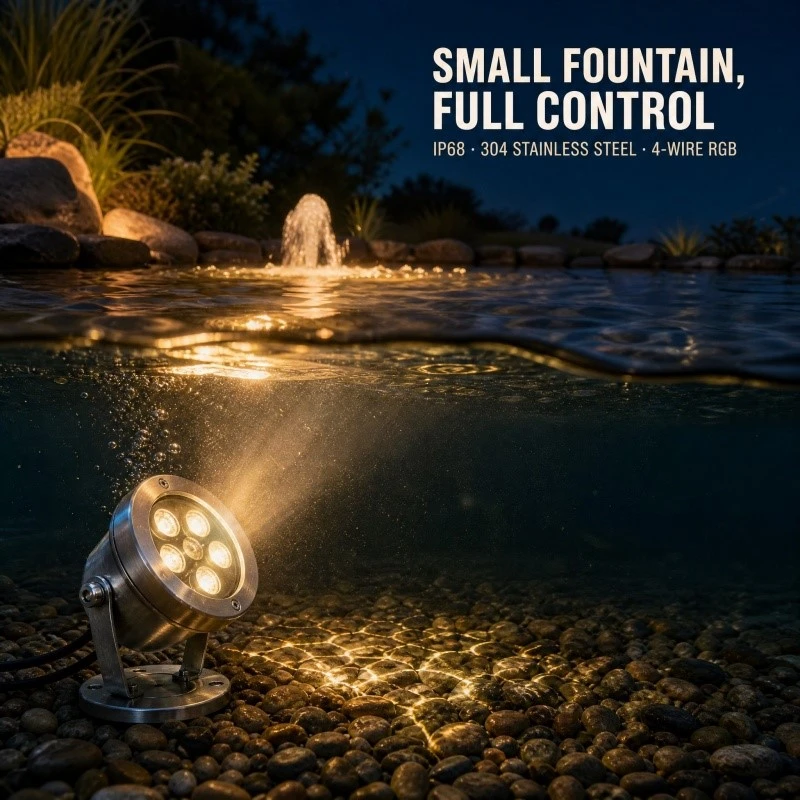
People often have different interpretations of what "IP68" means. Some assume it implies the device can be submerged to any depth, while others believe an "IP68" rating guarantees a ten-year lifespan. Both assumptions are incorrect. Rather than dwelling on abstract concepts, this article focuses on what "IP68" actually means in the context of underwater fountain lights-how to evaluate it, what questions to ask, and how to avoid common pitfalls. If you are selecting lights for a project or vetting suppliers, the following information may help you steer clear of unnecessary complications.
What do the two digits in "IP68" represent?
"IP" stands for "Ingress Protection," a rating system defined by the international standard IEC 60529. The two digits that follow serve specific purposes:
• The first digit, "6," refers to dust protection. As the highest level in this category, it indicates that the interior of the fixture is completely sealed against the entry of dust. For underwater lights, this is generally less critical, as there is typically no dust present in an aquatic environment.
• The second digit, "8," refers to water protection. It signifies that the device can withstand continuous immersion in water. The specific conditions for this are determined through an agreement between the manufacturer and the buyer, making it a more rigorous standard than "IPX7."
Therefore, of the four characters in "IP68," only the final "8" is truly relevant to the performance and longevity of a fountain light.
There is no universal "depth" standard for IP68
This is the most common point of confusion. The standard merely specifies "continuous immersion" without mandating a specific depth or duration. In practice:
• Some manufacturers may label a product as "IP68" based on testing at a depth of 1 meter for 30 minutes.
• Others may test their products at depths of 3 meters or more, with continuous immersion lasting several days.
• Yet, both products will simply state "IP68" on their specification sheets.
In short, an IP68 rating is a baseline, not a guarantee. What truly matters are the specific conditions attached to the rating: the maximum allowable water depth and the duration of the immersion test. If your fountain pool is 2 meters deep, but the lights were only tested for a depth of 1 meter, then the "IP68" rating is of limited practical value for your project.
The difference between IP68 and IPX7-don't confuse them
When comparing quotes, some procurement officers may notice that certain lights are rated IPX7 and come at a significantly lower price, leading them to consider switching. It is crucial to distinguish between the two:
• IPX7: Designed for temporary immersion-typically 1 meter deep for 30 minutes. This is suitable for scenarios where equipment might occasionally be submerged, such as an in-ground light encountering accumulated water.
• IP68: Designed for continuous immersion; suitable for lights that remain submerged year-round.
Fountain lights are submerged 24 hours a day; choosing an IPX7-rated light for this application is like trying to go deep-sea diving in a standard raincoat. It might hold up for the first week, but the seals will inevitably fail. Do not risk the integrity of your installation just to save a little on the budget.
Why fountain environments are more demanding than typical underwater settings
While all these environments are underwater, a fountain pool is fundamentally different from an ornamental fish pond or a swimming pool. Furthermore, an IP68 rating verified in a laboratory may not fully account for the pressures present on-site:
• Water impact: Water jets near the fountain nozzles exert constant force on the light fixture, creating long-term mechanical stress on the sealing rings and cable outlets.
• Complex water chemistry: Landscape water often contains chlorine, algae, and calcium or magnesium salts (from hard water). Some projects even use seawater or reclaimed water, which are far more corrosive than standard tap water.
• Thermal cycling: Lights generate heat when turned on and contract when they cool down after being turned off. This repeated thermal expansion and contraction causes the sealing material to fatigue over time, eventually leading to the formation of tiny gaps.
That is why we often tell our clients: an IP68 certification from a laboratory merely proves that a product is watertight at the time it leaves the factory-whereas a fountain environment tests whether it will still be watertight three years later.
Where Leaks Actually Occur: Cable Entry Points and Sealing Structures
Based on our experience with after-sales issues, the lamp housing itself is rarely the source of a leak; in the vast majority of cases, the problem lies where the cable enters the lamp body. Pay close attention to the following:
• Cable Entry Design: High-quality products use waterproof connectors combined with potting compound to effectively "fuse" the cable and the lamp body into a single, integrated unit. Cheaper alternatives often rely merely on a compressed rubber ring, which tends to loosen over time.
• Potting Process: When internal circuitry is encapsulated (potted) with epoxy or silicone, the driver and LED chips remain protected even if water manages to seep into the housing.
• Cable Material: Standard PVC cables can harden and crack after prolonged immersion. For underwater applications, it is recommended to use specialized cables that are resistant to hydrolysis and UV radiation.
• Lens-to-Housing Seal: The material and compression level of the sealing gasket between the lens (cover) and the housing are critical to long-term performance.
A common, yet externally invisible, failure mode occurs when water "creeps" into the lamp body by traveling through the gaps between the copper strands inside the cable.
Beyond Waterproofing: Materials and Heat Dissipation Determine Lifespan
While an IP68 rating addresses water ingress, the overall service life of a light depends on several other factors:
• Material Corrosion Resistance: 304 stainless steel may suffice for freshwater projects, but for seawater or pools with high chlorine content, 316L stainless steel or copper alloys are recommended. For aluminum alloy housings, the quality of the anodizing or protective coating is key.
• Heat Dissipation Design: Underwater environments can actually offer better heat dissipation than air-provided the lamp is well-designed to conduct heat efficiently to the outer housing. If a high-wattage lamp has poor thermal design, internal temperatures will rise, significantly accelerating the degradation of sealing gaskets.
• Low-Voltage Power Supply: Underwater lights should operate on DC12V or DC24V, paired with a certified, compliant power supply. While not strictly a matter of "waterproofing," this is a fundamental requirement for underwater safety.
Summary
An IP68 rating is a necessary, but not sufficient, condition for underwater fountain lights. To summarize:
• The "6" indicates dust-tight protection, while the "8" signifies suitability for continuous immersion-though the specific depth and duration are defined by the manufacturer.
• Only an IP68 rating is suitable for permanent underwater use; an IPX7 rating is intended only for short-term immersion.
• Real-world fountain environments-involving water flow, water quality, and temperature fluctuations-are far more demanding than laboratory conditions.
• Water ingress typically occurs at the cable entry point, rather than through the light housing itself.
• Material quality, heat dissipation, and low-voltage power supply are critical factors that determine the actual service life of the fixture.
• When purchasing, always request the specific testing parameters and third-party test reports; do not rely solely on a manufacturer's claim that a product is "IP68-rated."
Are you selecting underwater lights for a fountain, water feature, or swimming pool project? We offer a wide range of IP68-rated underwater fountain lights, available in various wattages, light colors, and mounting configurations. We can recommend the ideal model based on your specific water depth, water quality, and operating environment, and provide both product samples and test reports. Please share your project requirements with us; we will respond within 24 hours with a tailored solution and a formal quotation.