

If you work in outdoor lighting procurement, you've likely encountered this question from clients: "Half of my yard is shaded by trees, and it's often overcast in the winter-will a solar floodlight still work?"
The answer isn't a simple "yes" or "no." While solar floodlights don't require constant direct sunlight to function, charging efficiency varies significantly based on lighting conditions. Furthermore, performance during overcast days or the winter season differs greatly depending on the specific configuration of the light. Below, we break down these contributing factors-information you can use to advise your clients or guide your own product selection.
Direct Sunlight Isn't Mandatory, But It Makes a Big Difference
Solar panels absorb light-not just "direct sunlight." While direct sunlight on a clear day provides the highest energy yield, solar panels can still generate power from the diffuse light present on cloudy days, albeit at a much lower output.
A more accurate way to put it is this: direct sunlight enables the fastest charging, while diffuse light results in slower-but still active-charging. Charging only effectively ceases when there is virtually no light at all. The key to selecting the right light isn't whether it *can* charge, but whether the energy collected throughout the day is sufficient to power the light all night long under the specific lighting conditions of the installation site.
How Much Does Charging Efficiency Drop Due to Clouds or Shade?
It's important to distinguish between these two scenarios:
Overcast conditions: Clouds convert direct sunlight into diffuse light. Solar panel output typically drops to a small fraction of what it would be on a clear day-the exact percentage depends on cloud density (thin clouds versus thick, heavy cloud cover). The panel will still generate power, just at a much slower rate.
Shading: If a solar panel is consistently blocked by buildings, walls, or tree canopies, it may only receive faint, reflected ambient light-often not enough to sustain nighttime operation. Another frequently overlooked issue is partial shading. Even a small shadow cast on a portion of the panel can significantly reduce the total output; because the individual solar cells within a panel are connected in series, the shaded cells can drag down the performance of the entire unit.
In practical terms, "occasional cloudy days" and "a panel that is permanently in the shade" are two very different challenges. The former can be addressed by ensuring sufficient system capacity (a "buffer"), while the latter requires adjusting the installation location.
Why Is Charging Difficult in Winter?
The challenges in winter stem not from a single cause, but from a combination of several factors:
Shorter daylight hours: As days grow shorter, the daily operating window for solar panels shrinks, while longer nights mean the lights need to stay on for more hours. This creates a "double whammy"-less energy coming in and more energy being consumed.
Lower solar elevation angle: Sunlight hits the panels at an oblique angle, reducing the effective light intensity. Furthermore, panels are more likely to be obstructed by distant buildings or trees.
Low-temperature impact on batteries: This is the most frequently overlooked factor, which we will discuss in detail in the next section.
Snow and frost accumulation: If a panel is covered in snow or frost, it is effectively blocked from receiving any sunlight.
Therefore, poor performance in winter usually doesn't mean the solar panel is "broken"; rather, it reflects a strain on both the energy supply and demand sides.
Battery Types and Low-Temperature Charging Protection
Batteries are, in fact, the component most prone to issues during winter.
Among common battery types, Lithium Iron Phosphate (LiFePO4) is a popular choice for many solar lights due to its long cycle life and high safety. However, it has a specific limitation: charging it at temperatures below 0°C can damage the battery and shorten its lifespan. Ternary lithium batteries are similarly sensitive to low-temperature charging.
Consequently, products designed for cold regions should feature low-temperature charging protection. When the battery temperature drops too low, the controller pauses charging and resumes it only once the temperature rises again. While this slightly narrows the charging window during winter, it protects the battery, preventing a significant loss of capacity after just one winter season.
If a customer is located in an area where winter temperatures frequently fall below 0°C, asking the supplier whether the product includes this protection is more important than simply comparing battery capacities.
Solar Panel Types and Power Sizing
Panel types: Monocrystalline silicon panels offer higher conversion efficiency and generally perform better in low-light conditions compared to polycrystalline silicon panels. As a result, monocrystalline panels are better suited for overcast weather and winter use.
Power sizing: Consider two floodlights, both nominally rated at 100W; one might be paired with a solar panel that is too small-sufficient for sunny days, but unable to keep up when the weather turns cloudy. When evaluating a product, consider these three figures:
The solar panel's rated power
The battery capacity
The light's actual power consumption and its intended duration of operation each night
Larger solar panels and higher-capacity batteries provide a greater buffer for periods of consecutive cloudy weather-though, naturally, this also increases both cost and physical size. The key to selecting the right unit is to ensure that, within your budget, you have a sufficient buffer tailored to your specific climate, rather than simply chasing the highest possible specifications.
Split-Design: Placing the Light and Panel Where They Work Best
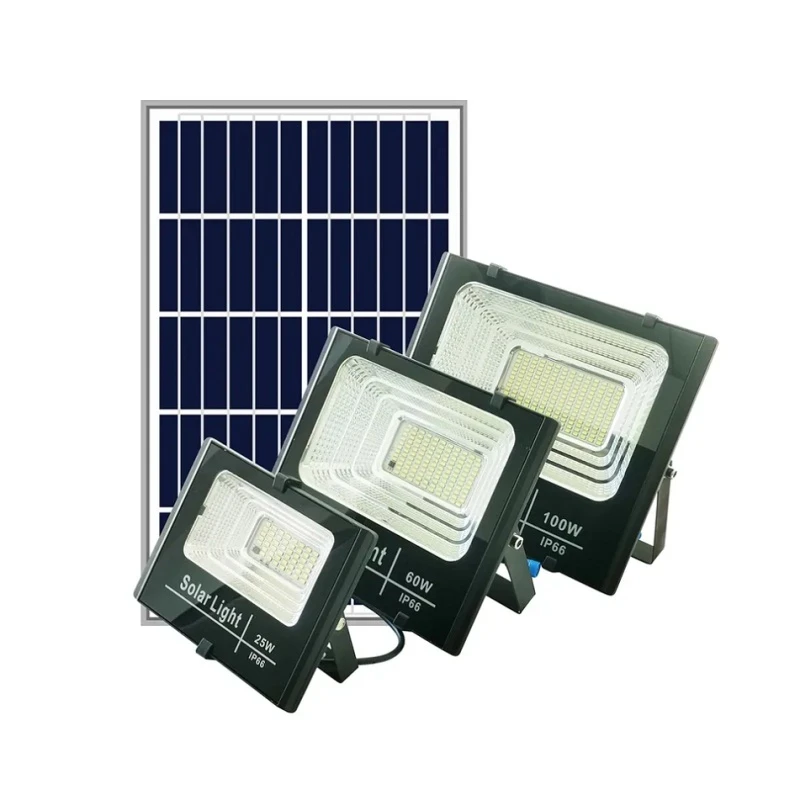
If your desired installation spot is in the shade, but there is a sun-exposed wall or roof nearby, a split-design solar floodlight is the more practical solution.
In a split-design system, the solar panel and the light fixture are connected by a cable. This allows the panel to be installed in the location with the best sunlight, while the light fixture can be placed exactly where illumination is needed. This approach ensures you don't have to compromise on either lighting placement or charging efficiency.
In contrast, an all-in-one (integrated) design offers easier installation and a cleaner aesthetic; it is best suited for locations that already receive ample sunlight. Neither design is inherently better; the right choice depends entirely on your specific installation environment. Note that for split-design systems, the length and gauge (thickness) of the cable can affect voltage loss; if the components are placed far apart, be sure to verify that the cable specifications are appropriate.
Installation Angle and Routine Maintenance
The performance of the exact same light can vary significantly in winter depending on whether it was installed correctly.
Orientation and Tilt: In the Northern Hemisphere, solar panels should generally face south. The tilt angle can be set based on your local latitude; in regions with harsh winters, increasing the tilt angle helps the panel sit more perpendicular to the low-angle winter sun. If your product features an adjustable bracket, tweaking the angle with the changing seasons can significantly improve winter charging performance.
Avoid Obstructions: Before installation, observe how shadows shift throughout the day. Keep in mind that in winter, the sun sits lower in the sky, meaning a spot that was perfectly clear in the summer might become obstructed.
Routine Cleaning: Dust, bird droppings, fallen leaves, and accumulated snow can all reduce power output. Regularly wiping down the panel surface and clearing away snow are the most cost-effective ways to boost efficiency.
Conclusion
Solar floodlights do not require direct sunlight all day; they can still charge under diffused light, though with lower efficiency than on clear, sunny days. However, if a unit is placed in a location that remains completely shaded, it will likely struggle to provide sufficient power for nighttime illumination. Performance often declines in winter due to a combination of shorter daylight hours, a lower sun angle, cold temperatures, and potential snow accumulation-with low-temperature battery charging protection being the most critical factor.
When selecting a product, consider the type of solar panel, the balance between power output and battery capacity, and the overall design. If necessary, opt for a split-design model to position the solar panel in a sunnier spot. Combined with an optimal installation angle and regular cleaning, these lights can function effectively during winter or on overcast days in most regions.
Need help choosing the right product?
Solar irradiance, winter temperatures, and installation environments vary significantly by location; a model that performs well in one place may not be suitable for another. If you are selecting solar floodlights for a specific project, market, or client base, please share details regarding the target region, installation environment, and required lighting duration. Our team can recommend the ideal power specifications, battery capacity, and structural configuration for your needs, and we are also happy to provide product samples and price quotes.
Our address
No. 5-3 Niujiao Road, Yanchuan Community, Yanluo Subdistrict, Bao'an District, Shenzhen
bwzm18@ledbenweilighting.com






