

Clients often request "mini" corn-style LED bulbs-compact enough to fit into wall sconces, crystal chandeliers, or small downlights-while insisting that they remain as bright as standard bulbs. It sounds like a reasonable request, but achieving it is a delicate balancing act.
This article cuts through the fluff to focus specifically on "mini" corn bulbs: what earns them the "mini" label, how they maintain high brightness, and what their physical limits are. Whether you are a procurement specialist, a brand representative, or a lighting designer, this guide will help you better evaluate whether a particular product is worth choosing.
How is "Mini" defined for corn-style LED bulbs?
There is no universal international standard for the term "mini" in the lighting industry; it is largely a matter of convention. Generally, it can be understood through two criteria:
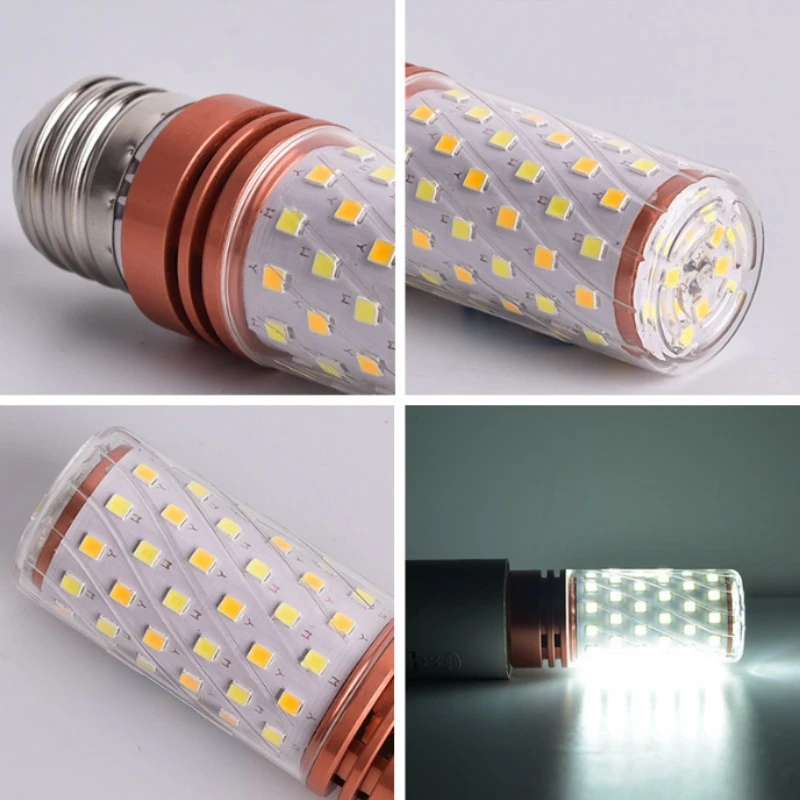
Physical dimensions: The total length of the bulb is typically between 50–90mm, with a diameter of about 15–30mm-significantly smaller than standard A60 corn bulbs (which are usually over 100mm long).
Base type: "Mini" versions typically feature smaller bases-such as E12, E14, G9, BA15d, or E17-designed to fit the sockets found in smaller fixtures like chandeliers, wall sconces, and vanity lights.
In short, "mini" implies more than just a reduction in size; it means the bulb can fit into spaces where conventional corn bulbs cannot. This is the primary reason clients choose them.
Achieving high brightness in a small form factor: The role of LED chips and luminous efficacy
The brightness of a corn-style LED bulb is essentially the product of the number of LED chips multiplied by the luminous efficacy of each individual chip. When the bulb's size is reduced, there is less space for chips-so where does the brightness come from?
Increasing the luminous efficacy of individual chips: Currently, the industry standard relies on SMD (Surface Mounted Device) chips, such as the SMD2835 or SMD4014. High-efficiency chips can deliver 100–150 lumens per watt (or even more), providing the most direct way to compensate for the limited space available in a compact bulb. Optimizing Layout Density: LED chips are arranged more compactly on the small lamp body-sometimes in multiple layers or a spiral pattern-to ensure that every inch of the surface emits light.
Consistent LED Quality: Even when two products claim the same luminous efficacy, inferior LED chips may degrade rapidly under high temperatures; they might appear bright when first purchased, only to dim significantly after just a few months of use.
In short: For "Mini" LED lamps, it's not about the "quantity" of LEDs, but the "quality" of each individual chip.
Heat Dissipation: The Biggest Drawback of a Small Form Factor
This is the most practical challenge for "Mini" corn-style LED lamps. A smaller lamp body means less surface area for heat dissipation; if heat cannot be effectively expelled, both light output (lumen maintenance) and the product's lifespan will suffer.
Common solutions include:
Using housing materials with superior thermal conductivity-such as aluminum-based circuit boards paired with thermally conductive plastics or aluminum lamp bodies.
Regulating power output rather than blindly increasing wattage. For a given lamp size, higher power makes it significantly harder to keep temperatures under control.
Selecting PCB materials for the LED boards that offer better heat dissipation and shorter thermal conduction paths.
Those with experience in designing compact lamps know that the true measure of a "Mini" LED isn't its claimed brightness, but rather its stability-how well it performs after being lit for an hour.
Fitting the Driver into a Limited Space
Beyond the LED chips, the lamp body must also house a driver. If the driver is too bulky, the lamp cannot be made compact.
Low-wattage "Mini" lamps typically utilize highly integrated driver solutions, featuring streamlined, miniaturized components.
Some designs employ linear constant-current circuits or compact switching power supplies, requiring a trade-off between physical size and electrical efficiency.
If dimming functionality is required, the driver becomes more complex and demands more space; such products must be designed with extra structural headroom.
This is why "Mini" corn-style lamps with dimming capabilities are often slightly longer-or have a lower maximum power rating-than their non-dimmable counterparts.
The Advantages and Limitations of 360° Illumination
In corn-style LED lamps, the LED chips are arranged around the lamp body, providing a beam angle approaching 360°-a feature that holds true for "Mini" versions as well. Advantages:
Light is emitted in all directions, making these bulbs ideal for fixtures where the bulb is exposed (i.e., not hidden behind an opaque shade), as they provide uniform illumination.
For older light fixtures that lack internal reflectors, these bulbs offer better light output efficiency compared to LED boards that emit light from only one side.
Limitations:
If a fixture incorporates a reflector or requires focused (directional) light, a portion of the 360° light output may be wasted.
When installed with the base facing upward, heat can accumulate more easily; therefore, proper ventilation for the fixture is essential.
Ideal Applications for Mini Corn Bulbs
Crystal chandeliers and candle-style pendant lights (with E12/E14 bases)
Wall sconces and bedside lamps
Vanity lights (mirror-front lighting) and bathroom fixtures
Small floor lamps and table lamps
Decorative lighting, as well as residential or commercial fixtures with compact shades
Energy-efficient retrofits for older, small halogen or incandescent bulbs
These applications share common requirements: limited space and strict constraints on installation dimensions, yet a need to maintain high brightness.
Summary
The "mini" in "mini corn bulb" refers to its compact physical dimensions and base specifications, designed specifically to fit into small lighting fixtures. Its "brightness" is achieved through high-efficiency LED chips, a dense component layout, and optimized power management. Ultimately, the long-term, stable performance of these bulbs depends on less visible factors: thermal management (heat dissipation) design and the LED driver circuitry.
While a compact bulb can certainly be very bright, there is always a trade-off between brightness and lifespan. Choosing a reputable manufacturer and carefully reviewing technical specifications is far more important than simply chasing a higher wattage.
Interested in our Mini Corn Bulb series?
We offer a wide range of Mini Corn Bulbs with various base types and wattage options, including dimmable versions, customizable color temperatures, and OEM/ODM services. If you are looking for a light source that fits a specific fixture, or if you would like to request samples to test brightness and heat dissipation, please feel free to contact us. Simply share the dimensions of your fixture and the intended application, and we will recommend the best solution and provide a quote.
Our address
No. 5-3 Niujiao Road, Yanchuan Community, Yanluo Subdistrict, Bao'an District, Shenzhen
bwzm18@ledbenweilighting.com






