In environments such as cold storage facilities, cold chain warehouses, and frozen food processing plants, lighting equipment is exposed to low-or even sub-zero-temperatures year-round. Choosing the wrong fixtures can lead to issues ranging from light degradation and flickering to driver burnout or housing cracks. Furthermore, the labor costs for replacing these lights-combined with the costs associated with operational downtime-far exceed the price of the fixtures themselves.
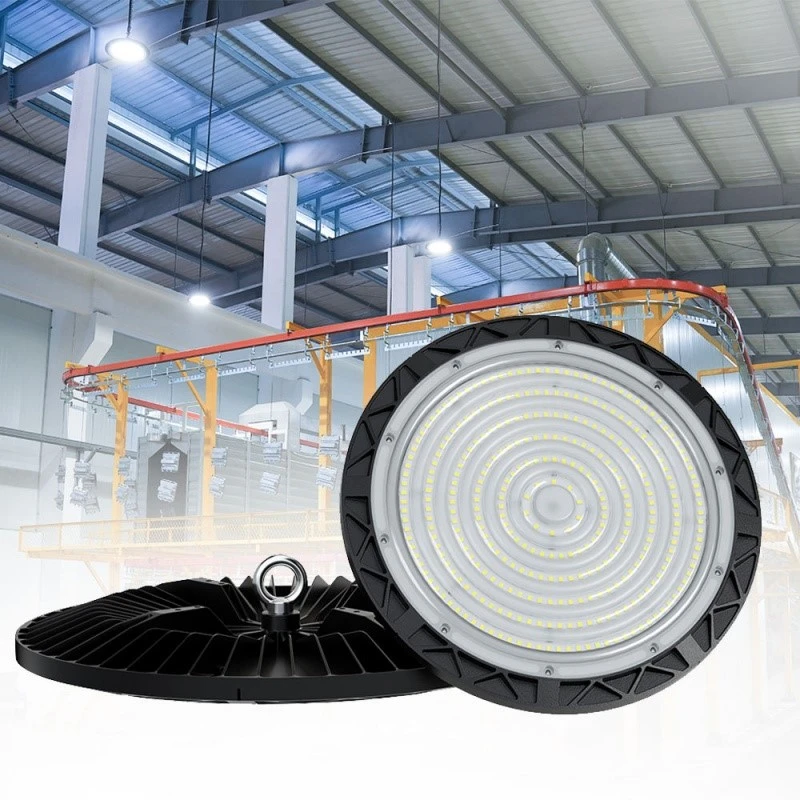
A common question from procurement professionals is: "Can standard UFO high-bay lights be used in cold storage?" The answer is yes, but not all UFO lights are suitable. Below, we outline several key factors to help you make the right choice and avoid common pitfalls.
Why LEDs are Naturally Suited for Low-Temperature Environments
Traditional metal-halide and fluorescent lamps struggle in cold temperatures; they are slow to start, experience significant drops in light output, and may fail to ignite altogether in sub-zero conditions. LEDs, by contrast, operate on a different principle-emitting light directly via semiconductors. In fact, lower temperatures actually increase the luminous efficiency of LED chips, resulting in more stable luminous flux. Additionally, LEDs require no warm-up period and provide instant illumination upon power-up.
For cold storage facilities-where lights are frequently switched on and off, and personnel may only enter for short periods-this instant-on capability is a major practical advantage: there is no need to wait for the lights to brighten, and frequent switching does not shorten their lifespan.
Evaluating UFO Lights for Cold Storage: Check the Operating Temperature Range
Standard UFO high-bay lights are typically rated for an operating temperature range of approximately -20°C to +45°C. While this is usually sufficient for refrigerated storage (0°C to 10°C), it may not be adequate for blast freezers (below -18°C) or deep-freeze facilities (-25°C to -40°C).
When selecting fixtures, keep the following in mind:
Check the "Operating Temperature" (Ta) specified in the technical datasheet, rather than relying solely on a vague claim of "low-temperature resistance" in marketing materials.
For frozen storage, opt for models specifically rated for -30°C or -40°C.
Exercise caution if a supplier cannot provide clear documentation or test data regarding low-temperature performance.
The LED Driver: The Most Vulnerable Component in Cold Environments
While LED chips themselves are inherently resistant to low temperatures, the LED driver is often the true weak point. In standard LED drivers, the capacitance of electrolytic capacitors can drop at low temperatures, potentially leading to startup difficulties, flickering, or unstable output.
It is recommended to verify the following:
Check whether the driver uses low-temperature-resistant capacitors or has undergone low-temperature startup testing.
Ensure the driver's operating temperature range aligns with the specifications required for the lighting fixture.
Drivers from reputable brands (such as Meanwell, Inventronics, etc.) typically provide more comprehensive data regarding low-temperature performance.
Even among identical UFO-style high-bay lights, differences in driver components can lead to significant variations in failure rates when used in cold storage environments.
Waterproofing and Condensation Prevention: An Overlooked Risk in Cold Storage
The primary challenge in cold storage is not just the low temperature, but the temperature differential and humidity. When personnel or goods enter or exit, the significant temperature difference between the interior and exterior can cause condensation to form on the surface and inside the fixture. Moisture ingress can lead to short circuits, metal corrosion, and fogging of optical components.
When selecting lighting, consider the following:
An Ingress Protection (IP) rating of at least IP65 is required; for high-humidity environments or areas subject to wash-down procedures, IP66 or higher is recommended.
Pay attention to the sealing design, such as the use of silicone gaskets, waterproof terminal connectors, and pressure-equalization vents (breather valves).
Fixtures equipped with breather vents can balance internal and external air pressure, helping to reduce moisture accumulation.
Housing Materials and Thermal Design for Low-Temperature Environments
UFO-style high-bay lights typically feature die-cast aluminum housings with cooling fins. While the thermal load is generally lower in cold environments, the choice of materials and structural design remains critical:
Die-cast aluminum is resistant to low temperatures and less prone to brittle fracture, making it more reliable than certain plastic components.
For covers or lenses, polycarbonate (PC) is recommended, as it offers superior impact resistance and is less likely to crack at low temperatures.
If the cold storage facility contains corrosive gases or requires regular cleaning and disinfection, opt for fixtures with an anti-corrosive surface treatment.
Practical Tips for Installation and Use in Cold Storage
Beyond the lighting fixture itself, installation methods and operational practices also affect service life:
Installation Height: UFO-style lights are generally suitable for mounting heights between 5 and 12 meters. Given that cold storage facilities often feature complex racking systems and varying ceiling heights, select the appropriate beam angle to ensure uniform illumination and avoid shadows cast by storage racks. Lighting Effects and Brightness: Cold storage facilities require high illuminance levels for tasks like sorting and inventory management. It is recommended to calculate the required illuminance based on the actual work surface, rather than relying solely on wattage.
Sensor Controls: Integrating microwave or PIR sensors allows lights to automatically dim or turn off when no one is present. This not only saves energy but also reduces heat output from the fixtures, thereby lowering the cooling load on the facility's refrigeration system.
Power Cables and Connectors: Use cables rated for low-temperature environments; standard PVC-insulated cables can become hard and brittle in cold conditions.
Summary
UFO high-bay lights are suitable for cold storage, provided the correct model is selected:
LEDs inherently perform better in low temperatures than traditional light sources.
The operating temperature range must encompass the actual temperatures within the cold storage facility.
The LED driver is the critical component for stability in low-temperature environments.
An IP65 (or higher) ingress protection rating and a condensation-resistant design are essential.
The choice of housing materials, sensor controls, and mounting methods should be tailored to the specific application.
In short: Don't just buy a "UFO light"-buy a "UFO light designed for low-temperature environments."
Need a lighting solution for your cold storage facility? Contact us.
We offer UFO high-bay lights specifically designed for cold storage, cold-chain warehousing, and low-temperature workspaces. We provide customization options for operating temperature, power, beam angle, and sensor controls. If you are working on a cold storage lighting project, simply share the internal temperature, mounting height, and total area with us; our team will recommend the ideal model and provide a complimentary lighting design plan and price quote.
Our address
No. 5-3 Niujiao Road, Yanchuan Community, Yanluo Subdistrict, Bao'an District, Shenzhen
benwei10@benweilighting.com