

Modern architecture and landscape illumination use wall washer lights. Nighttime images can be created by uniformly lighting walls or objects. This essay quickly covers their basics.
What is wall-washing light?
Wall washing lights emit light linearly. Its major purpose is to evenly "wash" light over vertical or inclined surfaces like building exteriors, fences, sculptures, etc. The light resembles water running over the wall, hence the name. The main goal is to eliminate dark spots and portray item shape and texture evenly.
Basis of operation
Wall washer lights normally have many high-brightness LED sources. Point sources are diluted and combined into continuous, softly-edged light bands using carefully designed lenses or reflectors. To spread the light uniformly and cover the target area, keep the lamp a specific distance from the lit surface (adjust according to beam angle and desired effect) when installing it.
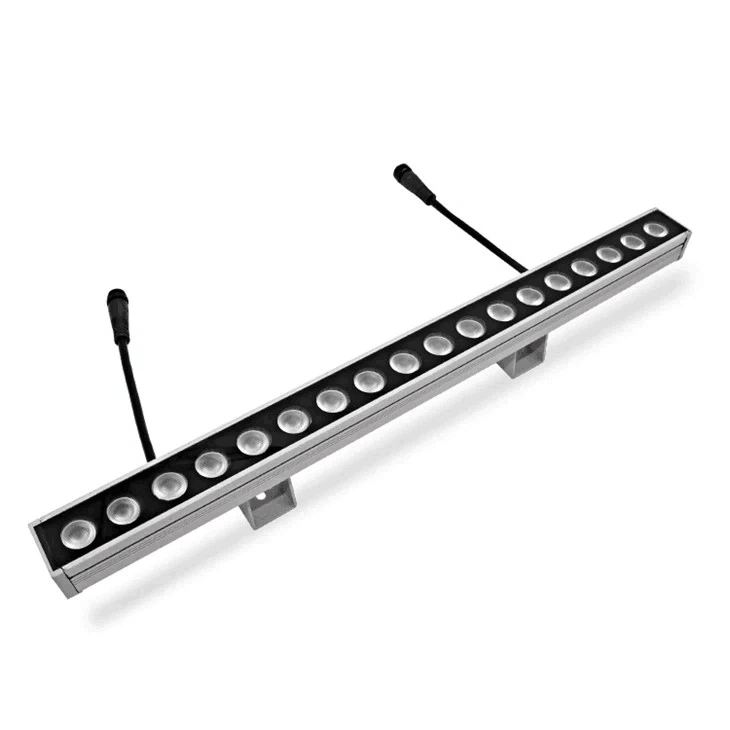
Key performance indicators
Angle of beam: Determines light diffusion range. Distance-focused irradiation uses a small beam angle (10°–25°), while close-range, large-area uniform coverage uses a wide beam angle (40°–60°). The right beam angle is critical.
Powerful and bright: Lamp brightness depends on power (watts W). The lit area, desired brightness, and ambient light conditions should determine the option. Higher power does not necessarily mean better. Meeting requirements is crucial.
IP level: Outdoor use requires IP level consideration. In rainy and snowy weather, lamps should be IP65 (dust- and low-pressure water jet-resistant) or IP66 (dust- and strong water jet-resistant).
Light and color rendering: White light can be warm or cool (3000K warm, 4000K neutral, 6000K cold). Higher color rendering index (CRI, Ra value) (greater than 80) means more accurate object color reproduction. RGB or RGBW bulbs change color.
Main use cases
Wall washer lights are popular.
Lighting the building facade: Illuminate the entire wall to showcase its outline and materials.
Lighting trees, bushes, sculptures, retaining walls, water features, etc.
Commercial space: Make shopping mall, hotel, and store exterior walls look better at night.
Key lighting for museum display walls, art gallery paintings, and special background walls.
Installation and Use Advice
Distance to install: The light spot breadth and homogeneity depend on the lamp-wall distance. The light spot widens with distance, but homogeneity may diminish. Check product instructions or test.
Angle of installation: Keep the light beam's primary axis perpendicular to the lit surface for optimal uniformity. Extreme angle deviation causes unequal light dispersion.
Fixing and Wiring: Secure with mounting brackets. Standardized power line connections must meet electrical safety regulations. Waterproofing is essential for outdoor projects.
Debugging: Testing requires powering on after installation. Check for too bright or dull areas and whether the light effect covers the target area equally. Adjust lamp location and angle as needed.

Summary
Wall washer lights provide consistent linear beams, enhancing the nighttime visual effects of buildings and landscapes. Selecting and operating them requires understanding their fundamentals, essential factors (beam angle, power, IP rating, color), and application scenarios. With proper installation distance, angle, and on-site troubleshooting, wall washer lights can improve evening lighting.
For more details about our offerings, please contact us at bwzm18@ledbenweilighting.com.





