

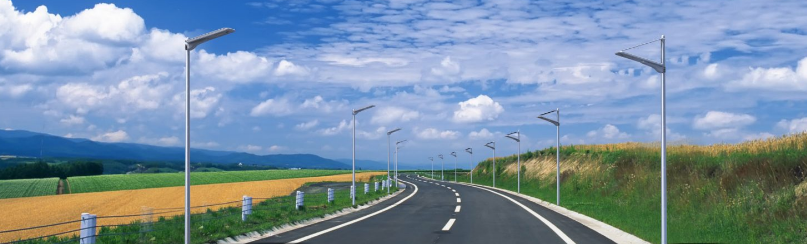
For municipal properties, such as highway lighting, street/road lighting, walkway/pathway lighting, parking lot lighting, residential public lighting, park/campus/tourist resort lighting, industrial park/construction site lighting, sign/billboard lighting, and security/temporary lighting, municipal solar street lights are a cost-effective and energy-efficient alternative.
Municipal solar street lighting may support urban infrastructure development and reduce reliance on the grid. Street lighting supplied by solar panels uses only renewable energy. Solar street lighting for municipalities also withstands natural calamities better. Solar street lights continue to operate even when the grid is out, considerably lowering the carbon impact of your community.
Towns and cities can provide affordable lighting for safety and quality of life in difficult-to-reach areas thanks to municipal solar street lighting without compromising their commitment to the environment. It's also crucial for city government agencies to update and improve public space lighting systems to increase security throughout the city.
Municipal Solar Street Lighting Reduces Costs
Since it draws its electricity from a renewable, natural source like the sun, solar street lights are economical. Because lights don't need to be at all linked to the electrical grid while using solar energy, the city may save thousands of dollars. full cancellation of the monthly power charge. as solar energy is cost-free. There are no expenses for trenching or wiring, which helps bring down the price of installation.
Because we now know the key advantages of municipal solar street lighting for your municipality, here are some things to think about:
We take pride in our ability to provide dependable Municipal solar LED street lights to brighten roads, gardens, streets, and parks across Africa, the Middle East, and Southeast Asia, delivering much-needed light to isolated locations. Several customers have long trusted and shared our solar street lights, and they need little upkeep. What is the process? We made a significant effort to ensure that the solar and batteries in our systems are appropriately scientifically sized, together with a revolutionary new German patent solar street light and purpose-built, efficient energy management.
A correctly scaled Municipal solar street light has precisely the right amount of solar power, battery storage, and LED fixture efficiency to run the project while also providing backup power to endure during unpredictably bad weather and without the need for further solar panels or batteries. That is the ideal solution—not too many solar components, which would make the system too costly, nor too few, which would cause the system to fail early.
These are 2 crucial elements The latitude of solar street light installation, battery capacity, and backup power all play a role in producing an appropriately sized, dependable solar street light.
Place of installation of municipal solar street lights
Every solar lighting project's placement should always be the first priority. Solar sunlight, which is measured in kilowatt-hours/square meter/day, is available in certain nations but is insufficient in others due to more overcast and wet days. Compared to Western Europe and North America, Africa gets a lot more solar energy each day. This suggests that installing solar lighting is appropriate for African nations.
city-owned solar street lights Backup energy and batteries
A municipal solar street light's batteries determine whether it will operate or not, therefore a potential buyer could be concerned about a battery that fails too soon. A battery or solar technology's inherently flawed design is virtually never the cause of premature battery demise. This problem is the result of faulty system scaling, poor energy control, and incorrect design. This solar light will operate dependably for many years when a manufacturer has carefully constructed a system, worked on effective energy management, and scaled it with an adequate solar array power and battery capacity.
For solar street lighting, LiFePo4 batteries are the priciest since they have the maximum energy density. Solar lamps often employ Li-ion batteries.
This is an illustration of how to size solar batteries. Imagine for the sake of this example that our solar street light is powering a 100-watt LED bulb at 100% output for a 12-hour span during a Philippine winter night. The overall load on our system each night would be 1200 watt-hours (100 watts x 12 hours = 1200 watt-hours). Considering ideal conditions and a fully charged battery at the start of the night. What is the minimum capacity for each battery type as 12 hours does not equal 100% power; it may be 2 hours 100%, 2 hours 70% power, and 8 hours 20% power. A rigorous evaluation of the battery's capacity is required.
Conclusion
The most crucial phase in creating a Municipal solar street light to guarantee long-term dependability is proper size. Please get in touch with us if you want to know more about the science behind solar scaling.





