

Many clients have asked us a very direct question: "Will your lights still work in the winter?" This is likely the primary concern for buyers located in high-latitude regions or areas prone to frequent rain and snow. The answer isn't a simple "yes" or "no"; it depends on the specific configuration of the lights, the installation method, and the actual local sunlight conditions. Let's break down these key factors.
Understanding the Challenge: What Changes in Winter?
Many people simplify the issue by saying there is "less sun" in winter. In reality, what truly affects power generation is the number of "peak sun hours"-the equivalent number of hours per day with sunlight at standard intensity.
In winter, days are shorter and the sun's angle is lower, meaning photovoltaic (PV) panels receive significantly less energy.
During overcast, rainy, or snowy weather, power generation doesn't stop entirely-PV panels can still utilize diffuse light-but the output drops substantially.
Meanwhile, because winter nights are longer, the lights need to stay on for a longer duration.
The core challenge in winter, therefore, is that power generation decreases while energy demand increases. The entire system design must be centered around addressing this contradiction.
Three Core Components That Determine Winter Performance
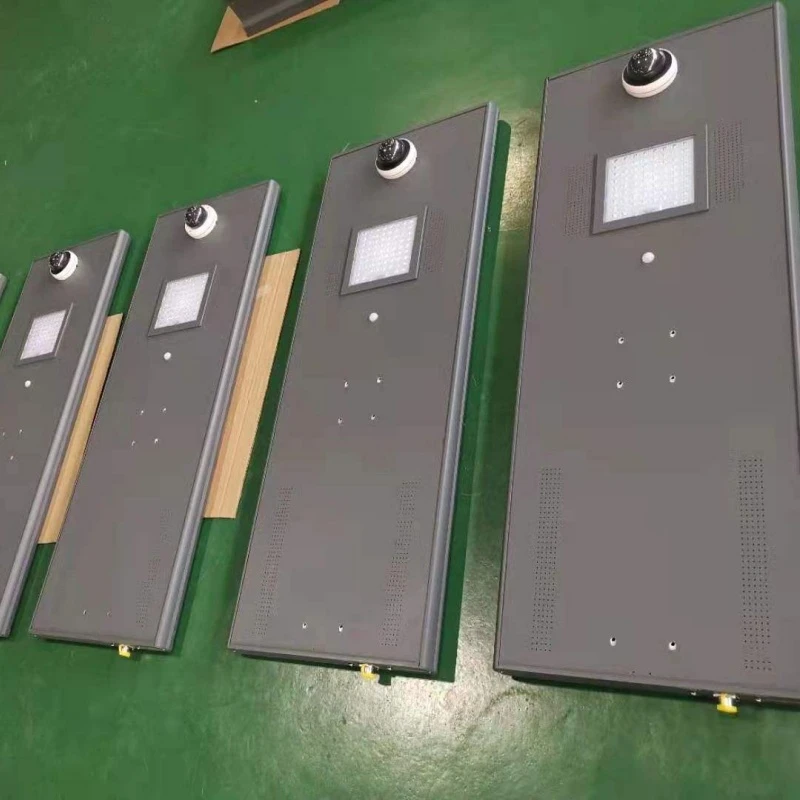
Integrated street lights combine PV panels, batteries, controllers, and the light fixture into a single unit. Given the limited space, the quality of each individual component is critical.
PV Panels: Opt for high-efficiency monocrystalline silicon panels. Their advantage over standard panels becomes even more pronounced in low-light conditions.
Batteries: Lithium iron phosphate (LiFePO4) batteries are the current industry standard, offering a long cycle life and high safety. In winter, the focus should be on the *actual usable capacity* rather than the nominal (rated) capacity.
Controllers: Controllers equipped with MPPT (Maximum Power Point Tracking) technology can capture energy more effectively when sunlight is weak, offering higher charging efficiency than standard PWM controllers.
Battery Capacity and Consecutive Overcast/Rainy Days
To gauge whether a light can continue to function during adverse weather, we use the concept of "days of autonomy"-the number of days the light can operate normally on battery power alone, without any recharging.
In regions with good sunlight, 2 to 3 days of autonomy are generally sufficient. For regions with frequent cloud cover and snowfall in winter, it is advisable to design for an autonomy period of 4 to 5 days or even longer.
A longer autonomy period is not necessarily better; increasing battery capacity also increases costs, weight, and the physical dimensions of the light fixture. Since integrated solar lights have limited space, a balance must be struck between battery capacity and structural design.
Intelligent Control: Maximizing Illumination with Minimal Energy
Using the same amount of energy more efficiently allows for longer operation. For lights used in winter, the control strategy is often more critical to actual performance than the raw hardware specifications.
Time-based Dimming: Reducing brightness to 30%–50% during late-night hours-when there is little pedestrian or vehicular traffic-can result in significant energy savings.
Motion Sensing: Operating at low brightness when no one is present and automatically increasing brightness when someone approaches is ideal for parks, walkways, and rural roads.
Low-Battery Protection: When the battery level is low, the system automatically reduces power consumption to extend the duration of illumination, rather than exhausting the remaining charge and leaving the area dark for the rest of the night.
These features can typically be pre-configured based on the specific requirements of the client's location.
The Impact of Low Temperatures on Batteries
In winter, limited sunlight is often accompanied by low temperatures-a factor that is frequently overlooked.
The discharge capacity of lithium batteries decreases in cold weather, effectively reducing their usable capacity.
Charging lithium iron phosphate (LiFePO4) batteries at temperatures below 0°C can damage the cells; therefore, a low-temperature charging protection feature is necessary to pause charging when temperatures drop too low.
For regions that experience prolonged periods of extreme cold, consider opting for batteries designed for a wider temperature range or light fixtures equipped with thermal insulation.
Before purchasing, always verify the battery's operating temperature range and ensure that the controller includes low-temperature protection.
Installation Details: Tilt Angle, Obstructions, and Snow Accumulation
The way a light is installed can lead to a significant difference in energy generation during the winter.
Tilt Angle: In winter, the sun sits lower in the sky; increasing the tilt angle of the photovoltaic panel helps it capture more sunlight and facilitates the shedding of accumulated snow. Integrated lights with adjustable tilt angles offer a distinct advantage in high-latitude regions.
Orientation: In the Northern Hemisphere, panels should generally face due south, while in the Southern Hemisphere, they should face due north. Shading: In winter, shadows cast by trees and buildings are longer. Before installation, check for any potential shading throughout the day-especially between 10:00 AM and 2:00 PM.
Snow Accumulation: Solar panels produce almost no power when covered by snow. Choosing panels with smooth surfaces and an appropriate tilt angle will help snow slide off naturally.
Project Information Required Before Procurement
To ensure a solution is truly practical, the following information should be as detailed as possible:
The project's location (latitude/longitude or city) and average daily winter sunshine data.
Road type and width, light pole height, and the spacing between lights.
Required duration of illumination each night.
The lowest local winter temperature.
The typical number of consecutive days with overcast, rainy, or snowy weather during winter.
This data is essential for determining whether an all-in-one (integrated) solar street light is suitable, as well as the appropriate sizing for the solar panel and battery.
Conclusion
Limited winter sunlight does not mean all-in-one solar street lights cannot be used; success depends on getting a few key factors right:
Select high-efficiency solar panels and MPPT controllers to maximize power generation in low-light conditions.
Ensure sufficient battery capacity based on the local frequency of overcast or rainy days.
Utilize smart dimming and motion-sensing technology to conserve energy.
Verify that the battery includes low-temperature protection to withstand local climate conditions.
Optimize the tilt angle during installation, avoid shaded areas, and account for potential snow accumulation.
In regions with extreme sunlight limitations, consider more suitable split-type or hybrid lighting solutions.
Not sure which configuration is right for your project? Send us the project location, road specifications, and lighting requirements. Our engineers will develop a tailored solution based on local sunshine data and provide a quote. You can also leave a message directly, and we will get back to you as soon as possible.
Our address
No. 5-3 Niujiao Road, Yanchuan Community, Yanluo Subdistrict, Bao'an District, Shenzhen
bwzm18@ledbenweilighting.com






