

Having worked in the lighting industry for a long time, the question I'm asked most frequently is: "Can 'elephant-trunk' (flexible-arm) lamps be used to illuminate paintings, walls, or display cabinets?" The answer is yes-in fact, these are among the applications where they excel. However, there is a difference between simply "lighting something up" and "lighting it well." This article breaks down the key details you need to know.
Why flexible-arm lamps are ideal for directional lighting
The defining feature of a flexible-arm lamp is its ability to be bent and held in a specific position. With fixed downlights or spotlights, the angle is essentially locked in once installed-adjusting it would require altering the mounting hardware. Flexible-arm lamps, by contrast, can be adjusted by hand to change the direction and height of the light beam.
This flexibility is highly valuable in display environments: whether you are swapping out paintings, rearranging wall displays, or updating seasonal merchandise on shelves, the lighting can be adapted accordingly-without the need for new wiring or additional ceiling cutouts. For galleries, retail stores, exhibition spaces, and even residential interiors where displays frequently change, this level of flexibility is incredibly practical.
Lighting artwork: Key considerations
When illuminating paintings or other exhibits, the primary goal is to "reveal details clearly without damaging the piece."
High color rendering: If colors are distorted, the nuances and brushwork of a painting will lose their intended impact. For display settings, it is generally recommended to choose light sources with a high Color Rendering Index (CRI).
Controlling the beam spread: Ideally, the light spot should cover the artwork-or be slightly smaller-with soft edges for a more natural look. If the light spills onto the surrounding wall, the painting can appear to "float" or lose its focus.
Avoiding glare from direct, head-on lighting: For works protected by glass or oil paintings with textured surfaces, direct front-facing light often creates an unsightly bright reflection (glare). Positioning the light at an angle from above is usually a much better approach.
Managing UV and heat: Prolonged, close-range exposure to heat or ultraviolet (UV) radiation can damage materials like paper, watercolors, or canvas. It is safer to opt for LED light sources that emit minimal heat and UV radiation.
Lighting walls: Spot lighting vs. wall washing
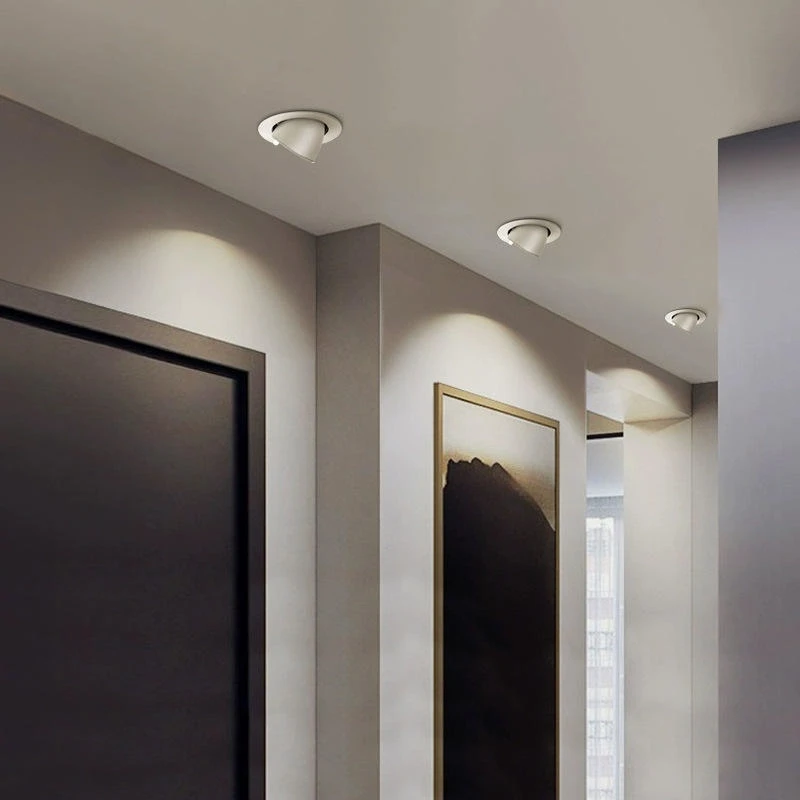
When it comes to wall lighting, there are two distinct approaches, each producing a very different visual effect. Accent Lighting: Used when you want to highlight a specific spot on a wall-such as a painting, a decorative piece, or a brand logo. In this case, use a narrow beam and adjust the fixture's arm to direct the light precisely onto the target. By keeping the surrounding area slightly darker, you create depth and visual layering.
Wall Washing: Used when you want an entire wall to be evenly illuminated. Employ a wider beam and position the fixture close to the wall, casting a soft, uniform wash of light from top to bottom. A note of caution: if the wall has a rough or textured surface, light hitting it at an oblique angle from a close distance will accentuate that texture-which could be a desirable aesthetic feature or an unwanted blemish. It is best to test the lighting before final installation.
Lighting Display Shelves and Cabinets: Installation and Angles
The challenge with shelves and display cabinets lies in their confined space, multiple tiers, and the tendency for items to cast shadows on one another.
Lighting from above or the upper side: Mount the spotlight (often referred to as an "elephant-trunk" or adjustable-arm spotlight) on the top of the cabinet or along its edge, angling the arm downward to illuminate the products on the shelves.
Layered approach: If a cabinet has three or four tiers, a single light will struggle to provide even coverage. Using two lights from different angles to cross-illuminate the space can help minimize shadows.
Mind the glass: If there are glass doors, an incorrect lighting angle can cause the fixture itself to be reflected in the glass, or result in distracting glare that obscures the products. Adjusting the angle downward and ensuring the light isn't positioned directly in the viewer's line of sight can significantly improve the result.
Consider the material: Items made of metal, jewelry, or glass are highly sensitive to light, requiring precise angle adjustments; meanwhile, fabrics, paper goods, and wooden items are more sensitive to heat and color temperature.
Key Specifications to Consider When Purchasing
When selecting adjustable-arm spotlights for display purposes, pay close attention to the following parameters:
Beam Angle: Narrow beams are ideal for highlighting specific points, while wide beams are better for illuminating larger surfaces. If you want a versatile fixture that can adapt to various scenarios, look for models with interchangeable lenses or adjustable focus.
Color Temperature: Warmer light is generally better for artwork and creating a cozy, home-like atmosphere, whereas neutral-toned light is better suited for product displays where accurate color reproduction is essential. Stability of the lamp arm: Whether the arm sags over time or maintains its set angle directly impacts the user experience. This should be tested as early as the sampling stage.
Mounting method: Options such as clamp-on, base-mounted, wall-mounted, or track-mounted each suit different scenarios; ensure the choice aligns with your actual installation site.
Power and brightness: Brighter isn't always better. In display lighting, the goal is to achieve a level that is "sufficient yet comfortable."
Practical tips for installation and adjustment
Once the lights are installed, don't rush to finish up. Take a few minutes to do the following-it will significantly improve the final result:
Turn off the ambient lighting, switch on only the "elephant-trunk" (adjustable-arm) spotlights, and view the display from the perspective of the audience.
Walk around the exhibit to check for any glare or unwanted reflections.
After positioning the lamp arm, give it a gentle nudge to ensure it remains secure and doesn't shift.
Check back after a while to see if the lamp arm shows any tendency to sag.
Common pitfalls to avoid
Placing the light too close: This creates a small, overly bright spot with harsh edges and may even cause localized overheating of the exhibit.
Focusing solely on brightness rather than light quality: Even if the brightness is sufficient, poor-quality light-such as harsh glare or dull, washed-out colors-can actually make the exhibit look worse.
Neglecting cable management: Since the lamp arm is adjustable, messy or haphazard wiring looks untidy and detracts from the overall visual appeal.
Relying on a single light for all tasks: Walls, paintings, and display cabinets have different lighting requirements; using the same setup for all of them rarely yields an ideal result.
Conclusion
Returning to the initial question: Can "elephant-trunk" (adjustable-arm) spotlights be used to illuminate artworks, walls, and display shelving? Yes. Their adjustable arms offer greater flexibility in these settings compared to fixed lighting fixtures. Achieving a high-quality lighting effect depends on several factors: the light source's color rendering and heat management, selecting a beam angle that suits the target object, ensuring the installation position and angle avoid glare, and confirming that the lamp arm itself is sufficiently stable.
Looking to select the right adjustable-arm spotlight for your space or project? If you are looking for lighting solutions for a gallery, retail store, showroom, or residential project, please share details about your space, installation requirements, and general needs. We will recommend the most suitable models and configurations for your specific situation, and can also provide samples or customized solutions. Simply leave a message or send an inquiry, and we will get back to you as soon as possible.
Our address
No. 5-3 Niujiao Road, Yanchuan Community, Yanluo Subdistrict, Bao'an District, Shenzhen
benwei10@benweilighting.com






