When selecting integrated T5 LED fixtures, many buyers don't ask first about lumens or price; instead, they pose a very practical question: "If I install these in a workshop, warehouse, or cold storage facility, how long will they actually last?"
This concern is well-founded. Industrial and commercial environments differ significantly from typical office spaces-they often involve airborne dust, vibrations from machinery, and long operating hours (frequently over a dozen hours at a stretch). Under such conditions, standard lighting fixtures often fail much sooner than their rated lifespan suggests.
Why the Integrated T5 Design Excels in Harsh Environments
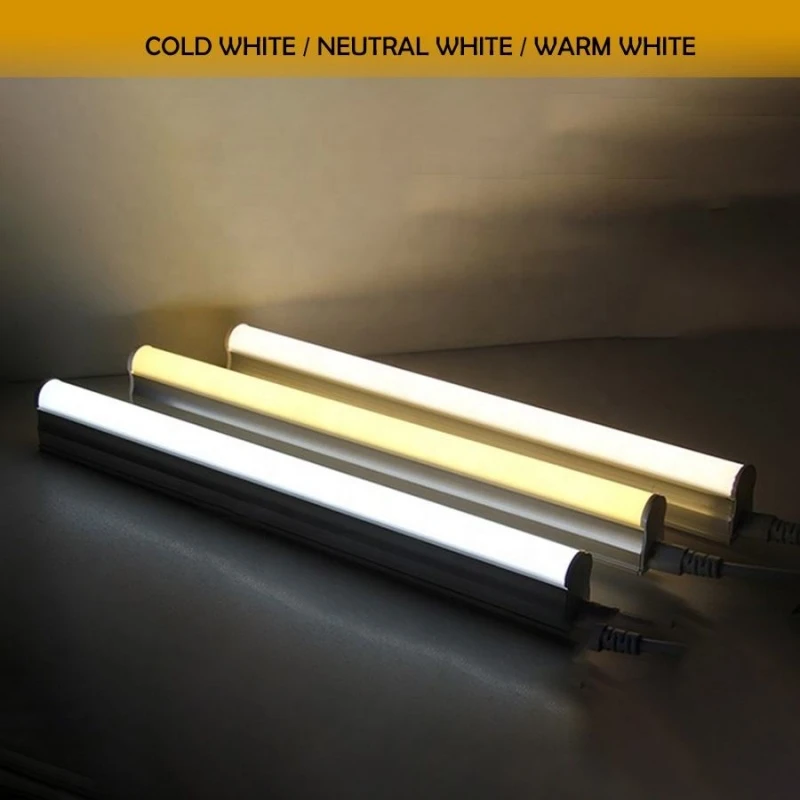
Traditional T5 fixtures consist of two separate components-a tube and a mounting bracket-connected via end-cap pins. In contrast, an integrated T5 fixture combines the light source, driver, and housing into a single, self-contained unit that comes with its own mounting hardware and is ready for immediate connection to a power source.
In complex operational environments, this design offers several inherent advantages:
Fewer individual components mean fewer points of contact or connection.
The unified housing allows for a more continuous, robust seal.
Installation is simplified-there's no need to align pins or assemble separate brackets-which reduces the risk of on-site errors.
Multiple fixtures can be daisy-chained (connected in series), simplifying wiring and minimizing the number of connection points.
Simply put, the harsher the environment, the more advantageous a simpler design becomes. This is the fundamental logic behind using integrated fixtures in industrial settings.
Dusty Environments: Sealing and Heat Dissipation Are Key
Dust creates two main types of issues: it can penetrate the interior of the fixture, or it can accumulate on the exterior surface.
1. Look for a Specific Ingress Protection (IP) Rating-Don't Just Settle for the Term "Dustproof"
For workshops, warehouses, or parking facilities with high dust levels, opt for products with an IP65 rating (or similar).
For standard indoor commercial spaces, an IP20-rated fixture is usually sufficient; there is no need to pay for a higher specification.
When requesting quotes, insist that the supplier specify the exact IP rating-do not accept vague terms like "dustproof and waterproof."
2. Examine the Junctions Between End Caps and the Diffuser/Cover
Dust most easily enters through the gaps at the end caps. High-quality products will feature a sealed gasket or an integrated, one-piece design. When you receive a sample, try squeezing the end cap-if it feels loose, that's a red flag.
3. Check for ease of cleaning
Smooth PC covers or frosted diffusers can be wiped clean instantly with a damp cloth.
Conversely, designs with grooves, ridges, or complex textures tend to trap dust, making them difficult to clean.
4. Don't overlook how dust accumulation hinders heat dissipation
A layer of dust on a light fixture acts like a "winter coat," trapping heat inside and accelerating the aging of internal components. In environments prone to dust, it is essential not only to choose the right product but also to establish a regular cleaning routine-wiping the fixtures down every few months can significantly extend their service life.
Vibration-prone environments: Fewer connection points mean fewer points of failure
In areas with machinery like stamping presses, conveyor belts, or frequent forklift traffic, light fixtures are constantly subjected to low-level vibrations. Common issues with traditional tube lights in such settings include poor contact at the end caps, cold-soldered LED chips, and loose internal drivers. Integrated T5 fixtures offer clear advantages in this regard:
By eliminating the connection point between the lamp tube and the fixture housing, they remove potential issues like loosening or poor electrical contact.
The LED board is secured directly to the aluminum housing or the fixture body, ensuring a more even distribution of mechanical stress.
Unlike glass tubes, which are bulky and fragile, integrated fixtures typically utilize polycarbonate (PC) or aluminum-plastic composite structures, offering superior impact resistance.
However, not all integrated products offer the same level of vibration resistance. Keep the following in mind when making a selection:
How securely is the LED board fixed? Some budget-friendly products rely solely on adhesive, which can fail over time due to vibration; look for designs that use clips or screws instead.
Is the LED driver potted (encapsulated in resin) or otherwise firmly secured? Components that are left unsupported are highly susceptible to failure under vibration.
How is it installed? Whether using suspension chains, clips, or screws, the mounting must be rigid-never rely on the fixture's own weight to keep it in place.
Are the connectors for daisy-chaining (linking multiple units) equipped with a locking mechanism to prevent them from coming loose due to prolonged vibration?
Long-Duration Operation: Heat Dissipation, Driver Quality, and Lumen Depreciation
In many environments-such as warehouses, production lines, cold storage facilities, or underground parking garages-lights may remain on for 12 to 24 hours a day. This is where the "nominal lifespan" figures often prove to be misleading.
Heat Dissipation Design
Fixtures with aluminum-alloy bases generally offer better heat dissipation than those with all-plastic housings.
The quality of the thermal interface-how tightly the LED board is bonded to the aluminum housing-directly determines how effectively heat can be conducted away.
Every incremental rise in temperature accelerates LED degradation (lumen depreciation); this is the most significant factor affecting longevity.
Quality of the LED Driver
While the LED chips themselves are highly durable, it is almost always the driver that fails first. Pay attention to:
The brand and temperature rating of the capacitors.
The presence of overvoltage, overcurrent, and short-circuit protection.
The input voltage range-ensure it is sufficiently wide to allow for stable operation even when the local power grid fluctuates.
Lumen Depreciation Data
Ask the supplier for the testing basis for the "L70" lifespan (the time it takes for luminous flux to drop to 70% of its initial value).
For applications requiring 24-hour operation, request documentation regarding aging tests-for example, details on the duration of high-temperature stress testing.
Flicker Issues
Individuals who work under artificial lighting for extended periods are highly sensitive to flicker, which can easily lead to eye fatigue. Selecting a driver solution with low-flicker performance is particularly important for workshops and assembly line workstations.
Summary
Looking for the ideal T5 integrated LED tube for your specific environment?
If you are sourcing T5 integrated LED tubes for a warehouse, workshop, cold storage facility, parking garage, or commercial space, please feel free to contact us directly. Simply provide us with details regarding the installation site, environmental conditions (such as dust, humidity, or vibration levels), daily usage duration, and the estimated quantity required. We will recommend the most suitable model based on your specific operating conditions and provide technical specifications, test data, and samples.
Our address
No. 5-3 Niujiao Road, Yanchuan Community, Yanluo Subdistrict, Bao'an District, Shenzhen
benwei10@benweilighting.com