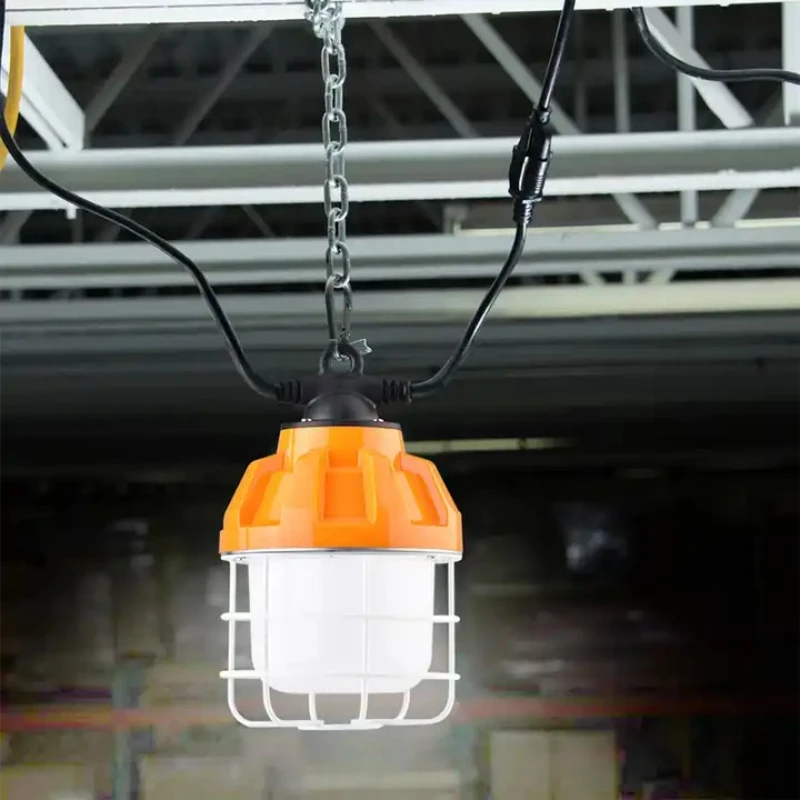
Anyone who has worked on construction sites, emergency road repairs, event setup, or equipment maintenance has likely encountered this: you've just set up your lights when it starts to rain-or perhaps a toolbox bumps into one, and by the next day, it's flickering. Since temporary lighting is often used in harsh environments, "ingress protection" (IP) ratings are a critical factor when choosing equipment. Many temporary lights on the market are labeled "IP65," but what exactly does that rating cover-and what does it fail to protect against? This guide breaks down the rating based on real-world usage scenarios to help you make the right purchasing decision.
What does "IP65" actually mean?
An IP code consists of two digits, each representing a specific level of protection:
The first digit, "6": Indicates complete protection against dust. No dust can enter the enclosure; this is the highest level of protection against solid objects.
The second digit, "5": Indicates protection against water jets. During testing, the unit is subjected to water sprayed from a 6.3mm nozzle from all directions at a flow rate of approximately 12.5 liters per minute for several minutes-with no water allowed to enter the enclosure.
Important note: IP65 covers "water jets" (splashing/spraying), not "immersion." If you need a light that can be submerged in water for a short period, look for an IP67 rating; for long-term submersion, you need IP68.
Can it be used in the rain?
Yes-this is a classic use case for IP65-rated equipment.
The intensity of the water jets used in testing is generally greater than that of natural rainfall. A compliant IP65 light can handle standard rain, heavy downpours, and wind-driven, angled rain.
However, there are two exceptions to keep in mind:
Prolonged exposure to standing water: If a light is placed in a low-lying area where its base becomes submerged, this exceeds the scope of an IP65 rating.
High-pressure washing: Cleaning a unit at close range with a high-pressure water jet creates pressure far exceeding the test conditions; in such cases, an IP66 rating or higher is recommended.
Will dust get inside in dusty environments?
No-this is the most robust aspect of an IP65 rating.
In environments such as building demolition, grinding and cutting operations, tunnel construction, or warehouse loading and unloading, fine dust is often present in large quantities-but an IP65-rated unit will keep it out. The first digit, 6, indicates that dust cannot penetrate the housing; this ensures that the LED chips, driver, and wiring remain free from dust accumulation or short circuits.
However, dust may still collect on the exterior surface. If the lens (cover) becomes dirty, it can affect light output; simply wiping it clean will resolve this, as it is a matter of routine maintenance rather than an internal issue.
What Ingress Protection (IP) Ratings Don't Cover: Impacts and Drops
Many people conflate "dustproof and waterproof" with "drop-resistant." In reality, IP ratings only assess protection against dust and water-they have nothing to do with impact resistance.
Impact resistance is measured by a different standard: the IK rating (ranging from IK00 to IK10). A higher number indicates a greater capacity to withstand impact energy. Since temporary work lights are frequently moved, bumped, or even dropped from stands, it is best to consider both IP and IK ratings.
For general construction site use: An IK rating of 08 or higher is recommended.
For environments involving frequent handling or rough conditions: An IK rating of 09–10 is advised.
If a product's specifications list only an IP rating (e.g., IP65) without any mention of impact resistance, you should verify this with the supplier.
Key Details That Determine Durability
Two products may both be rated IP65, yet their actual lifespans can differ significantly. These differences usually stem from the following factors:
Gasket/Seal Material: Silicone seals offer superior resistance to aging and temperature fluctuations. In contrast, lower-quality rubber can harden and crack over time, causing the waterproof seal to fail.
Cable Entry Point: This is the most vulnerable spot for water ingress. High-quality products use waterproof cable glands to secure the cable, preventing gaps from forming if the cable is pulled or tugged.
Housing Material: Aluminum alloy housings provide excellent heat dissipation and compression resistance. Engineering plastics are lighter, but one must ensure they offer good weather resistance and UV protection.
Lens/Cover Material: Polycarbonate (PC) covers are more impact-resistant than standard glass and are less prone to shattering.
Screws and Seams: Stainless steel screws resist corrosion, and a well-engineered seam design is essential for maintaining a long-term seal.
Thermal Management: Sealed structures are inherently more difficult to cool; poor heat dissipation can accelerate the aging of seals and gaskets.
How to Verify Products Before Purchase
Don't rely solely on the spec sheet. Here are a few ways to filter out unreliable products:
Request third-party test reports rather than relying only on the manufacturer's own IP rating claims.
Ask about the specific test conditions-for example, whether the product has undergone water-jet testing or temperature-cycling tests.
Perform a simple self-test upon receiving a sample: operate the unit while exposed to rain or water jets, then open it up to check for any internal moisture or condensation.
Verify whether the cable is replaceable and ensure that the connectors are also designed to be waterproof.
Check the warranty period and after-sales policy; manufacturers with greater confidence in their product quality typically offer longer warranties.
Tips for Daily Use and Maintenance
Before use, inspect the sealing rings and the cable jacket for any damage.
Avoid leaving cable connectors submerged in standing water for extended periods.
Ensure the stand is stable; reinforce it during high-wind conditions to prevent it from tipping over.
Wipe the unit dry before storage; do not store it for long periods while covered in mud or water.
Clean the lens/cover with a soft cloth; avoid using corrosive solvents.
Summary
While IP65-rated temporary lighting is well-suited for environments exposed to rain, water splashes, or high levels of dust, it is not a universal solution:
Waterproofing: Protects against water jets and rain, but is not designed for prolonged submersion.
Dustproofing: Completely prevents dust ingress; only surface cleaning is required.
Impact/Shock Resistance: Not covered by the IP rating; check the IK rating instead.
True Durability: Depends on specific details such as the quality of the sealing rings, cable entry points, housing, and lens/cover.
When selecting a product, look beyond the "IP65" label. Consider the intended use environment, IK rating, materials, and test reports to ensure you choose a truly durable product.
Need IP65-rated temporary lighting? Get in touch.
If you are looking for reliable IP65-rated temporary lighting for construction, equipment rental, events, or maintenance projects, we can recommend the ideal power output, protection rating, and structural design based on your specific needs. We can also provide test documentation and product samples. Please leave a message or send us an email with details about your application environment, required quantity, and delivery timeline-we will respond promptly with a quote and a tailored solution.
Our address
No. 5-3 Niujiao Road, Yanchuan Community, Yanluo Subdistrict, Bao'an District, Shenzhen
benwei10@benweilighting.com